


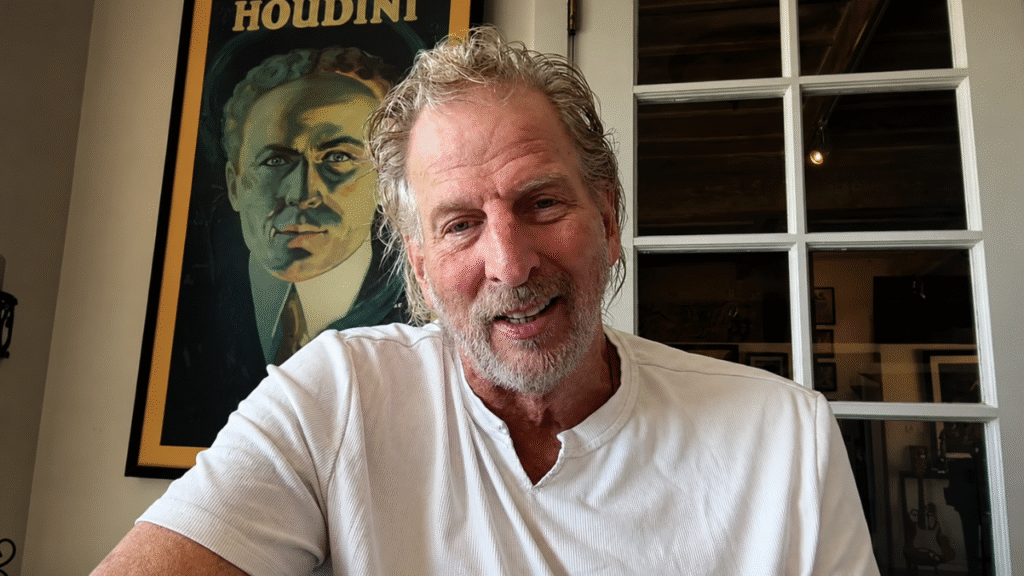
Barry Katz is a talent manager and producer who has worked with Dave Chappelle, Bill Burr, Louis C.K., Jim Gaffigan, Dane Cook, Wanda Sykes, Jay Mohr and Bert Kreischer, many of them before anyone else would book them. A former stand-up from Massachusetts, he founded the Boston Comedy Club in New York's Greenwich Village in 1988 and ran it until 2005. He hosts the Industry Standard podcast and runs a mentorship programme for comedians.
Most of our interviews are with comedians. Barry Katz is the person who was standing behind a good number of them. He gave Louis C.K. his first regular room, signed Dave Chappelle and Bill Burr when they were young and unknown, and worked with Dane Cook as Cook showed the rest of comedy what the internet was for. We asked him what he saw in them, why he gave up performing himself, and what he makes of the crowd work clips that now fill every comedian’s feed. His answer to the last one took the form of a homework assignment.
Why he stopped performing
Katz began as a stand-up, and he is frank about what drove him out of it. “I’d kill one night and do okay the next night, do really well the next night, bomb the next night, and I’d be doing the same stuff.” He hated how long the craft took to master, and how much the swings cost him. “Mentally it was hard to take.”
“That’s what the great comics are. They don’t care. They just look at the audience as the writing partner. They know they’re funny. And clearly I didn’t.”
There was a second reason, and it was control. Before the internet, he says, a comedian could reach nobody directly. Other people decided where you worked and who saw you, and a career ran on word of mouth and politics. So he started booking rooms himself, one-night shows in clubs and bars across New England, and built his own company. “I would be in control. Nobody else.” (Jason Salmon told us he now goes on stage hoping to fail at something, which is the attitude Katz says he never had.)
The Boston Comedy Club, in New York
He married at twenty-five. His wife died eight months later. He mentions it briefly, as the reason he could not wait to leave Boston. He got in his car, drove to New York and found an apartment within a day. Then he went to a comedy club that he knew was about to close, which had been run by his friend, the comedian Eddie Brill, and talked the owners into letting him reopen it under a new name.
“I don’t know how I did it. It was the dumbest idea in the world: the Boston Comedy Club, in New York. But I did it. And Louis C.K. was my first client. He hosted the first show, helped me put up the lights and fixed the sound system.”
The club ran for seventeen years. Established names such as Bill Hicks, Ray Romano and Chris Rock worked there regularly. But the acts Katz cared most about were the ones nobody else was booking.
“I loved the hunger in them”
His first clients were all young, some of them still teenagers: Burr, C.K., Chappelle, Nick Swardson, then Gaffigan, Jeff Ross and Wanda Sykes. Jay Mohr, he says, was on Saturday Night Live at about nineteen. Why sign people that young?
“I love original comedians that were young. I loved the hunger in them. I loved the desire to want to be better every day, as opposed to the older comics, who were more jaded and more cynical.”
Older acts, he felt, had been in it so long that they thought negatively and felt entitled. The young ones had more possibilities. And since the club was his, the politics of who was supposed to be booked did not apply. “It was my club. It was my house. And I got to choose who was in my house.” Someone once called him a kingmaker, we told him. “Maybe you interviewed my mother when she was alive,” he said. We have written about what Chappelle’s specials can teach a comedian.
Of Dane Cook he says: “an amazing visionary when it came to what was coming, and how he could jump on it before anybody else”. Social media did not exist for comedians before Cook, and plenty of comedians now use his methods. Katz is not sure how much credit Cook gets. “Maybe you don’t need credit. Maybe you just need to know that it happened.”
Comedy isn’t fair: forty-two years against four months
Katz remembers Tony Hinchcliffe parking cars at The Comedy Store in Los Angeles, and later inviting him, more than once, to come and see a new show called Kill Tony in the Belly Room upstairs. It held about eighty people, and when Katz went there were forty or fifty. The next time, he arrived late, ran up to the Belly Room and found a different show. He tried the Original Room. Not there either. Walking back, he saw a crowd spilling out of the 400-seat Main Room, squeezed in, and found Kill Tony.
That show has since changed a lot of lives, and he uses two of them to make a point. Cristina Mariani, as he tells it, went on four months after starting comedy and was headlining within about a year. Andy Huggins, the Houston one-liner comic in his seventies, had been doing stand-up for forty-two years and living in a studio apartment before he got to headline at all.
“Comedy isn’t fair. He didn’t get the break until forty years in. She got the break four months in. And somehow, some way, she was ready for it.”
There has always been a door like that, he says. Before Kill Tony it was Joe Rogan’s podcast. Before that, a place in the cast of Saturday Night Live. Before that, five minutes on The Tonight Show with Johnny Carson, which took his client Louie Anderson to 5,000-seat venues. The hard part is what comes after. “It’s one thing to win when the lights are shining the brightest. It’s another thing to follow it up with another equal or better performance, and then another.” Those five minutes still have to be a tight five. (Mark Ryder told us his own break came down to one email.)
What’s your favourite Tom Brady moment?
We had told him Mark Normand was a favourite of ours, and he used Normand as his example. Normand started at open mics like everyone else. He broke through because he has a unique voice and point of view, Katz says, but also because of something he calls “the accountability to greatness”: the work nobody sees. Then he asked us a question.
“They always say Tom Brady is the greatest of all time. But you ask anybody, what’s your favourite Tom Brady moment? They never say: I was on YouTube and I saw this video of him sitting on a folding chair watching football film for two hours and twenty minutes.”
Nobody’s favourite moment is the meal plan or the practice throws either. “Your favourite moments are when the lights are shining the brightest. But you have to be accountable and train behind the scenes, when no one’s looking, so you’re ready for when the lights shine the brightest.”
You can evolve. You don’t have to
We suggested that he had been at the centre of a shift from polished comedians to rougher ones. He did not accept the premise. There have always been both kinds, he says. Sebastian Maniscalco, Gaffigan, Chris Rock, Taylor Tomlinson and Iliza Shlesinger are polished. Kam Patterson is not. C.K. talks to you as if you were at a table in a bar.
What does change is the comedian. George Carlin began on television in a suit, was in jeans and long hair doing the Hippy Dippy Weatherman a decade later, and was a political comic a decade after that. D.L. Hughley, by his count, has changed lanes five times. But Louie Anderson never changed, and neither has Rock. “You have to be willing to evolve. That doesn’t mean that you have to.” His conclusion: “If you’re great, there’s no rules. If you’re persistent, there’s no rules.” He gave the Finnish comedian Ismo as proof. Nobody else does what he does, so nobody can stop him. We have a guide to how Carlin built a joke, and a piece on how Ricky Gervais changed over two decades.
The one line he argued out of a special
Does a manager argue with a comedian about material? Mostly not. “When you’re working with extraordinary artists, you get out of the way, and you make their dreams come true as best you can.” Early in a career he will give notes, and he still offers a tag to established acts when he thinks of one.
He described one recent disagreement. A comedian had an hour special with a single line in it saying that a certain musician was terrible. Katz wanted it out and the comedian wanted it in. What settled it was a question: if people watched both versions, would anyone say the special was award-worthy with that line and worthless without it? “It would never happen.” His test for any line is whether it is “the deciding factor” in the special being great. If it is a little over the edge and that is not what the comedian is known for, cut it, “because that’s not their lane”. If it is their lane, as it was for Bill Hicks, “lean into it”.
“Search their crowd work. You’ll find zero”
Our last question was about comedians who build an online following on crowd work clips and then run out of material when they are booked for an hour. He did not answer directly. He set a task.
“I’d like all of your audience members to jot down the ten most influential comedians, dead or alive, on a piece of paper. And I’d like your audience to go on YouTube and search for crowd work clips of those people. You know how many clips you’ll find? Zero.”
He was careful to add that he loves crowd work. Buddy Hackett was one of his closest friends. When he hosted shows, crowd work was all he did. He enjoys watching Matt Rife, Jessica Kirson and Nate Jackson do it, and says Jackson has excellent written material too. His argument is only about the record. Put together your Mount Rushmore of comedians, he says, then a second and a third. “Did Carlin do crowd work? Does Chris Rock do crowd work?”
The one possible exception is Don Rickles, and Katz is not sure he counts. On television Rickles went into the audience and roasted people, usually without asking them anything or waiting for a reply. So use crowd work to build an audience, he says. But a comedian who trusts their writing will put the writing online. That writing is what our guides to the callback and comic timing are about.
An $850 apartment by the ocean
Katz spoke to us looking out at the sea, and kept glancing at it. He has wanted to live by the ocean since he first saw it as a child. The first time he managed it was when Nick Swardson told him about someone leaving an apartment on Venice Beach in Los Angeles. It was a third-floor walk-up beside a halfway house, it cost $850 a month, and by his account it smelled as though a mountain lion lived there. “But I was on the ocean. It didn’t have to be the greatest part of my dream, but at least it showed me that it was possible.”
He comes from a small town, he reminded us, as we do. “We write, we direct, we create and we star in our own lives.” He does not pretend it goes smoothly. Sometimes, he says, life breaks your legs and you do not know why. It is hard to see any purpose in it while it is happening. Afterwards you notice all the things you are doing that you would not be doing otherwise. Several comedians made the same point in our piece on turning the worst moments of your life into comedy.
Listen to the full Barry Katz interview on Spotify

You can find Barry Katz at barrykatz.com and at @barrykatz on Instagram. For more conversations like this one, see all our comedian interviews.