


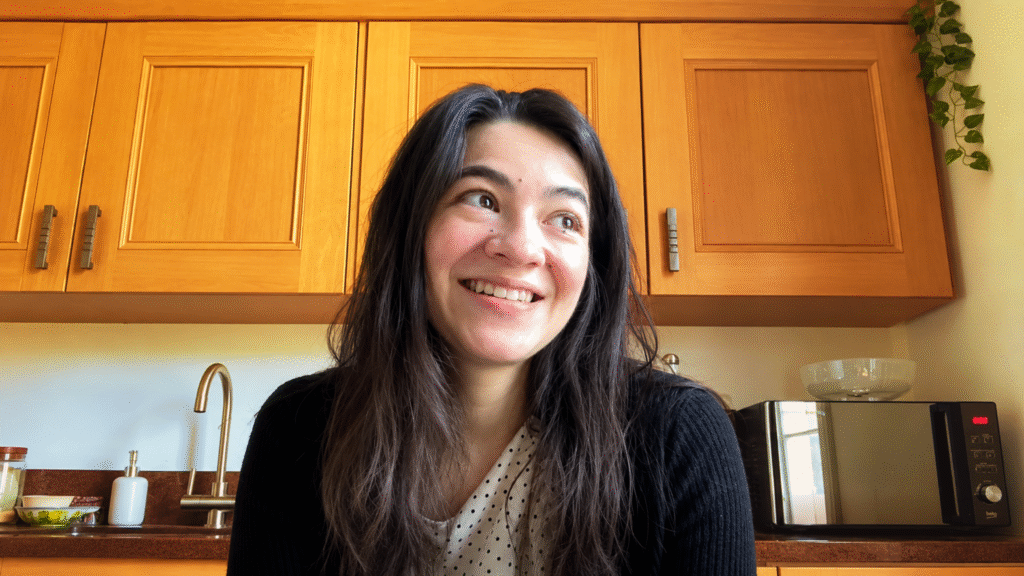
Irene Woo is a French-Chinese stand-up comedian who grew up in France and is based in New York. She was a senior software engineer at Google, her first job, until she left in 2025 to do comedy full time. She trained in stand-up and improv at the People's Improv Theater and in improv at the Upright Citizens Brigade, and has been performing for four years. Her first hour, Golden Child, ran at Just the Tonic at The Mash House during the 2026 Edinburgh Fringe.
Most people who quit a job to do comedy worry about money. Irene Woo worried about a phone call. She had a job at Google, the kind of job an immigrant father can mention to his friends, and a Chinese dad who had been steering her towards straight As since childhood. Deciding to leave was one thing. Telling him was another, and it became the subject of her first hour.
The first laugh, read off a sheet of paper
She started with a class. The People’s Improv Theater in New York ran a stand-up course that asked students to bring two pages of jokes to the second session. Woo, who had always loved watching stand-up, gathered her notes, wrote them up and arrived terrified.
“I don’t think I even made eye contact with people. I was just reading from my paper. And some people in the class started laughing. There’s other things in my life that I’m proud of, but this felt like the biggest achievement for me.”
She had to walk for a while afterwards because the adrenaline would not let her go home and sleep. We asked whether it was like a first drink or a first drug. “A little bit, but better, because you don’t feel bad the next day.”
The course ended with a five-minute set in front of friends. Open mics followed, then booked shows, then longer sets, all while she was still writing software during the day. She is not the only comic we have spoken to who came from a serious profession: Stephan Dyer left a senior banking job, and Jason Salmon moved to New York as an engineer.
A system for bad nights
Four years in, she is matter-of-fact about how the job is learned. “The only way for you to really get better is to try things in front of people.” That means rooms where nothing lands, and rooms that are unfriendly in other ways. “Open mics can be really brutal sometimes. You’re the only woman in the room.” After one especially bad mic she stopped performing for a couple of weeks.
Her answer was the kind an engineer would come up with. She noticed that a bad set was spoiling her whole evening and sometimes the next few days, decided that was not sustainable, and built a rule.
“Whenever I have a bad set, I get myself a sweet treat. If I bomb, I know I have a reward. So it’s not too bad.”
A piece of cake, or a slice of pie. A good set needs no reward, she says, because the feeling is the reward. When she explained the system to her boyfriend, his only question was: “Yeah, but you don’t bomb that much, right?” CeeKay Brown, who did 180 shows in her first year, told us she still does open mics to test material in front of people, as Woo does.
How to tell your Chinese dad you quit Google
Woo is half French and half Chinese, and her father was closely involved in her schooling. The plan, at various points, was for her to become a dentist. She became a software engineer, and Google was her first job. “It’s very easy to brag to your friends that your kid is working at Google,” she says.
In June 2025 she decided to leave. Around the same time, Google offered a voluntary exit programme, which she took as a sign. She had a couple of weeks to make up her mind, and she spent them preparing for one conversation.
“What I was really, really scared of is losing the support of my dad, because I care so much about that relationship.”
So she treated it like a project. She talked to people inside and outside work about whether it was a sound decision. She went through her savings. “I literally made a roadmap for the year,” she says, so that she could arrive with data and show it was not an impulse. Then she rehearsed the call with her boyfriend, playing out the different ways it might go. “We did improv, basically.”
She also chose to ring her parents before she handed in her resignation, not after. They did not get a vote, she says, but she wanted them to feel involved in her life and not presented with something already done. How the call went is the ending of the show, so we will leave it there.
Golden Child: stand-up first, story second
“It’s truly about how I told my Chinese dad I quit Google to do comedy full time,” she says of Golden Child. The hour runs from her childhood through her teenage years and her time in tech to the call itself. She wrote most of it between late 2025 and early 2026, with a few older jokes carried over.
The method matters to her. She did not write a story and then add punchlines. She wrote jokes in sections, a tech section, a childhood section, and wrote far more than she needed, on the view that quantity helps. Then, working with a director, she kept only the strongest material and arranged it. One event from early in the show keeps returning: a run of jokes, back to the event, another run, back again. “I wanted this to be stand-up first.” (We have guides to how a joke is built and to the callback, which is the device she is describing.)
Her favourite part to perform is the last fifteen minutes, where she goes back to how she felt on the day of the call. Her favourite part to write was a section about the bouquet toss at weddings. She was not sure anyone else felt the way she did about it. Performing it, she found that a lot of women do. Meg Millane built a whole Fringe show out of weddings.
Type A comedy, and crowd work you can relax through
A friend once described her act as “Type A comedy”, and she has kept the label: precise, led by the writing, a bit nerdy, and true to who she is. Improv, which she studied at the People’s Improv Theater and at UCB, is her counterweight. “I’m naturally an overthinker, so improv is really helpful, because you can’t think.” You have to listen to the person in front of you, and that, she says, is what makes a comic better at talking to an audience.
She has a firm rule about how she does it.
“If I ever do crowd work on you in my show, you really don’t have to be scared. You will come out on top. I’m not here to make fun of you.”
Nobody, she points out, pays to sit in the front row and be mocked. She would sooner be the one the room laughs at. What a comedian does owe the room is energy, something the Fringe was teaching her daily. “It’s your job to bring the energy up.” Not dominance, she says, but being the highest-energy person present, at “200 per cent”.
Her influences are deliberately mixed. Growing up in France she watched Gad Elmaleh. In the United States it was Jim Gaffigan, because he is clean and the whole family could watch, and later Sam Morril, Pete Davidson, Michelle Wolf, Ali Wong, Trevor Noah, Ronny Chieng and Nikki Glaser. “I try not to focus on one person in particular, because then you end up just mimicking what they do.” She has not studied clowning, though she would like to. Sevrin Willinder can tell her what she is in for.
When we spoke, a few days into the run, the audiences had been good ones: people who work in tech, Asian women and French people, she said, which is more or less the show’s subject matter sitting in the seats. Asked what anyone coming should expect, she had the answer ready: “To laugh, to reflect on their relationships with their parents, and to feel inspired to take a risk.”
You can follow her at @theirenewoo on Instagram. For more from Edinburgh, see our Fringe coverage and all our comedian interviews.
Watch Irene Woo talk about quitting Google, telling her dad and writing Golden Child
