


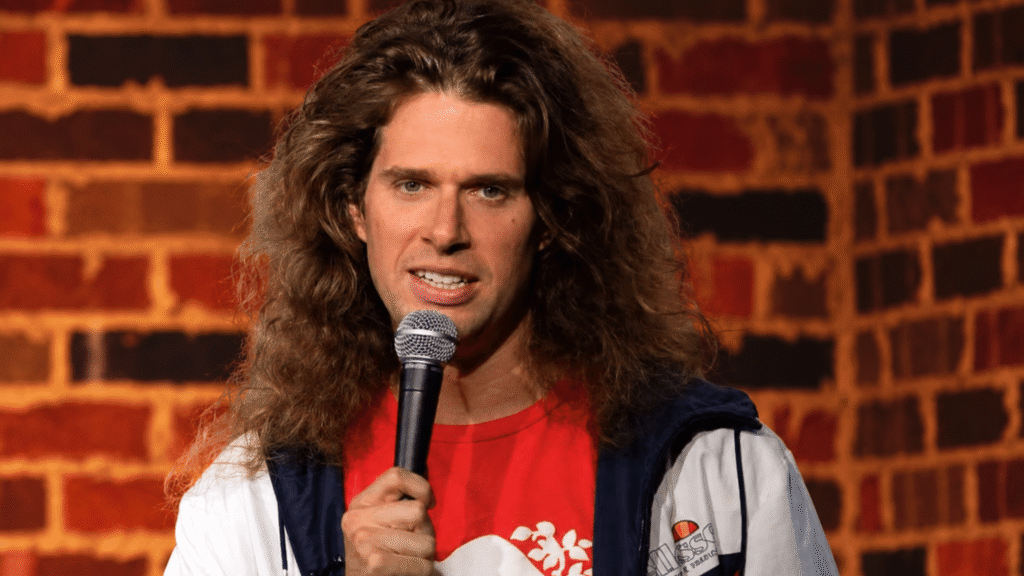
There is a man in a ski mask yelling outside the Capitol building right now, and there’s a real chance the Secret Service is enjoying it. That man is John Jacobs, a Detroit-born comedian who also prays before every show, got attacked on stage once and pressed charges, and once wrote an entire 40-track comedy album because a song wouldn’t stop playing in his head while he was mopping a gym.
None of this reads like a normal comedy career, and that’s sort of the point. We talked to him about reality TV, satirical journalism, hecklers, and why having nothing to lose turned out to be the best creative permission slip he’s ever given himself.
From the star of a reality show which was focused on matchmaking, to doing open mics in Tampa — how did that transition feel?
I had been doing stand-up for about 7 years before I got on reality TV, so it was a pretty natural transition. I just went back to performing after I did the show, but was able to start touring colleges around the country, which was pretty amazing. I went to college in Tampa — that’s why I was in Florida. I’m originally from Chevy Chase, Maryland. Reality was so fun and easy for me because I was already a performer and I didn’t really care about anything else. I wasn’t worried about how I was portrayed on the show. Luckily I think it came out pretty well.
What was the point in your life when you realised you wanted to pursue stand-up comedy for a living, and not television or some job?
I was the funny kid in school growing up, and I always made my friends laugh. I think I had a talent for comedy. In high school my friends kept pushing me towards it and saying I should try it. So I did when I was a senior in high school, and I never stopped.
You had a very tough childhood, and now your entire focus is making people laugh. How did it feel getting your first laugh on stage? Did it heal something from your own past?
I didn’t consider my childhood “tough,” but I did grow up with Tourette syndrome, which was really disruptive, and I lost my mom when I was 16. But I always tried to focus on the positives in my life — I had good friends and a good family, so everything else didn’t seem too stressful, especially compared to the things that were truly hard in life. It feels amazing to make people laugh. I don’t think I was necessarily good at much else, but it came naturally for me. It makes me feel good to know I’m giving people a nice night out. Makes me feel like I have purpose. I say a prayer before every show, asking God to let me do well for these people and give them a good time.
How do you create your set? Do you write it all down? Or do you take some random topics and just riff on stage?
I have a list of joke topics on a little piece of paper I look at before I go up. The jokes are created at any moment throughout my day — I’ll have a thought, write it down in my phone or on paper, then think about it more when I look back at it and try to make it into a full joke. I can’t force myself to sit and write — it just happens when it happens. I don’t try to force it. I don’t think you can really force creativity to happen. It just hits you.

Not every comic agrees on how much of that can stay instinct. Ian Edwards breaks down the more deliberate side of joke-building, where a punchline gets placed, word by word, rather than waiting for it to hit.
Your jokes are not just witty, but bold and outspoken. You’ve tackled topics that most comedians avoid because they’re scared of getting cancelled. What encourages you to take that risk?
I think having nothing to lose and everything to gain. I feel like I have nothing — no stable career, no financial stability, I’m not beholden to anyone or anything. I’m not worried about my friends or family judging me, so I just say whatever I want. I don’t try to upset anyone and I don’t like being negative on stage, so I avoid that. But if I think something is funny, I’m going to make a joke out of it and say it on stage or in the street.
A comedy music album, Summer at Southside — a huge risk. Very few (Zach Galifianakis, Bo Burnham) pull off that genre. What made you confident enough to actually work on it and put it out?
I like trying different things out of my comfort zone, and I had no experience with music. But one day while I was working as a janitor at a gym, a song came into my head that I couldn’t get out, and I had to get it recorded — it felt like the only way it would leave me. So I made my first song, and the producer I was working with realised how fun and easy it was making the song, and we realised we could make an entire 40-track album together. It took 2 years. Again, I have nothing to lose, and I’m not worried about how people will judge a thing I make. So I love making whatever.
There have been multiple hecklers at your show. Do you think it’s your duty as a comedian to always be in charge of the room and shut them up? Or do you just avoid them like unwanted noise?
I try to deal with hecklers in a pretty civil fashion because I’ve been doing it for so long, and they usually don’t actually bother me or get under my skin. So I feel like I take it pretty easy on them when I’m shutting them up or telling them to stop. In 2025, a man came on stage and attacked me during a show as well, and that made me realise — yeah, it’s not really worth it to argue with a crazy heckler. I pressed charges and it took about 9 months before the guy just kind of accepted some form of punishment.
You’re one of the co-founders of Tampa News Force, the award-winning satirical news team. How does writing satire as part of a team change the muscles you use as a solo stand-up — and which one is harder?
Writing fake news articles is fun and easy because there are no limits in writing, as opposed to physical performance. Anything you imagine can be written, and that’s a fun exercise — coming up with ridiculous news stories, I love it. Live performance is definitely harder. There is no heckling or instant feedback with writing. You just put it out and it exists. Like a painting in a gallery.
You’ve opened for some of the biggest names in the game — Margaret Cho, Anthony Jeselnik, Nick Swardson. What was your one key takeaway working with them?
No major takeaway from working with stars. They’re all different, they all do their own thing — there wasn’t really a pattern amongst any of it. They were all pretty unique and had their own style and fanbase. It’s been cool to work with so many people I grew up loving. But I don’t think there’s anything specific I’ve learned from working with them.
Who are your stand-up idols?
My idols are George Carlin, Dana Carvey, Greg Giraldo, Tom Green, and Pablo Francisco. I just try to do things that I think would make them proud. I’ve only gotten to meet and work with Pablo Francisco, and that was a dream come true for me. It’s definitely a life goal to meet Tom Green and Dana Carvey. Dana’s special Critics’ Choice may have been the first stand-up performance I ever saw on television, and everything about him fascinated me. I took note that he seemed to be dressed comfortable and casual but still commanded an entire theater. It was thrilling. I still think of that special often and quote it.
Your stand-up tone is so diverse — you can be loud, soft, thoughtful and even musical. What’s the kind of tone that you love the most on you?
That’s nice of you to say. The tone I love the most? Hmm. When I’m out in the street with the ski mask on in front of government buildings — those are moments where I feel like I’m operating at my full potential and using my skills in a way that no one else seems to be doing, and would make Carlin proud. It’s hard to present political concepts in ways that are enjoyable and also neutral to either party. I hate both sides. I hate everyone in power. The system can work, but the people operating it have been corrupt for my entire lifetime, so I have no example of it working correctly. I believe with the right regulations against politicians, it can work.
The last question. The mask and the White House. How did that concept pop up in your head?
I’ve been doing street performance for 7 years now, and each year I like to do one bigger project that puts me out of my comfort zone. Combining the street performance with the masked character in front of America’s most famous and recognisable political buildings was a perfect combination that resonated with people really well. I get to kind of be a tool or a mouthpiece and say things that a lot of people want to say but don’t have the ability or nerve to do directly in these political places. I’m shouting wild stuff in front of the White House and the Capitol, and the Secret Service and police love it. Pretty much everyone who’s witnessed it loves it. I’ve had very little negative feedback in real life while doing what I’m doing. And the messages I get online from people have been overwhelmingly positive in a way that nothing I’ve ever done before has been. This project and character seems to utilise my abilities in a way beyond regular stand-up or performance, so I’m happy to be able to do something so unique and different in a moment when it feels so relevant and necessary.
Somewhere between a janitor’s shift that turned into a 40-track album and a ski-masked rant outside the Capitol that the Secret Service apparently loves, John Jacobs built a career that refuses to sit still. He got attacked on stage once and simply decided it wasn’t worth arguing with a crazy heckler. That’s basically his whole philosophy: absorb the chaos, keep going, see what happens.
He says he has nothing to lose. At this point, it’s starting to look like that’s the whole strategy, and it’s working better than most five-year plans ever do.
If John Jacobs’ path, from reality TV to a janitor’s shift to a ski mask outside the Capitol, has you convinced comedy careers rarely move in a straight line, Rebecca Wolf’s own unlikely road from a school play to a stuffed pig husband is worth reading next.