


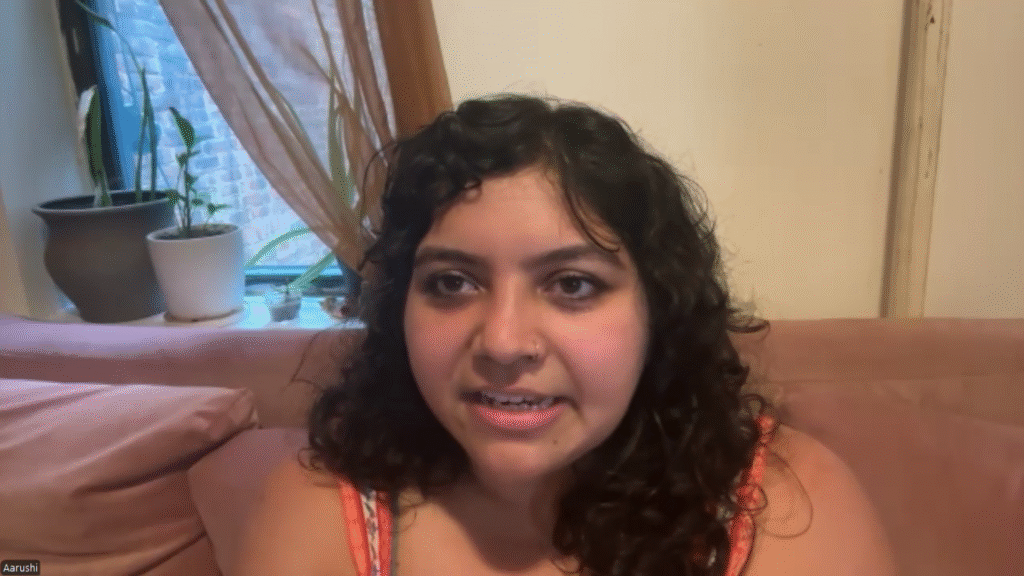

Aarushi Agni was born in India and grew up in Madison, Wisconsin. She moved to New York in 2016 for an MFA in writing. She has been doing standup for about eleven years. None of the jokes from her first open mic survived. She started in sketch, pulled onto an all-Asian team because they needed a singer. Improv came last, which she now thinks was the wrong order. It lowered her performance anxiety more than anything else had.
Emoji: The Hieroglyphs of Our Time is her first solo hour. She describes it as a TED Talk that is also a musical. It is also a comedy, and it is about human connection online. Underneath that sits a personal story that changed how she thinks about love. The show began life as an eighteen-minute presentation. She is a queer South Asian writer, singer and comedian. Her first audiences were aunties at Indian parties in the Midwest.
We caught up with Aarushi to talk about open mics, a clock reading 11:11, and Rachel Bloom. We also covered why she believes she has been manipulating people into listening her whole life.

The aunties, and the child who could not say no
It became established in her family that she could sing. The Indian parties in Madison were large, and the request always came late.
Rushi, we want you to sing.
The aunties responded, she says, as though her voice cured their suffering. She was very small, and the crowd held far more life experience and power. Watching them be moved by her affected her deeply.
She is also clear about the mechanics of it. Her parents would say that everybody wanted her to. Everybody would then perform wanting it, which removed her ability to decline.
In that moment when they would ask me to sing, I ceased to be a child and became this other thing.
That transformation is not a complaint. It is closer to the origin story of the performer.
The fear, and what outweighs it
She still feels shame-adjacent emotions before going on. Her working principle has not changed.
But the desire to be understood is greater than my fear.
She notes it gets decided case by case, even now. On stage is where she has control and influence over a room. She says she has got better at owning the space she takes up.
The worst room, and the best one
The toughest gig she can name was an open mic in Bushwick. Everyone appears to hate you, which is a misreading. They are looking at their notebooks, working on their own material.
Comedians are the worst audience for comedians. We’re also kind of the best.
Both halves of that are meant. The people who ignore you are also the people who understand the job.
Rooms that take, and rooms that give
The early mics were mostly white men. She was often the only woman there, and sometimes the only person of colour. Her assessment of those rooms is unsentimental.
This is draining my energy, it’s actively taking from me.
Then she found mics run for queer people and people of colour. Those are where her friendships in comedy came from. They are also where she worked out which rooms were safe to build in.
Eleven years, and nothing salvageable
She dates the first open mic to about eleven years ago. That was the first time she did jokes in a way anyone would call standup. She is blunt about the quality.
And my jokes were really bad. Not a single joke survived.
Sketch came via a team that needed a singer for its musical pieces. Improv came last, and she thinks the sequence was wrong. Her anxiety about performing dropped enormously once improv started.
Her theory is that improv makes anxiety structurally impossible. You cannot worry about what happens next when nobody knows what happens next.
Taking these controlled leaps of faith is really good for us, to understand that we don’t have all the answers.
That is a fairly generous reading of not knowing. It is also, she suggests, transferable well beyond a stage.
The breakup that turned the music off
She went through a bad breakup after moving to the city. It was with someone she played music with, which complicated the aftermath. Music, in her account, is too pure and too emotional to sit near.
When your feelings are already out of control, you have to turn it off. So she stepped sideways into comedy instead.
A lot of people who do comedy are really sad. And I love to be around funny people, because they just don’t care that you’re sad.
That indifference reads as kindness in her telling. It was the correct room for that particular year.
A poet’s precision, an improviser’s calm
She has always written songs and poems, which sets a certain standard. The right word makes a sentence land, and the wrong one flattens it. That instinct made her a careful, deliberate writer.
Improv training loosened all of it.
Sometimes I’ll riff something really good and I won’t even remember it, because I was in a playful mind, not a writing mind.
She describes herself now as chill about the whole thing. The precision has not gone, but it has stopped being anxious.
Why this is her first hour


She has never made a standup special, and is candid about why. She never felt there was enough energy behind the material.
Which is actually really unkind to my work, because it is good standup and I’m a great performer.
Her real diagnosis is different. Some part of her did not feel fully represented by standup alone. This show puts the singing and the writing back in the same room.
The clock that said 11:11
Emoji started as a presentation, and she corrects the length firmly. It was eighteen minutes, not twelve. The venue had a large clock at the back that only performers could see.
She looked up at the emotional peak of the piece. The clock read 11:11.
She had never braided ideas together like that in her work before. She describes the sensation as hitting on something universal. That early version also ended with a song.
Manipulating people into listening
She loves closing on a song, and is precise about the reason. A song makes everybody in a room listen to you. She points out that comedy does exactly the same thing.
So basically I’ve been manipulating people into listening to me my whole life, by being funny and knowing how to sing.
It is a joke, and it is also an accurate account of the show. Both tools are pointed at the same target.
Nicole Byer and Rachel Bloom
She admires Nicole Byer for building a career out of being funny with her friends. The appeal is being aspirationally cool and completely normal at once. Then there is Rachel Bloom.
She calls Crazy Ex-Girlfriend a master class in musical comedy. She credits it directly with improving her own comic songwriting. If she could swap bodies with anyone ten years ago, Bloom is the likely candidate.
A workshop in how to be human
Her pitch to anyone considering it is not modest. She says it is unlike anything else on the Fringe programme.
It’s almost like a workshop in how to be human — and you get to be human in a room with other people.
She also wants people to notice the songs. The premise is strong enough that the music gets overlooked in conversation. She insists the music is the part that is really good.
Agni says the desire to be understood outweighs the fear of being seen. She adds that it gets decided case by case, even now. Eleven years of open mics went into arriving at that. So did the rooms that drained her, and the ones that did not. Emoji is the first time she has felt fully represented by her own work. It braids the digital, the musical and the personal into one hour. She wants you to notice the songs, which she thinks get overlooked. She also promises it will change your life. She says this with the confidence of someone who has tested it.
The show’s full title carries a subtitle. It is Emoji: The Hieroglyphs of Our Time, or how I learned to stop worrying and send the risky text. It plays the studio at C ARTS, C venues, C aquila. The run is 5–30 August 2026 at 15:00. There are no performances on 17 or 24 August.