

Imagine watching a film where characters speak with stiff postures, minimal gestures, and props just exist without purpose.
That’s what happens when a scene isn’t blocked.
Let’s dive into what scene blocking is, how it works, and why it’s essential for a film. We will deconstruct iconic scenes that stood out not just for performances but for smart scene blocking.
To celebrate the return of the revered Miranda Priestly (Meryl Streep) and Andy Sachs (Anne Hathaway), we will use scenes from The Devil Wears Prada (2006) to explain various aspects of scene blocking.
What Is Scene Blocking in Films?
Scene blocking is the positioning and movement of actors from one position to the other in a scene, including their physical actions and interactions with the rest of the characters and the space as a whole. For example, look at this screen grab from a scene in The Devil Wears Prada (2006):
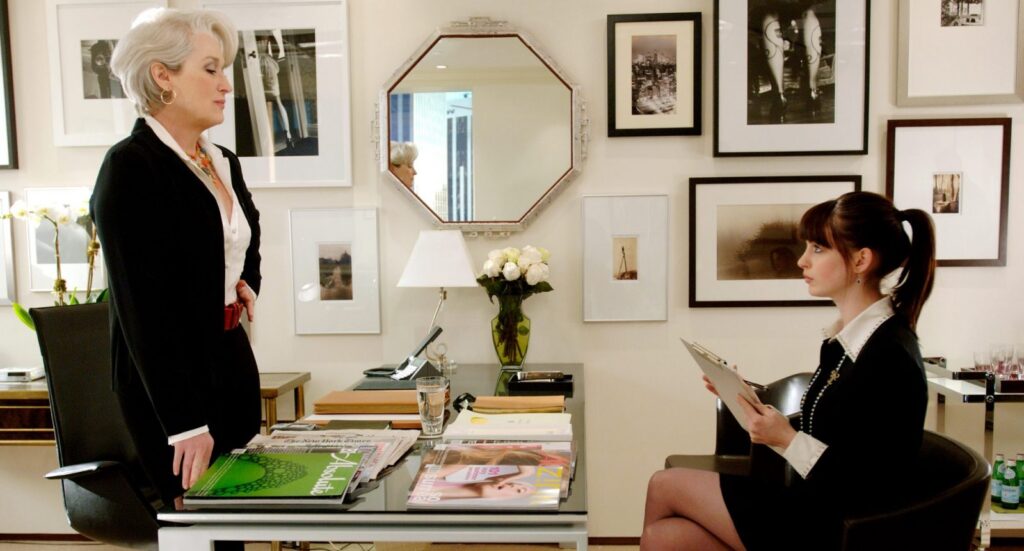
The scene blocking here involves the placement of Miranda Priestly and Andy on either side of the desk, their positions relative to the camera and each other, and the props like the table, mirror, magazines, and paintings.
Why Is Scene Blocking Important in Films?
Scene blocking influences how the audience perceives the characters and the actions they are seeing in a specific scene. Scene blocking is important because it:
Helps with visual Storytelling
Let’s take the same example from the previous section. From the screenshot, can you infer:
- Miranda is the boss, and Andy is the employee
- Miranda’s towering posture conveys authority, while Andy’s timid stance signals submission
- Miranda is looking down at Andy, while Andy looks up to Miranda
That’s the power of scene blocking; one frame or scene can communicate numerous stories.
Maintains Rhythm
Scene blocking dictates the rhythm of the film by shaping the movement, pauses, and overall visual tempo from one scene to the next. By controlling the expressions, movements, and gestures of the characters with scene blocking, directors control the pacing of the scene.
Watch this scene (0:46-1:45) from The Devil Wears Prada (2006):
The office staff is moving around in a well-choreographed flurry. The quick moments, like picking up phones, adjusting coats, and tidying desks, are all part of scene blocking. Notice that there are minimal dialogues, but we know that the entire office is in a state of panic. The rhythm is frenetic.
In contrast, within the same scene, Priestly’s entry into the office is calm. There’s chaos around her, but the rhythm slows as focus shifts to her.
Communicates Subtext
Scene blocking communicates what remains unsaid during emotional or intense moments. Here’s a scene from The Devil Wears Prada (2006) that communicates subtext well:
Miranda is slouched, and she looks disheveled. Her demeanor is a far cry from her usual poised presence; her emotional exhaustion is apparent. The hesitance Andy portrays by not moving closer also communicates an unsaid boundary between the two; she is a colleague, that’s all.
Controls Viewer Focus
With the right scene blocking, a filmmaker will be able to control exactly who they want the viewers to look at, even if the scene is crowded with other characters and props.
In this scene, we see Andy walking through the streets of New York. Though surrounded by a crowd, the focus stays on her as people walk past.
Contrast this with what happens after she spots Miranda. Andy melts into the crowd, and we can spot her only if we follow her movement carefully; the focus is now on the city and its people as a whole.
This scene blocking choice also conveys the subtext that Andy is now back to being just someone in the crowd, and she is no longer Miranda Priestly’s assistant, a job role everyone prays for.
What Influences Scene Blocking on Set?
Now, let’s look at the factors that influence scene blocking:
Camera Placements
The position of the cameras and the extent to which they can move (and the 180-degree rule) dictate how a cinematographer and director block a scene so that movements are precise and coherent on screen.
Check out this scene in La La Land (2016), from 0:08 to 0:40:
Mia (Emma Stone) and Sebastian (Ryan Gosling) meet at the coffee shop where Mia is working. The camera follows Mia as she walks from one part of the counter to another and zooms closer to her as we see Sebastian rushing in, and you can see him behind her.
In an interview with The Moveable Fest, Linus Sandgren, the cinematographer of the film, talks about how he wanted such scenes to reflect heightened reality:
“It’s like old school storytelling/blocking with a camera [where] it’s interesting when actors move in the scene, if you want to be in a closeup or a wide, then let the actors drive you, but then the camera helps as well, …..those long takes to bring an actor in and he walked away, and it becomes a two-shot of two people, then one of them comes to camera and then the camera travels with him. We felt that was something that could give a little more three-dimensional space for the viewer.
Therefore, camera placements and scene blocking have to go hand-in-hand.
Lighting Setup
The lighting setup dictates scene blocking to avoid unwanted shadows and to maintain continuity across different angles. Even a well-lit scene falls flat if blocking ignores light direction, shadows, or exposure.
A great example of lighting determining scene blocking is Episode 1 of Severance, during Helly R’s (Britt Lower) orientation. The scene has harsh lighting, and Helly sits right under the light, perfectly centered.
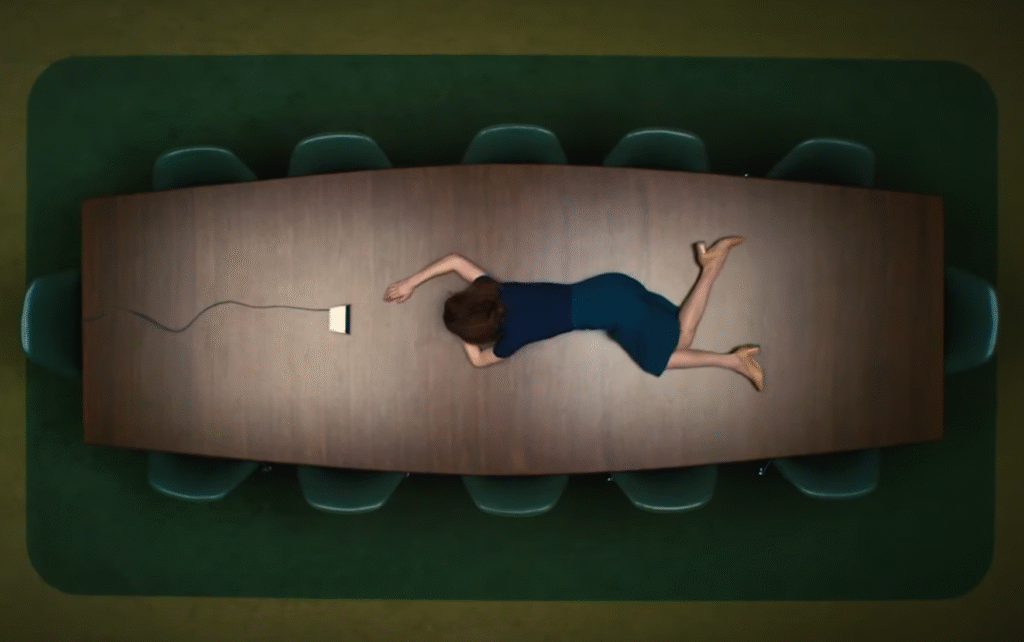
The clinical lighting defines how actors move through various scenes in the show while also communicating the themes of compliance and surveillance.
Physical Space/Set Design
Directors and cinematographers must block scenes based on the physical space available. Sandgren, in the same interview with The Moveable Fest, mentions what they had in mind while shooting La La Land (2016) and how they had to adapt:
You know the whole scene where they’re coming to that party…and this guy jumps into the pool?
We had another location for that and already had blocked out how that scene was going to work, but then we lost it. We found a new location and suddenly, there was this roof from which this guy could jump in; there was a guy jumping in the pool already — but now he was jumping in from the ceiling, so it changed everything.
Doorways, streets, or room layouts often constrain (or shape) movement.
The above are not the only factors that influence how a scene is blocked. An actor’s natural movements and quirks, equipment logistics, time, and budget constraints also play a role.
How Is Scene Blocking Done?
Though non-linear and highly personalized, scene blocking usually follows these steps:
- During the table read, the actors understand the beats of a scene
- At the rehearsal, the screenplay is tested and refined, and the camera and lighting are adjusted to ensure the blocking is working.
- The camera crew then marks what goes where, with tape and chalk
- The scene is shot
The director ensures rhythm, subtext, and tempo. The cinematographer ensures the camera and lighting are done in a way that complements the director’s vision. The assistant director, along with the script supervisor, helps track continuity.
Finally, the actors suggest changes based on whether the movements feel organic to them.
What Happens When Scene Blocking is Not Done?
Without scene blocking, there’s no structure to a scene. When scene blocking is not done correctly, three things happen:
- Viewers see things they shouldn’t, as is apparent in this compilation of movie scenes, in which you can spot the filming crew
- Actors are moving aimlessly, or there’s confusion as to who the viewer is supposed to focus on, leading to weak performances.
- Uneven pacing or flat visuals, due to which emotional scenes don’t land.
To Block or Not To Block?
The answer is always yes!
Scene blocking is more than just telling actors where to stand. It helps with rhythm, subtext, audience focus, and visual tempo. It’s instrumental in creating a memorable viewing experience. When done well, you won’t even notice intentional scene blocking; it will all seem organic and effortless.
Are you building your own scenes? Closely notice who moves, who stays still, and where the camera looks in your favorite films. That’s where your story will live, too.


