


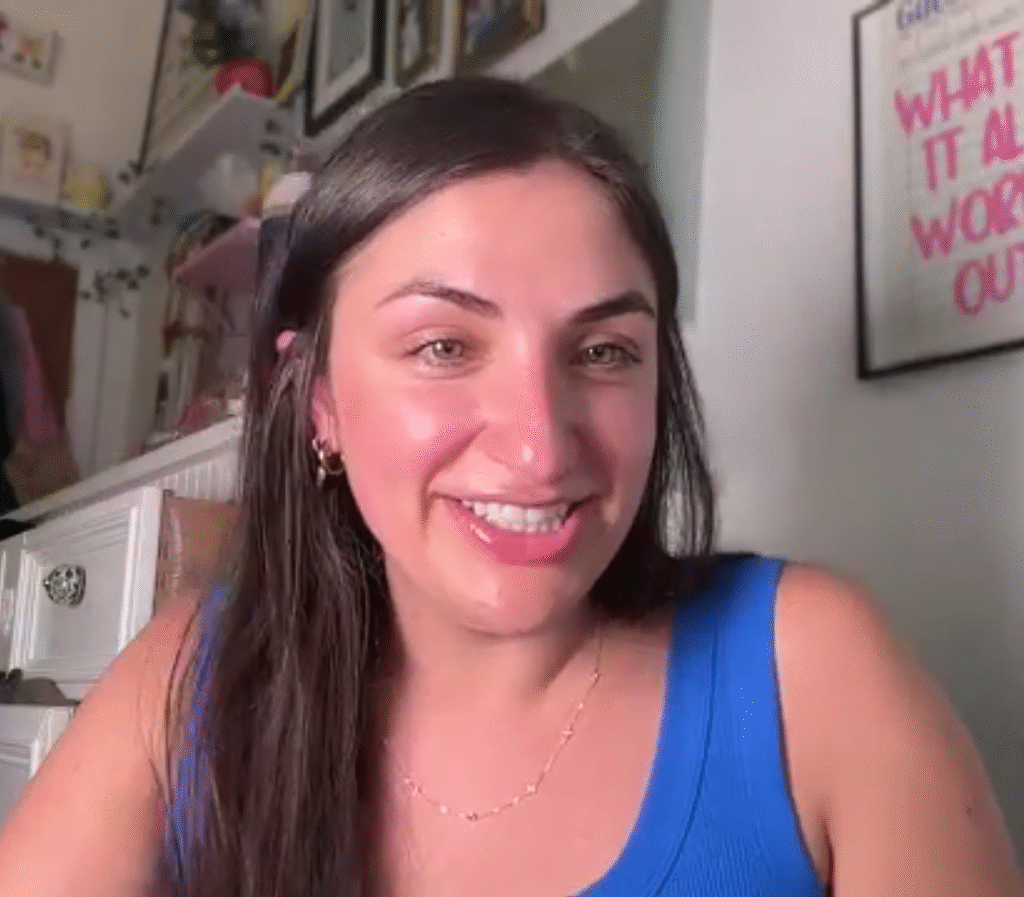
Liz Coin grew up in Iowa and now works out of New York. Her first stage role was Drake the butler, at eleven. It was a community theatre production of Annie. The lead forgot his lines and kept calling for champagne. Coin walked on with two trays and improvised the rest. The room came apart, and she drew a conclusion she still uses.
Lizzy Sunshine is her Fringe hour, and it contains almost everything. Standup, improv, musical theatre, clown, dance, crowd work and a magic trick. There are also deliberately bad impressions, which is the joke. The premise is that her brother is meant to co-star. He phones before curtain to say he is running late. He never arrives. What that turns out to mean is the show. It ends with the audience singing to her. She raised fourteen thousand dollars to bring it over. Almost none of it went on the set.
We caught up with Liz to talk about champagne trays, potato chips and paper towels. We also covered what happens when the facade comes off in front of strangers.
More champagne
She was not cast as Annie. She was cast as Drake, the butler, and she was eleven. Then the leading man went blank on stage and started improvising a request. He wanted more champagne, repeatedly, because he was drowning.
Coin came out holding a tray in each hand.
More champagne.
A rural Iowa community theatre crowd lost its collective mind. She worked out why immediately, and has never stopped applying it.
This isn’t something I wrote before. This is happening today.
The laugh came from the real situation, not the fictional one. She thinks that is the whole basis of standup and crowd work.
The World of Beer
Her first actual standup was in college in Chicago. The venue was a restaurant called The World of Beer, and the stage was the back of a bar. Nobody there had come for comedy, and nobody listened.

She wore a dress, on the theory that stages require dressing up. She also brought roughly three longhand pages of script to follow. She reports that it was extremely bad, and she still has the pages somewhere.
Pretty funny for a chick
Her first New York open mic was a tiny sweaty room full of men. She used her time to talk about visiting her brother in prison. An older comic approached afterwards, having himself died on stage.
You’re pretty funny for a chick.
Coin’s recollection of her own reaction is deadpan. She decided she had made it in the big bad city.
Sketch first, standup by necessity
For a long time she insisted she was not a standup at all. She was frightened of it, and preferred playing characters to playing herself. The reason she started was not ambition but craft.
She wanted to get better at writing TV pilots and sketches. The fastest route to that is writing jokes and testing them at open mics. So she went, and the early results were confused.
Her first sets were pure act-outs. She would introduce a woman who worked at her local TSA checkpoint, then perform her like a sketch. It took a while for the obvious correction to land.
I need to actually write punchlines and be myself.
The stage presence was never the problem. Talking into a microphone and holding a room came naturally.
Not raised on standup
She admits, quietly, that she did not grow up watching much standup. Her formative material was Carol Burnett and sketch shows. She loved Whose Line Is It Anyway?, funny films and musicals.
That left her feeling foreign inside the standup world. The structure and the material were the parts she had to learn.
Noises Off, and falling down
Noises Off is a stated inspiration, and she lights up about it. She loves anything farcical, and she loves physical comedy without qualification.
People falling down will always be funny.
Her taste runs to the tongue-in-cheek, slapstick, old-school end of things. She notes this sits oddly in modern standup, where she avoids sex material entirely. It leaves her, by her own description, a bit old-fashioned.


Wanting to look stupid
Physical comedy is not what mainstream standup expects. Doing it gets you labelled an alt comic, which she accepts cheerfully. One recent set involves pretending to rip her shirt off.
Rooms enjoy it, and purist standups often do not. They want the pure form, joke after joke, with nothing in between.
Her clown training pushes her the other way entirely. She describes an epidemic in New York comedy of everyone wanting to look cool.
I strive to be the thing on stage that you are here in the audience to laugh at.
That is a classic clown position rather than a modest one. Switching between it and standup uses a different part of her brain. On a standup stage she wants to seem witty and prepared. As a clown she wants to seem like an accident.
The potato chips problem
Her Instagram is full of sketches rather than standup clips. She calls herself a scientist throwing spaghetti at the wall. The characters are more fun to make and perform much better.
She is candid that this may be her central professional problem.
Liz, you gotta pick a lane, girl.
A bigger following opens doors and brand deals and income. Getting one means becoming a content creator, which means less stage time. The maths is also demoralising in the short term.
A carefully written, well-edited video can do two hundred views. Something filmed on a toilet can do two million. She was given one piece of advice that reconciles it.
Social media people are there to eat potato chips, and when they like your potato chips enough, they’ll come see you in person for their steak dinner.
The chips are not the meal, but they are the invitation. You do not get to skip them.
Last year’s ten shows
This is her first full Fringe. Last year she came for about a week to scope it out. She did ten shows and the response beat her expectations.
Audiences were building, and the last two sold out. Then the run ended, which she found frustrating. She also collected three or four five-star reviews.
A London theatre saw the show and invited her to bring it over. She is direct about what the whole exercise costs.
This s*** is hard.
Announcing a show and asking people to come is a leap of faith. Last year, she says, gave her the courage to do the whole month.
Where the fourteen thousand went
She raised fourteen thousand dollars, which suggests an elaborate production. It does not go on the set, and that is deliberate. The character believes she is on Broadway with an enormous budget.
The reality the audience sees is closer to a fifteen-year-old in a church basement. There is tech, and there are lights, but very few large props. The money went to marketing, flights and housing.
A month at the Fringe is simply expensive. That is the least glamorous fact in the interview.
Everything except juggling
The show contains standup, improv, musical theatre and crowd work. It also has clown, a fully scripted dramatic monologue and a farcical one. There is dance, and there is a magic trick.
She lists it as every form of performance except one. She cannot juggle. The impressions are deliberately terrible, which is the joke about the character.
The logic is that Lizzy Sunshine throws everything she has at the room. The question the show is asking is what remains after that.
Making the audience the genius
She brings an audience member on stage, and is unworried about it. Her position is that it is reliably funny if you let it breathe. The trick is entirely about who gets to be clever.
The secret to audience participation is: the audience needs to look like a genius.
Audience participation creates tension because people dread being humiliated. So the volunteer has to be the smart one, and she has to be the idiot.
You want to make them brilliant.
In this show the room chants the volunteer’s name to bring them up. Anyone who participates gets a lollipop afterwards. She says it never bombs because the setup makes failure impossible.


The brother who never arrives
The show is written for two people, her and her brother. He does not appear in it, and that is the premise. He calls before curtain to report a fender bender and asks her to start without him.
She goes out and explains there has been a small incident. Five minutes, she tells the room, and he will be here. The show proceeds, and he keeps not coming.
At the end another phone call explains why, and the facade comes apart. What the hour has actually been about is loving someone with addiction. Her brother has struggled with it for years.
There’s always the Les Miserables underneath the funny musicals.
Lizzy Sunshine is the childlike front she built over that. Her instruction to herself, and the show’s engine, is the same line.
You have to keep the show going.
She is insistent on one point about the tone. It is funny, and she promises it is not depressing.
Paper towels at a retreat
The writing happened fast, and she describes the process as violent. It was January 2024, and she had just watched somebody else’s solo show. Before that she had seen almost none, beyond a video of Fleabag.
The question that opened it was why she was doing all this alone. Being alone was funny, and the skill she had built to be delightful was remarkable. What she wanted to know was what sat underneath it.
The rest arrived at a guided meditation retreat, which she cheerfully calls woo-woo. She left the room to go to the bathroom and did not want to go back. She found a coat rack, put on other people’s coats and looked in the mirror.
Who let her out? Ooh, who let her out?
She wrote all of it down on paper towels, which she still has. Then she wept, missing her brother with what she describes as childlike rage. She called him at three in the morning.
You can’t die. You’re my big brother. I’m the little sister.
He is alive and doing better now. That call is somewhere underneath the hour she has built.
Toxic versus earned positivity
She rejects the idea that the show came from anywhere other than optimism. Her point is that there are two kinds and they are not the same. Toxic positivity refuses to admit anything bad is happening.
She has done plenty of that, and says so. The other kind does not require pretending.
That s*** sucks, but I’m gonna hope for the best anyway.
If she had to write an essay on the show, she has the thesis ready. It opens as toxic positivity and ends as the earned kind. The reveal is the hinge between them.
This sucks, and now we’re in it together.
The final image is Lizzy Sunshine with nothing left to give. She has told the truth, the brother is not coming, and she quits. Enough Easter eggs have been planted that the audience knows what to do.
They sing the song from Annie back at her. The hope travels in the other direction for once.
Amanda Bynes, and other influences
Her film taste is old and unashamedly girly. The Noises Off film, obviously, and Singin’ in the Rain for being a musical that is also funny. She rates Angus, Thongs and Perfect Snogging extremely highly.
Coming-of-age comedies and romcoms are the through-line. She’s the Man she considers a cinematic masterpiece.
Amanda Bynes is a genuine influence rather than a joke. Coin is sorry about how hard Bynes’ life has been. Somebody once gave her a description she has kept.
You are if Amanda Bynes kept doing comedy.
Her message to anyone coming is less composed than that. It is closer to a plea, delivered warmly.
Thank God you’re here.
She would also like a hug and a follow. She says it is hard out here, and that she loves it anyway.
Lizzy Sunshine is a show about a facade, performed by someone who built one. Coin is clear that she is genuinely an optimist. Her distinction is between the toxic kind and the earned kind. Toxic positivity denies that anything is wrong. Earned positivity admits it and keeps going anyway. The hour walks from the first to the second in real time. By the end she has stopped performing and the audience takes over. They sing the song from Annie back to her. It is a neat circle for someone whose first laugh came in Annie. She promises it is not depressing.
Lizzy Sunshine plays the Edinburgh Festival Fringe this August, for the full run.