
Hannah Ponturo wrote 1518: The Dancing Plague first as a film, then as a play. She is also directing it, and is one of four producers. She made most of the props herself. The costumes came largely out of the actors’ own wardrobes, layered up to read as medieval. The show is a historical satire about a real outbreak of compulsive dancing in 1518. Underneath it is a love story between two peasants, Anna and Katherine. She wrote it five years ago, and it sat in a drawer for most of them.
Ponturo grew up in children’s theatre and ran her high school drama club. She took a theatre major in college, then found she preferred writing to acting. An award from Ensemble Studio Theater in New York settled it. She has been writing ever since, and keeps drifting into satire. She says the world feels upside down enough to make that unavoidable. This script was originally a straight drama. It was not working at all, so she made it funny.
We caught up with Hannah to talk about Barbie dolls, Frau Troffea and the four elements of dying. We also covered why she cut forty minutes out of her own script.
Lady Macbeth, with Barbies
The first thing she wrote that felt like something was an abridged Macbeth. She was a high school senior, and she told it from Lady Macbeth’s point of view. It went into a Southern California drama competition, and it won first place.
And that’s when I realised — oh, I actually potentially might be good at something.
Her Lady Macbeth was a young girl playing with Barbie dolls. The other characters were the dolls, which made the whole thing a game rather than a scheme.
She’s not so evil from her POV. Obviously, no one is evil from their own point of view.
That instinct has stayed with her. Her characters read as bright and funny and kind, with something heavier sitting underneath.
Writers hate to write
She is unsentimental about the process, and quotes a line she cannot attribute. Writers hate to write, and love to have written.
I hate writing. But having written, and having a piece to show, is delightful.
She says the problem is not really block. It is the discipline of sitting down at all. Some months she cannot stop writing, and other months she does not write.
The script that sat in a drawer
She wrote 1518 in 2020 and 2021, and sent it to someone she respected. The response was that they did not get it at all. So she put it away and left it there for a while. When she came back to it, she found she still liked it.
It’s funnier now that we’re not in COVID. It’s hard to laugh at events when you’re still in them.
She is equally relaxed about notes from everyone else. She has met the same writers’ group at eight on Tuesdays for about five years.
You can’t really have a big ego when it comes to this.
Ultimately it is a group project, and she says anyone claiming otherwise is lying. Actors regularly hand her instincts and lines she could not have written. Sometimes one of them loads a throwaway line with so much meaning it turns thematic.
A history major, a film, and a drawer full of years
She first heard about the dancing plague as a college freshman. Her friend Jake was a history major and had picked it up in class.
That’s the craziest thing I’ve ever heard. But that’s also a play, a movie, a whatever.
She kept it in her back pocket for years without knowing what the story was. Two things unlocked it during COVID. One was watching Portrait of a Lady on Fire. The other was her own honours thesis, on Civil War women whose romantic relationships went unlabelled. The labels simply did not exist yet.
Ninety minutes into fifty
Edinburgh runs on time limits, so a ninety-minute script had to become a fifty-minute one. She describes the cut as a test in itself. The very silly scenes that do not move the plot went first.
I have to keep the love story between Katherine and Anna. That’s the show.
Everything else was negotiable. That one thing was not.
Air, fire, water, earth
Her choreographer is Sydney Diamond, who she calls one of the biggest parts of the team. Ponturo’s own dance background stopped at about age eleven. Diamond built a physical language for how the sickness progresses, organised around elements. The first stage is air, and it is loose and freeing. Then comes fire, which is erratic. Then water, heavier, pushing against everything.
And the last element before death is earth, where you’re really grounded, and not in a good way.
It gives the audience a way to read how far gone each dancer is. Nobody has to explain it out loud.
The point where it stops being funny
The show is built in levels. It opens silly, and invites you to enjoy the spectacle. Who is that strange woman dancing in the middle of the street? That is roughly what it was, before it became mass hysteria. Then it gets darker, and the laughing stops being available.
I think so much of tragedy is funny, because that’s how I cope. And what else are you going to do?
She points out that the funniest people historically tend to have survived something. Her own framing of it is blunt.
There’s a point where you have to laugh for your own sanity. Or you’ll start dancing uncontrollably.
That sentence is the show in miniature. The joke and the horror are the same object.
Accuracy is not the point
The play is based on a true story, but she is candid about her research. She calls it rudimentary, and expects a genuine sixteenth-century historian would find plenty wrong.
The point of it is not to be 100% accurate.
Frau Troffea, the woman who really did start the dancing, is a centrepiece. Everything about her in the play is invented. The Reformation arrived in 1519, so Ponturo sets the Church at its most corrupt just before.
The town crier knows
Every character except one is playing a serious drama. To them the situation is real and it is happening. The comedy comes from the audience knowing how ridiculous the premise is. The exception is the town crier, an omnipresent figure who is in on it. He is the one making the jokes, and he is as close to a wink as the show allows.
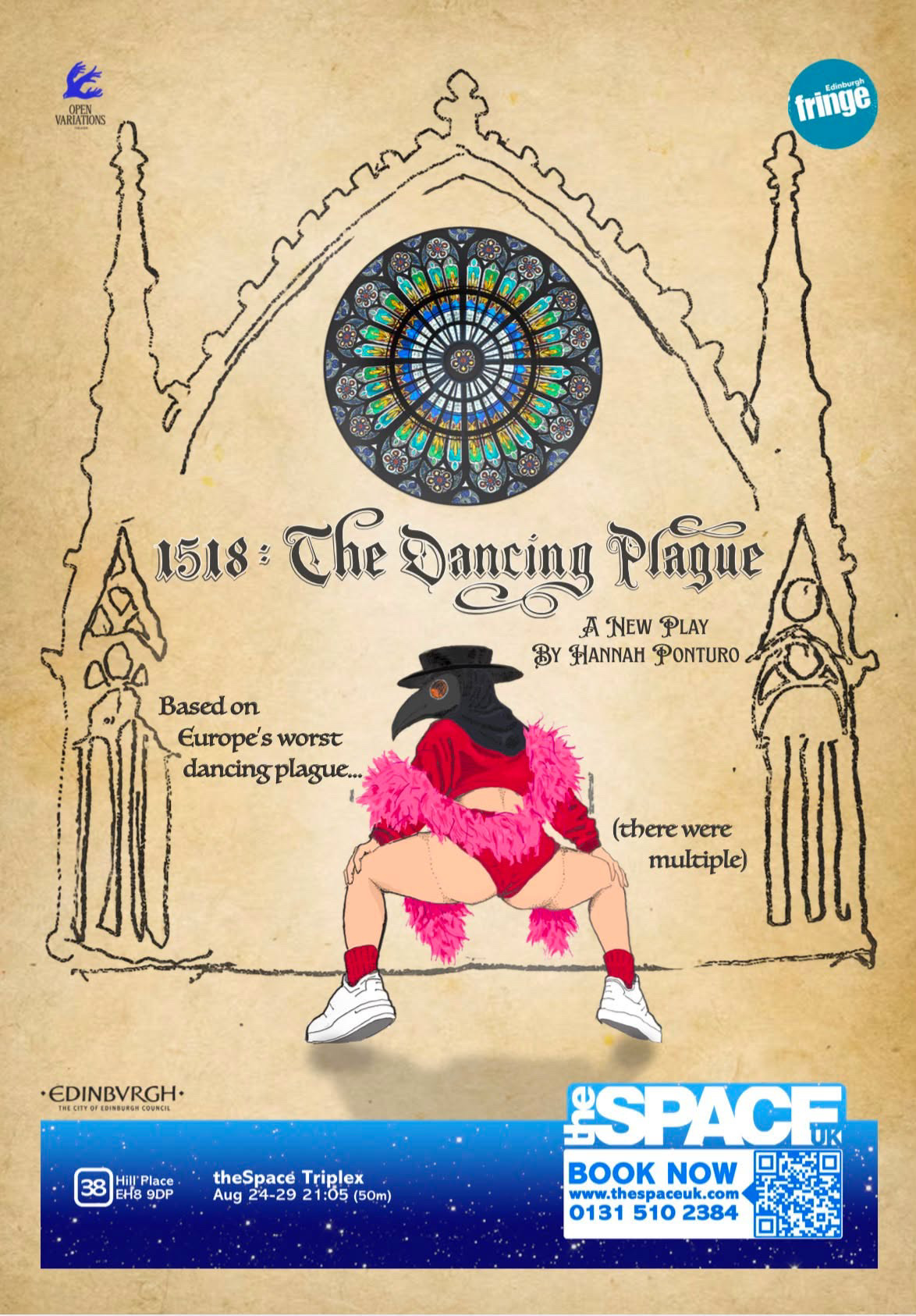
The poster was drawn by her friend Max Dorado, who does not do art for a living. Another friend, Cameron, built a custom font for the lettering. She would like it tattooed, though she stresses she means a fake one.
What she watches, and what she reads
Community is her favourite sitcom of all time. After that come 30 Rock, Unbreakable Kimmy Schmidt, Parks and Rec and Arrested Development. She rates The Great highly, and credits Disney Channel with shaping her sense of humour.
On the theatre side: Rabbit Hole by David Lindsay-Abaire, and anything by Suzan-Lori Parks. Something Rotten for being smart and silly at once, ideally with history in it. She saw Billy Elliot at nine and it set the whole career going. She notes that nothing in that show relates to her life at all.
Her last favourite is Rosencrantz and Guildenstern Are Dead, and she found it twice. Lion King 1½ was her favourite film growing up, and it does exactly what Stoppard did. Realising that, years later, blew her mind.
One line for the audience
Asked what she would say to anyone coming, she offered a small manifesto. Be excited, laugh, and hug the person beside you in a non-creepy way. Relish the human connection, and support people outside your usual circle.
And don’t dance your heart out — I don’t want to be blamed.
It is a joke, and it is also the thesis of the play. Enthusiasm and catastrophe are not always easy to tell apart.
The dancing plague is a strange thing to build a comedy on. Hundreds of people danced until they collapsed, and some of them died. Ponturo’s answer is that tragedy is where she finds most of her jokes. The show does not let you laugh all the way through. It starts silly and slowly stops being silly at all. What survives the tonal shift is the love story she refused to cut. Two peasants, in a town losing its mind, in the final week of the Fringe. Her closing instruction to audiences is characteristic. Hug the person next to you, and do not dance your heart out.
1518: The Dancing Plague plays theSpaceUK Studio at 21:05. The run is the final week of the Edinburgh Festival Fringe 2026. Written and directed by Hannah Ponturo, with choreography by Sydney Diamond. Presented by Open Variations Theater.