
Chloe Matonis plays a soldier who has travelled back from 2075. The character is called Lieutenant Love Doctor Hottie McTottie. Her mission is to end the loneliness epidemic before it takes hold. In her future, social contact has been criminalised for public safety. Boot Camp for Lonely People is the show built around that premise. It is a drill sergeant show about learning to talk to strangers. The audience gets bracelets, colour-coded by relationship status. They also get speed dates, small talk drills and winking practice.
Matonis is Chicago-based, and started standup around two years before lockdown. She works in hardware sales by day, after nine years in tech startups. She also runs a corporate comedy business called Humor Resources. She is studying Buffon clowning. Her husband was with the Blue Man Group. He is the one who noticed she had written Terminator 2. She had not noticed. The Fringe run is twenty-six days back-to-back.
We caught up with Chloe to talk about Darwin’s garden, a dog named Chloe, and thirty minutes of bombing. We also covered what her sister said after a show.
A soldier from 2075
The premise takes the present trend and runs it forward several decades. People keep withdrawing into the digital world until isolation is the norm. In that future, contact between people has been outlawed as a safety measure.
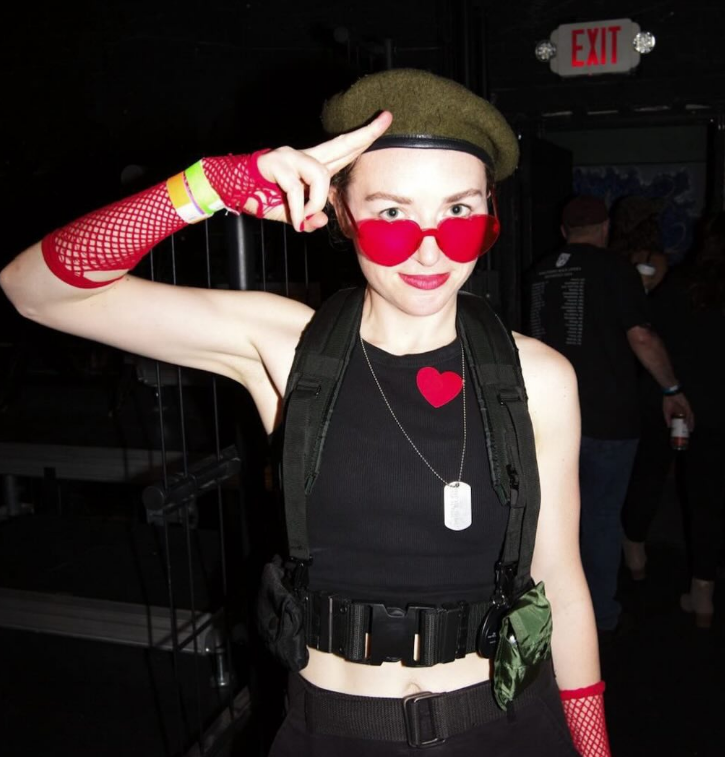
Her character comes back to fix it by force. She is commanding, militant and entirely a drill sergeant.
But I’m also preaching this message of love and connection.
That contradiction is the engine of the show. A sergeant screaming at you to make friends is inherently funny.
Bracelets, drills and speed dates
The interactivity is not incidental. Audience members come up on stage and speed date each other. There are drills in small talk, and a drill in how to wink.
Everyone is issued a bracelet on arrival. One colour means single, another means looking for friends, another means complicated. You spend the hour interacting with a futuristic soldier and with the rest of the room.
Ten pushups, and the bar afterwards
She enjoys the authority the costume grants her. The theatre frame makes it safe, and the audience knows it is a joke. That licence lets her be genuinely obnoxious.
Get down and give me 10 pushups.
People get on the floor and do them. She notes this is not available in most settings.
The show turns sentimental at the end, which she says catches people out. She wants them leaving hopeful, and less afraid of each other. Her closing instruction is an order like all the others.
Now go to the bar and hang out with each other.
Her favourite part of the night comes after the props are packed away. She goes down to the bar and finds the audience still there. People are buying each other drinks and making friends.
Age eight, on a beach
Her first laugh predates any stage. She and her siblings filmed parody videos, and she edited them. One had her pretending to be stranded on a beach.
Her parents laughed, and then showed it to their adult friends. She watched those adults laugh, and registered something specific about it. It was not the indulgent laugh people give a child.
Oh, that was genuinely funny. That was a real laugh.
She says she could tell the difference at eight years old. That distinction has been the job ever since.
Two dogs named Chloe
Her first joke to properly land came out of a tech startup in San Francisco. The office was dog-friendly, and two of the dogs were also called Chloe. One of them was badly behaved and in training.
So the owner spent all day shouting the name across the office. Matonis kept turning her head. She built the joke by leaving out which Chloe was being addressed.
Chloe, you dumb b*tch, learn how to work the printer.
Audiences latched onto it immediately. It was among her first genuinely successful bits.
Thirty minutes, and a watch
About a year into standup she did a strong seven minutes on someone’s show. A promoter in the audience ran a weekly open mic with a feature slot. He offered her thirty minutes, and she accepted without hesitating.
The room was full, mixed with musicians and poets, and it was a good night. She then bombed for the entire half hour.
Oh my God, I have 23 minutes left of this.
She was wearing a watch on stage, which made it worse. She would gather the room, lose them, gather them again and lose them again.
30 minutes of bombing really will toughen you up a bit. After that, I felt pretty invincible.
She is firm that progress in standup is not a straight line. The highs and lows arrive in no useful order.
It’s not like with time you’re just gonna get better and better.
That is the part she thinks beginners misunderstand. The good sets do not accumulate into permanent competence.
Writing for the wrong room
Early on she was frequently the only woman at an open mic. She noticed which of her jokes the male comedians responded to. They were the sexual ones, the ones about her body, and the self-degrading ones.
So she wrote more of those, because that was the available feedback.
They’re not a real audience.
The problem surfaced once she started getting booked properly. Couples on a Friday night did not respond the same way at all. She had been calibrating to a room that was not paying to be there.
What her sister said
The correction came from family rather than the industry. Her sister came to a show and found her afterwards.
Hey, I don’t think that’s really you, and I don’t think the audience thinks that either.
Matonis calls it an interesting lesson, which is generous phrasing. She shifted within her first year or two.
Her conclusion has hardened into a rule about artistic direction. Chasing what the audience wants might buy you a short run. In the long term the room can always tell.
Know yourself, and the audience will find you.
She frames the years since as adding layers and then shedding them. Standup, clown and this character are all part of the same process.
Lockdown, and learning to write
She was two years into standup when lockdown arrived. She now describes it as a gift, though she did not see that at the time. It forced her to work out what her writing process actually was.
She had written a lot of research papers at a liberal arts college. So she treated her standup like a thesis she was preparing. She sat at a desk and produced forty-five to fifty minutes over eight months.
When gatherings resumed she staged a special in her living room. Eight or nine friends watched her run the whole thing. A good deal of it turned out not to be funny, which is what audiences are for.
Blankets and Wine
She was living in San Francisco, where the weather cooperates year-round. She and her comedy partner had been producing shows before the pandemic. Her proposal during it was to move outdoors.
They started a free show in Golden Gate Park on Saturday afternoons. The timing alone was unusual, since comedy is a night business. They told people to bring blankets for the chill, and wine, then raffled wine at the end.
It has run every week since 2020, and her old partner still produces it. She is straightforwardly proud of that.
The open air created one technical problem she still remembers. Laughter has nothing to bounce off outdoors.
It would just float away into the sky.
She would come off convinced a bit had died. Looking at faces told a completely different story.
Two brains at once
She produces her own shows for a practical reason. Booking the venue, naming it, marketing it and filling the seats is control. The alternative is waiting for other people to book you.
The cost is running two operations simultaneously. The producer is counting seats, watching the bar, worrying about a late act. The performer has to walk on a minute later and be loose.
She describes it as exhausting and stressful. She also says she really enjoys it.
Hardware sales, and rejection
Her day job is hardware sales, after nine years around tech startups. Her LinkedIn lists both careers, which produces a reliable effect. Sales prospects want to talk about the comedy, and comedy contacts want to talk about the sales.
She thinks the two jobs draw on the same muscles. Reading a room, working out what people care about, active listening, warmth. And a very high tolerance for being told no.
Once you bomb on stage, you can handle rejection selling things.
Humor Resources is the third thing, running on and off for five years. It began as a Jeopardy-style game show for companies during the pandemic. It now covers interactive virtual game shows, in-person workshops and training.
The husband, and the clown show
He saw her perform at a bar in Chicago and was in the audience. He is a Blue Man Group alumnus, and a drummer, clown, actor and musician. He was assembling a cabaret variety clown show at the time.
He asked her to open it with ten minutes of standup. She did, then stayed and watched the rest of the bill. The clowning and music rearranged her sense of what a stage could be.
They kept working together and became close friends. Dating came about a year later, then an engagement, then marriage. He now helps direct her, and they swap scripts.
Darwin’s rocks and Seinfeld’s clock
Her writing routine borrows from an anecdote about Darwin. He would walk laps of his garden, kicking a rock into a line each time. Five rocks meant five laps, and the last lap took him straight to his desk.
So she does something physical first, walking or jumping around. No music, and the phone goes away entirely.
Your cell phone is the bane of any creative existence.
Sometimes the phone goes in a box in another room. Then comes the part she thinks most writers get wrong. Sitting down demanding jokes guarantees nothing arrives.
I’m gonna go write and see what comes out.
The other half is a time block, which she credits to Jerry Seinfeld. You do not go to the gym until you are in shape, you go for forty-five minutes. She commits to thirty minutes and usually finds it becomes an hour.
Simpsons, Conan, and a treadmill
She grew up on The Simpsons, watching from around five or six. She suspects it rewired her brain. Conan O’Brien was head writer then, and she has followed his sense of humour since.
Before starting standup she listened to a Pandora comedy station, heavy on Louis CK and Bill Burr. Later she watched a great deal of standup while training for a half-marathon on a treadmill. Taylor Tomlinson, Matteo Lane and Emma Willmann came from that period.
She rates Lane especially, for the pure crowd work shows he does in New York. He gives the audience advice, and he speaks four languages fluently. Watching him move between them is part of the pleasure.
Sarah Connor, in a costume
Asked which is easier, the character or herself, she picks the character. Lieutenant Love Doctor Hottie McTottie has parameters she defined. The costume, she notes, helps a surprising amount.
Her husband spotted the lineage before she did.
Wow, you basically wrote Terminator 2.
They watched it, and she conceded the point immediately. Playing Chloe Matonis remains the harder assignment. She is still working out how to be authentic and heightened simultaneously.
The show ends on a sentimental note, which Matonis says surprises people. She tells the audience their training is complete and sends them to the bar. Then she packs up the props and follows them down. Her favourite part of the night happens after the show. It is watching strangers buy each other drinks. That is the entire point, and she is unembarrassed about it. Twenty-six days back-to-back is a long time to sustain that. She compares the Fringe to getting a degree. You leave, she says, a different person than you arrived. She seems to consider that the selling point.
Boot Camp for Lonely People plays the Edinburgh Festival Fringe this August. The run is twenty-six days back-to-back.