

Krystyna Hutchinson and Corinne Fisher are New York stand-up comedians and the hosts of the podcast Guys We F****d, which they have released every Friday since 2013. Hutchinson took her first solo show, Congrats On Not Killing Yourself!, to the Gilded Balloon at the 2026 Edinburgh Fringe. Fisher also hosts the podcast Without a Country and runs a horror-themed stand-up night at The Comedy Store in Los Angeles. Their live show Slutsgiving returns for a second year on November 17.
This interview discusses suicide and childhood abuse. If you are struggling, please talk to someone: Tele-MANAS on 14416 in India, 988 in the United States, or Samaritans on 116 123 in the UK.
Krystyna Hutchinson and Corinne Fisher have put out a podcast every Friday for almost thirteen years and have not missed one. We had already interviewed each of them in writing. This time we got them on a call together, a few weeks after Hutchinson came home from a month at the Edinburgh Fringe, and asked what keeps a partnership going that long, how you put the worst night of your life on stage, and why both of them say they have never tried to shock anyone.
Thirty shows in Edinburgh, and a title chosen on purpose
Hutchinson’s main art is stand-up: setup, punchline, setup, punchline. A solo show, she says, “is a different animal”. Congrats On Not Killing Yourself! is about growing up with parents who bullied her, about cutting them off, and about what comes after. There are jokes all the way through. Near the end she re-enacts the night, years ago, when she tried to end her life.
On the second day of the run it occurred to her that she had to do that every day for a month. “I didn’t think ahead on this,” she says. She worried it would wear her down. It did the opposite, and she calls the month “an extreme catharsis”. She had never been to Scotland and did not know if the podcast had listeners there. She sold more than 700 tickets across thirty shows, and many of them sold out.
The title was deliberate. “I want people to know what they’re in for. We go there. I don’t dance around the subject.” She put her flyer up everywhere, and between word of mouth and people stopping in the street to ask what on earth the show was, it worked.
Being away for a month was harder than she expected, in small ways. In a British supermarket she recognised nothing but the fruit and vegetables. The audiences were different too. “They’re very shy, UK audiences,” she says, while American crowds have been trained by years of comedy that chases shock and are surprised by very little. The Edinburgh crowds needed warming up. Then they went with her.
“You land the plane gracefully. I have a joke right after. But you’ve got to let it breathe.”
She studied acting at college, and this was the first time, she says, that she was glad she had paid for the degree. We have a longer piece on why the pause matters as much as the line.
“Are you not healed from this yet?”
We asked how long the show took. “My whole freaking life,” she says. She began writing it in 2020, when the pandemic started, and soon understood that she was not ready. That was before she had cut contact with her parents. She needed time alone, therapy, reading and room to breathe first, and she gave herself years of it.
“Many times you’ll see folks, and I’m certainly guilty of this, talking about something really serious on stage, and you go: are you not healed from this yet? I can spot it from a mile away, because game recognises game.”
She did not want an audience sitting there worried about her. Waiting also gave the show its ending. About a year before the Fringe she went to a group reading by the psychic medium Laura Lynne Jackson, where around ninety people buy a ticket and a handful are read. Hutchinson was one of them, and the reading was about her parents. She had recorded the audio. “I was like, well, that’s the ending of my show.”
It is the same rule we heard from the comedians in our piece on turning the worst moments of your life into comedy: the story has to be finished before it is material. Hutchinson talked about the show before the Fringe in our written interview with her.
How they met: an internship and a bringer show
Hutchinson moved to New York because she wanted to work at Saturday Night Live. She knew she could not simply walk in, so she applied for an internship every semester to build a CV. The first one was at a talent management company, and Fisher worked there. Hutchinson was in her third year of college.
She did get the SNL internship in her final semester, and asked one of the writers what the wisest route onto the show was. He said stand-up, which she had never considered. So she booked her first bringer show, which she describes as the night “you beg your broke friends to pay way too much money to see you do five minutes and absolutely bomb”. Fisher was one of the friends who came. (Those five minutes are the start of every comedian’s tight five.)
Fisher wanted to do stand-up as well, and had a theory that you need an A project and a B project. The B project became a comedy duo. Three years later she brought Hutchinson the idea for the podcast.

Hutchinson did later audition for SNL, and says she sent in “the worst auditions possible”. She thinks she wanted it so much that she undermined herself. She still loves the show: one of her first memories is of her whole family watching it and laughing, and everything being all right for an hour. She no longer takes the rejection personally, and points to Jenny Slate, who was let go by SNL and then found the forms that suited her.
Thirteen years without missing a Friday
“Corinne and I have a chemistry that you can’t manufacture. I wish you could bottle it up. I’d be a billionaire.”
It was there on the first day, Hutchinson says, and it goes beyond timing. Each is good at the parts of the business the other is weak at. Fisher describes herself as the type who can work an eighteen-hour day on three hours of sleep. Hutchinson is the one who colour-codes the spreadsheets, because it soothes her. On stage, neither knows what the other is about to say, and neither minds. “It’s just a huge trust fall.”
The podcast was well received from the start, which Fisher almost regrets. “If you’re doing something that everyone likes, you’re not doing something very interesting.” For Hutchinson, the surprise was that it was thought daring at all. They had taken the way they talked with their friends in private and put a microphone in front of it. Only when listeners reacted did she realise that most people do not talk about these things. Her answer was: let’s change that.
We asked whether they play characters. Fisher says no. “I don’t really have a persona. It’s pretty much me.” The only difference is preparation: her stand-up is written in advance, and for Without a Country, where the subjects are serious, she studies as she would for an exam. Hutchinson says different people bring out different sides of her, and that listeners have the two of them the wrong way round. “People think Corinne is the meaner one of the two. It is me.”
Long partnerships like this are rare in comedy. Lucy Boisvert told us her writing partner is her “creative soulmate”, and described the same thing: two people who are different in useful ways.
What Slutsgiving actually is
When the two of them toured, Fisher says, they never wanted to sit on a stage and record an episode. “We thought that was boring.” Over the years they built an interactive format in which the audience feels like part of the podcast, and Slutsgiving, which began last year, is the best version of it so far. Hutchinson calls last year’s the best live show they have ever done. The timing is deliberate. Everyone does a Christmas show. Thanksgiving, Fisher points out, had only Adam Sandler.
It depends on fans who are willing to come up on stage and admit to things they are ashamed of. Hutchinson finds that freeing: everybody has good and bad in them, so who cares? The riskiest segment is a live prank call. Someone in the audience explains what a bad ex did, and the two of them invent a call on the spot. “It’s not bullying, because that’s not funny and that’s not our style,” Hutchinson says. The aim is to let the person know they have been seen, without fully calling them out.
Not shock, and the truth about hecklers
Their material covers subjects most comedians avoid, so we asked about hecklers. Fisher thinks the internet has given people the wrong idea. Going by the clips, comedians are heckled constantly. In real rooms, she says, the disruption is mostly people chatting among themselves, or “positive heckling”, where someone tries to join in the bit. And professional rooms have security.
“If you told me as a child that one day I was going to get paid money to speak, and if anyone else spoke while I was speaking they would be removed from the room, I would say: wow, dreams do come true.”
Hutchinson finds her bits in conversation. Something comes up with a close friend, she notes it on her phone, and then she develops it on stage, where she is by now so comfortable that she sometimes forgets she is on one. Neither of them recognises the word “edgy” as a description of what they do. These are simply the thoughts in Hutchinson’s head. Fisher puts it more sharply:
“I’m certainly not trying to shock people. I’m trying to make them think about something they’re familiar with in a new way. If that’s shocking, it should be a wake-up call that you’re probably living in an echo chamber.”
People want their own thoughts repeated back to them, she says, and that is no way to grow. It is why both of them admire Joan Rivers. Fisher says Rivers “just cuts right through” the nonsense. Hutchinson says she called everyone out, herself included, and nobody died of it: people laughed, went home and perhaps asked themselves a question. “That’s not what stand-up comedy has to be, by any means. But that’s my favourite kind.” Fisher told us in her own interview that she will not bend a set to please a crowd.
We told them that when stand-up took off in India, women comedians were met with “girls aren’t funny” too. Both knew the feeling. Having to work harder and get on stage more often, Hutchinson says, ends up fuelling you. “All that pressure turns into a diamond.”
Their advice on heartbreak
Their podcast runs on listeners’ stories, so we brought some from India. One was from a woman who had been with a man for ten years and was about to marry him when she learned that he had been secretly married to someone else for four of them. What should she do now?
Hutchinson was practical first: block him everywhere. Then be kind to yourself, because there are two things to grieve, the relationship and the person she thought he was. And remember that what he did says something about him and nothing about her. Fisher’s advice was about how to count the years.
“Instead of looking at it as, oh my God, I wasted ten years of my life, I think of it as: wow, you’ve got fifty more years left. So much more is ahead of you than behind you. Isn’t that delightful?”
Hutchinson added something we have thought about since. Heartache is one of the most intense kinds of grief, she said, and what fascinates her is that it is not permanent. When someone dies, the loss stays. Heartbreak feels as if it will kill you, and then one day, years later, a friend mentions his name and you have to think for a moment who they mean. “That’s going to be a glorious day.”
What’s next
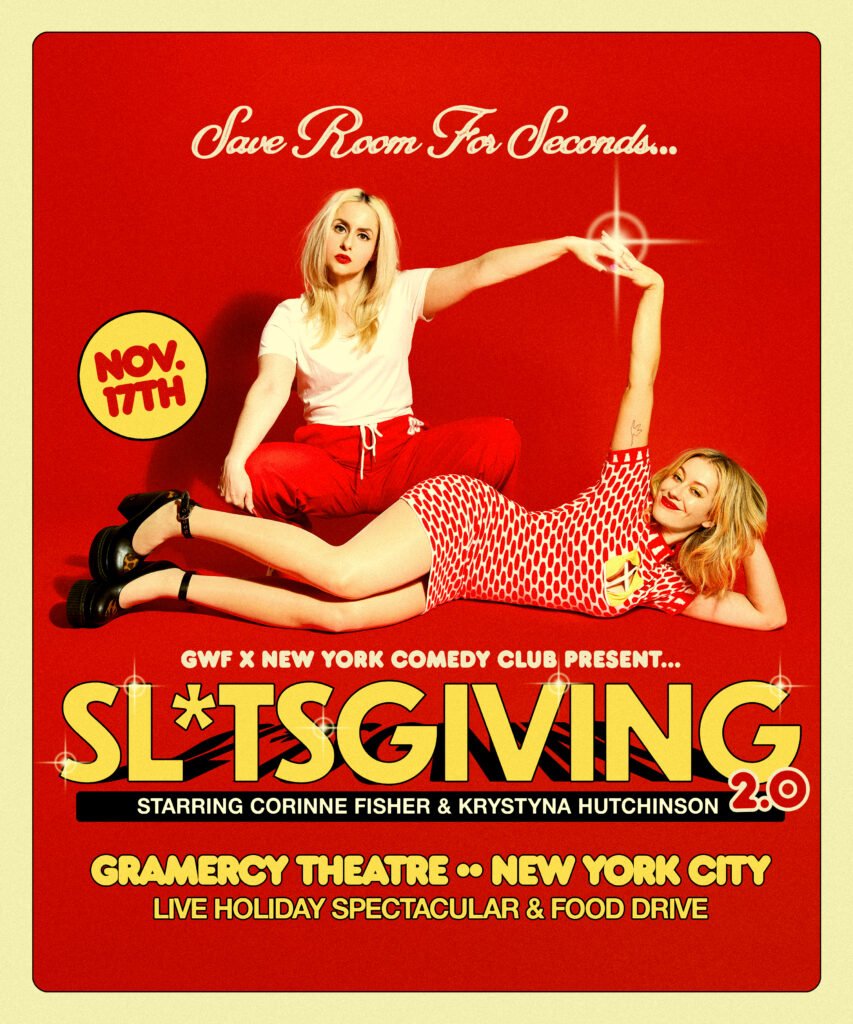
Slutsgiving 2.0 is on November 17. Fisher’s horror stand-up night is at The Comedy Store on October 25. She started it a couple of years ago because, to her surprise, the horror and goth scenes turned out to be far more alive in Los Angeles than in New York, and it has reconnected her with a close friend from film school who now directs independent horror films.
You can follow them at @krystynahutch and @philanthropygal on Instagram. For more conversations like this one, see all our comedian interviews and our Fringe coverage.