


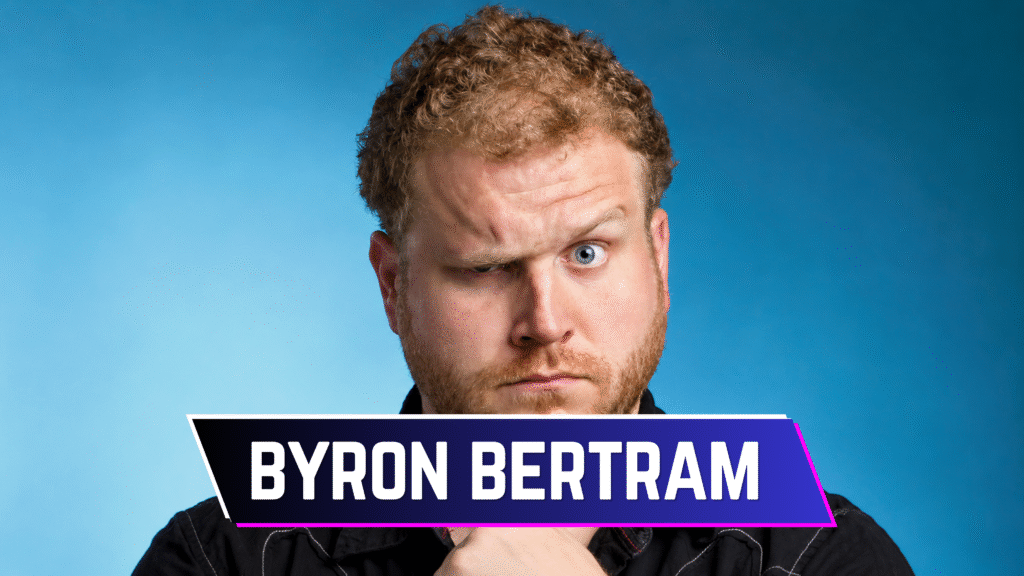
Byron Bertram is a comedian, actor and street performer from Vancouver, Canada, with more than twenty years of stand-up behind him. He learned to juggle at a summer performing arts school as a teenager and built a street show around juggling and a straitjacket escape that took him to England, Australia and across North America. His screen credits include Supernatural and Once Upon a Time. Online he is best known as Sergei Putinski, "Russia's only living comedian", a character shared by Bill Burr and featured on Tom Segura's Your Mom's House. His special as himself, Live at the Biltmore, is on YouTube.

Byron Bertram spent twenty years being good at stand-up in Vancouver, and for most of that time it did not help. He could headline. He could hold a room. People would find him after a show, tell him he was hilarious, and then ask what his name was. The thing that finally fixed it was not a better joke. It was a tracksuit, a gold chain and a Russian accent he picked up from an ex-girlfriend.
Sergei Putinski and the problem of being “just another white guy”
The character is Sergei Putinski, billed as Russia’s only living comedian: a fresh-off-the-boat immigrant who got out during the war and now has opinions about Canada, America and England. Bertram has been doing him for a couple of years. In that time Bill Burr shared one of the videos, the character turned up on Tom Segura’s podcast Your Mom’s House, and Bertram’s career moved, in his words, to a different level.
He is unusually plain about why. As himself, he says, he was one of the better comics in Canada and still could not stand out.
“I’m just another white guy who’s doing comedy. It’s like: oh, that guy’s funny, hilarious, what’s his name? When I’m Sergei it’s: the Russian guy, the Russian comic, that guy was hilarious.”
The character came out of a relationship. “I dated this crazy Russian girl and she was just so blunt and different,” he says. He learned her accent, borrowed her no-nonsense attitude and her observations about life in the West, and found the result funnier than what he had been writing. It also bought him room. Sergei can say things Bertram cannot, because Sergei has a ready excuse: “I don’t know anything, I’m immigrant.”
We put it to him that this is Andy Kaufman territory, with Sergei as his Tony Clifton, and he agreed that Kaufman was an early influence, discovered through old videos years after Kaufman died. Kaufman comes up often on this site: Larry Charles worked with him on the sketch show Fridays, and John Jacobs found his full potential in a ski mask outside the White House.
From straitjackets to stand-up: learning to perform without props
Bertram did not start with jokes. As a teenager he went to a summer school for the performing arts that taught everything from musical theatre to drumming. One of the courses was street theatre: unicycling, stilt walking, juggling. “I got so addicted to juggling,” he says. Then he saw outdoor street performers working crowds in Vancouver and fell for that too.
He built a show around juggling and escaping from a straitjacket and chains, and it took three summers before one performance finally worked the way he wanted. “It took three years before I was like, all right, I’m good at this.” The street show then paid for the plane tickets. Because he was already in England, Australia and cities across Canada and the States, he could do stand-up spots wherever he landed. (A unicycle sent Tori Morancay into comedy by a rather different route.)
The performing part of stand-up came easily. He compares it to an acrobat taking up breakdancing: the stage presence and the crowd skills were already there. What was hard was putting the equipment down.
“The biggest transition was being vulnerable, being naked. Not having these circus props, not my unicycle or juggling gear or straitjacket. All I have is just me and my words. I have no props.”
His first set shows how hard that was. He did a few minutes about being young and inexperienced, it was going well, and then he finished by juggling anyway. Other comics told him afterwards that he was funny and had not needed it. “It was kind of a safety blanket,” he says now. What stayed in the act was not the circus skills but the voices and accents, which is still where most of the physicality in his stand-up lives.

The room itself turned out to be the easy part. On the street you have to stop strangers and hold them. In a club, “I don’t need to gather this crowd out of nothing. They’re here and they’re waiting to laugh. So this is easier.” The culture was harder. Street performers, he says, had an honour-among-thieves loyalty to each other. Stand-up felt like high school, with a mood he sums up as “your success is my failure”. “You really feel like you’re in this by yourself.”
The first open mic, and eight hours in a car with his future
He was about nineteen when he took a comedy writing course at a community college, the kind that ends with everyone performing a short piece. After that he did what you did before online sign-ups: phoned the club on a Monday at the right time and asked for a spot. He was very nervous, and it went well. “It was magical and I felt like, okay, I can do this.”
He never doubted that he wanted to do comedy. What he doubted was how good he could be at it. He also never wrote the way newer comics are told to. He does not build a fresh five minutes to order; he writes constantly and feeds new bits into a longer set, between older jokes he trusts, until they settle in. If you want the conventional method, we have a guide to the tight five.
The first time he properly opened for a headliner, he also had to drive him from Calgary to Saskatoon. The man drank heavily and lied about everything he had achieved. The shows went fine. The eight hours in the car did not.
“I was like, oh my God, this is supposed to be a comic. This is my future. I’m going to be this guy.”
He decided every situation is different and kept going. He has no patience, though, for headliners who ask an opener to hold back so they look better. “If a comic is asking you to do that, he’s not a very strong headliner, or he’s not very confident.” He calls it weak and insecure.
What Sergei gets away with, and what he costs
Bertram expected a Canadian playing a Russian to get more hate than it has. In person there has been almost none. Russians come to the shows, tell him the accent is right and thank him for it. Online is different. He gets comments calling for him to be cancelled and others wishing him dead on the front lines in Ukraine, from people who assume the act is pro-Russian. It is not, and he does not think of his comedy as divisive. “I don’t think I’m malicious,” he says.
Hecklers, oddly, are easier as Sergei. The character can pretend not to understand what was said, and can be meaner than Bertram would be, because the audience hears it as a confused foreigner and not as an angry comic. Much of that is tone, which he says he never rehearsed at home. It came from years of holding street crowds and from repetition on stage. (We have a longer piece on why timing and delivery matter so much.) He is not the only performer we have spoken to who disappears into an invented person: Chloe Matonis plays a soldier sent back from 2075.
The cost is the one you would guess. Sergei gets the bookings, the following and the photographs after the show, and people still tell Bertram he is funnier as himself.
“I haven’t done stand-up as me in a while. I’m just this character. Who am I? Can I still do stand-up as me?”
He found out recently, when he was hired to perform as Byron. The first minute felt strange and then twenty years of muscle memory took over. He does not believe the internet simply prefers absurd comedy to clever comedy. It prefers whatever is easy to remember. “You’re not just another funny guy. You’re funny, but you’ve got this memorable hook.”
When the writing dries up, which he says comes and goes in waves, his fix is other comedians. Trading ideas with people who share your sense of humour is “like working out for your brain”. Brendon Lemon talks about relearning how to write in his interview on British jokes and an American mouth.

What’s next: a Sergei special and juggling vodka bottles
When we spoke, a Sergei special was planned within six months, with a run of around ten American cities first and the UK and Europe to follow. He wants to push the character towards longer stories and a proper backstory. And the props may be coming back. His idea for the finale is Sergei drinking from sponsored vodka bottles all night, then juggling them, so that a character the audience has taken for a fool suddenly does something difficult and exact.
His idols are the ones you would expect from all this: Norm Macdonald, Andy Kaufman, Bill Hicks, George Carlin, Louis C.K., Gilbert Gottfried, and Sacha Baron Cohen for character work. Carlin is one of the three comics in our breakdown of how a joke is built.
You can follow the character at @therussiancomic on Instagram, find more stand-up on Byron Bertram’s YouTube channel, and see tour dates at byronbertram.com. For more conversations like this one, see all our comedian interviews.
Watch Byron Bertram talk about Sergei, street performing and twenty years in comedy