


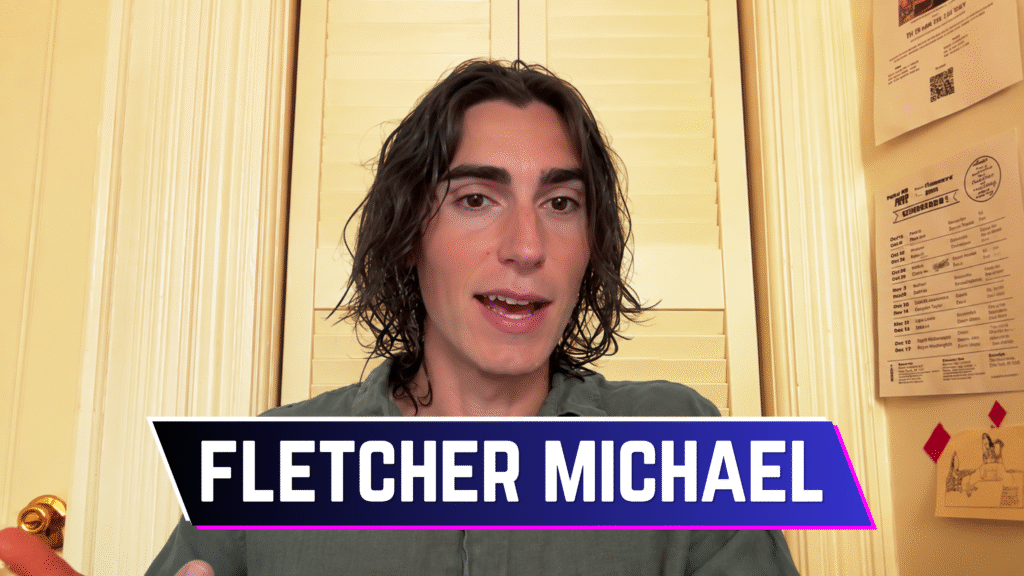
Fletcher Michael is a Brooklyn-based playwright, performer and novelist, and the founder of Infinite Monkey Theater Co. He is the author of the novels Vulture, Glass Bottle Season and Sidewalk Dance, and has published satire in McSweeney's and Points in Case. His stage work includes the plays First Liar on the Moon and Oops! We Lost a Nuke and the sketch show Chimp Cocktail. He wrote and performs in Did You Charge Your Phone for the End of the World?, which ran at Greenside @ Riddle's Court during the 2026 Edinburgh Fringe after a run at the New York City Fringe.
It is 2034. An asteroid is heading for Brooklyn, and the government will not tell anyone until an advertising agency has come up with a jingle that puts a positive spin on it. That is the premise of Fletcher Michael’s play Did You Charge Your Phone for the End of the World?, and it tells you most of what you need to know about how he writes. The idea is ridiculous. Everyone on stage treats it with complete seriousness. And somewhere underneath, he is after something real.
From published novelist to the stage
Michael moved to New York at about twenty-four intending to be a novelist, and he became one: three of his novels have been published. He also found out that he did not like the working conditions. “Writing a novel is just really solitary work,” he says. He had placed some satire pieces and knew he liked writing comedy. What he wanted was other people.
A friend suggested an acting class, purely as a way to meet actors who might appear in his shows. He fell for the form. “Writing for the stage, you’re writing for all five senses,” he says, and unlike film or television there is “just no safety net”. He also gets something no novelist does, which is to be in the room.
“It’d be weird to watch somebody read one of my novels. I don’t think I would like that. I don’t think that person would like that. But to experience something that I’ve written along with an audience at the same time, that’s what keeps me coming back.”
He founded Infinite Monkey Theater Co. to put on full-length plays. It also became the home of Chimp Cocktail, a sketch show with a cast of thirteen. The first run was ten shows at The PIT, a small comedy theatre in New York, and to his surprise it sold out: more than eighty people in a black box, standing room only, laughing at his writing. An off-Broadway residency at the Players Theatre followed, then Second City, then a short visit to the Edinburgh Fringe. “For the rest of my life, I’ll probably be chasing that feeling,” he says of the first night.
“Satire with a heart”: why the laugh is only the way in
Everything he writes is comedy first, but he has a phrase for the kind he means. “I describe it as satire with a heart.” His play First Liar on the Moon imagines that the moon landing was staged and that Neil Armstrong and Buzz Aldrin were actors tricked into performing it. It is a big, silly premise. It also follows Armstrong into depression and drink under the weight of the lie.
Those passages are hard on a comedy writer, because comedy gives you a verdict straight away and drama does not. “A laugh is really revealing for an audience,” he says. Sitting through a dark monologue in pin-drop silence, not knowing what the room thinks, feels to him “like ants on my skin”. He keeps the serious moments in because they make the comedy stronger.
“Oftentimes the laugh is just the way in. It’s just the foot in the door. That makes the audience feel comfortable. They think that they know what they’re watching, but then it also provides an opportunity to surprise them.”
Mark Ryder made almost the same argument to us about his own Fringe show: an audience that is laughing is open, and will follow you somewhere serious.
An asteroid, an ad agency and a jingle
Did You Charge Your Phone for the End of the World? has three characters, the staff of a small creative agency in Brooklyn, played by Michael, Collin Dennis and Lucy Boisvert. A shadowy client, standing in for the government, has given them a brief: make the asteroid sound like good news. The hour covers several months of them failing to. We watch them play idea-generating games, write songs, throw the songs away, and fall out over whose idea is best.
He calls it a dark comedy with absurd and surreal elements, about laughing in the face of death and making comedy in the face of capitalism. More than anything, he says, it is about which friendships survive when the stakes are as high as they can go, and about “creative process under pressure”. He adds that he personally has never had to write his way out of an asteroid hitting Brooklyn. (Tom Johnson’s Armageddon Out Of Here was another Fringe comedy about the end of everything.)
It is the first of his shows to have original songs. He had been struck at the previous year’s Fringe by how many shows mixed music, comedy and drama without settling into one category. The plot also needed them: the agency’s job is to write a jingle, so the audience has to hear the attempts. “The nature of comedy is commitment,” he says. If the characters take the jingle seriously, the audience starts caring which one the client will choose. He wrote the music in a day with former roommates from Bushwick who are working musicians. Liz Coin also brought a comedy with songs to this year’s Fringe.
The joke that bombed, and what pace taught him
Asked about a bit that died, he volunteered one of his own. In Oops! We Lost a Nuke, a puppet character says at the top of a scene: “If these walls could talk, they’d probably be screaming.” A whole scene plays out. At the end, Michael is alone on stage and the walls start screaming. On the page he found it very funny. In the theatre it got nothing, and he does not blame the delivery.
“You need to make sure that your setup is as good as your punchline. And there’s just too much distance between the two for that joke to have caught up with the audience.”
On the morning we spoke he had texted the show’s director to say the bit should be cut, and she agreed. (That gap between a setup and its payoff is the whole art of the callback; we also have a guide to how a setup and punchline fit together.)
The lesson that took him longest was pace. A script can seem to move quickly and then slow to a crawl once actors have to cross a stage and scenery has to change. He remembers standing backstage during a two-and-a-half-minute transition in an early show, “crawling out of my skin”. The new play is built to avoid that: one location, someone on stage at all times, scenes that tumble into each other. “In comedy, pace is everything.” We have a longer piece on why timing decides whether a joke lands.
A proper run helps too. Most of what he has staged has been at festivals, where a show might get three to five performances and still feel new on its last night. The year before, Chimp Cocktail had three shows in Edinburgh. This time he had twelve, enough, as he puts it, to get the show “on your bones”.
Working with people you trust
“My method, if there is a method, is just working with people I really trust,” he says. He wants collaborators who will tell him when he is wrong, because a writer who only carries out his own vision will have blind spots. Running a thirteen-person sketch cast taught him the rest. Thirteen comedians, he says, is “like trying to herd minnows”, and the only thing that gets them swimming in one direction is a shared goal. His motto: “If you treat it like a big deal, everyone else will too.”
What he wants an audience to leave with is the sense of having seen “an original idea executed in an original way”, something that could not have come from anyone else. His own favourites fit the description. His favourite novel is Zadie Smith’s White Teeth. He loves Tom Stoppard’s Rosencrantz and Guildenstern Are Dead, absurd comedy with a hard edge, which he says is his own project too. The best acting he has seen is Andrew Scott’s one-man Vanya. For comedy, he grew up on Will Ferrell and Judd Apatow’s films, and he says he would watch Ashley Padilla of Saturday Night Live read a phone book.
You can follow the company at @infinitemonkeytheaterco on Instagram and at infinitemonkeytheaterco.com. For more from Edinburgh, see our Fringe coverage.
Watch Fletcher Michael talk about satire with a heart and writing for the Fringe
