
Stacie Burrows has been on stage roughly as long as she has been alive. Her first credit was Old MacDonald Had a Farm at preschool. She played the black sheep, which she considers telling. Since then: theatre, improv, sketch, standup, musical comedy, solo theatre and storytelling. Her roots are in standup, in New York in the nineties. She spent about ten years in a comedy band called Mommy Tonk.
She is from Texas. Fool’s Gold Mine is her fourth show at the Fringe. It is storytelling, original music and a hundred and twenty-three photo cues. The subject is debt, and a childhood spent looking richer than it was. Her father was a Houston salesman who lost everything in the oil bust. He never once dropped the persona. She did not work out the truth until she was a teenager. He is eighty-seven and still going. The show is, among other things, a love letter to him.
We caught up with Stacie to talk about Lenny Bruce, fried chicken and the Texas oil bust. We also covered why she gave up trying to make her shows wild.
The black sheep
She dates the beginning to preschool without much irony. The role was the black sheep in Old MacDonald Had a Farm. She thinks the casting turned out to be accurate.
I’ve been on stage just about as long as I’ve been alive.
Once she found a stage she simply wanted to stay on it. She liked the people who made art, and she liked handing something to a room of strangers. Watching them receive it and be delighted was the whole appeal.
Why the roots matter
Of everything she has done, standup is the part she values most. Not because she still does it, but because of what it installed. It taught her to handle any room and any audience.
A standup set can stay loose, and you can pivot when the room turns. Her current show has a hundred and twenty-three cues, so looseness is not an option. She is confident she can stay on book anyway.
I’m pretty good at finding my way into everybody’s heart.
She now prefers solo work for the creative control. She loves collaborating, but she wants the final say on what goes up.
Mommy Tonk and the standing ovation
The comedy band ran about ten years, with her partner Shannon. It was called Mommy Tonk and the Assless Chaps, and it was about motherhood. That was roughly seventeen years ago, when nobody was doing it.
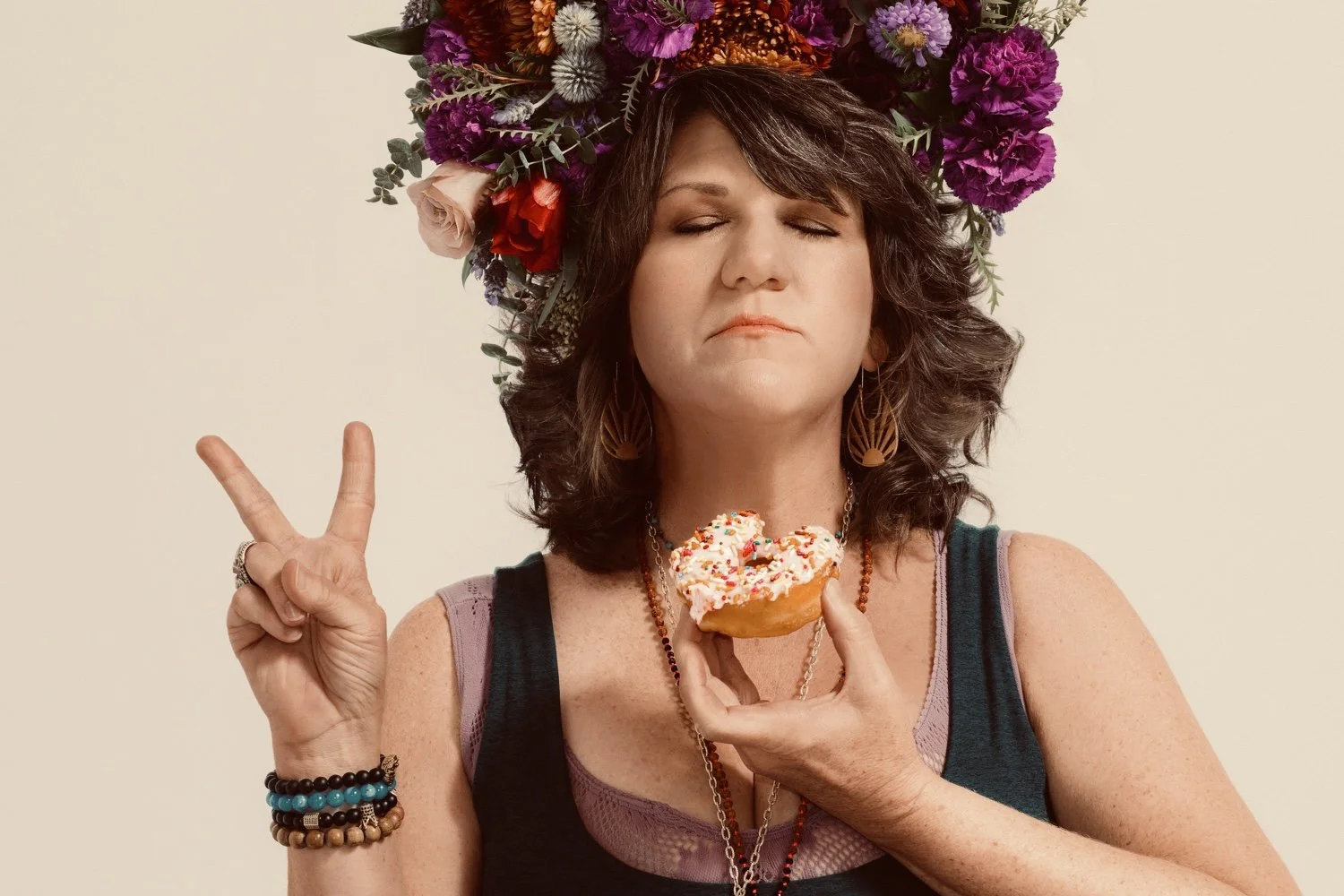
Nobody wanted to be labelled a mom comic at the time. So they built something that got round the label entirely.
Burrows is from Texas and Shannon was from Kentucky. Both could sing in a sweet Southern tone, and both were good at harmony.
Our lyrics were filthy.
The gap did the work. Beautiful harmonies would land on a raunchy punchline, and rooms fell apart. They played the main room at The Comedy Store on Sunset Boulevard.
We got a standing ovation in the middle of the set.
Neither of them had seen that happen in a comedy club before. She still describes it as the most memorable show she has played.
COVID, and the pivot
She describes herself as ridiculously optimistic, possibly to a fault. The first weeks of lockdown were fine on that basis. About three months in, the optimism ran out entirely and she got badly depressed.
What pulled her out was writing. She began No Good Drunk in 2020 with her best friend and co-writer Sam Small. He was the only person in her household bubble, and she was the only person in his.
They wrote outside, at a distance, and the songs came out beautiful. Later she recorded the album two people at a time, masked and isolated. Her engineer insisted it could be done safely, and it was.
The same period took her family to El Paso to find her grandfather’s grave. That trip was the point of the whole show. She calls the period productive, after the first few months of misery.
Twenty-six pages, and a first solo show
Standup came easily from the very first attempt. She says she never doubted her ability for a single day.
The first time I did standup, I was like, yep, I was born for this.
The hard part arrived with her first solo theatre show. That was Bulletproof Unicorn in 2022, and it was fully staged. Twenty-six pages of monologue had to stay in exact order, because every cue hung off the words.
Getting off book nearly beat her. She now has tricks for memorising a script, and No Good Drunk took five years to finish. She is glad she took the time.
The response to that show settled her direction. Grown men were crying after performances and she found herself consoling them.
The stories are funny, the music is how she felt
She is lyrics-driven and always has been. Writing a comedy song, she argues, is the easier job. If the jokes are strong, three chords will carry it.
She points to Tim Minchin as the counter-example and her idol. His musicality was so far beyond the requirement that it changed what the form could be.
Her own shows now work the other way round. The songs in them are serious, and every one is a ballad. The comedy lives in the spoken stories between them.
The stories in my show are telling you what happened in a funny way, but the music is how I felt about it.
Audiences arrive expecting a comedy and get a rollercoaster. The stories get the laughs, and the music is what they take home.
Fool’s Gold Mine, and the oil bust
The new show is about financial recklessness and living far beyond your means. She doubts any other country permits the scale of debt Americans carry. Nobody discusses it because it is embarrassing, which is precisely her brief.
I talk about uncomfortable s*** and sing pretty songs about it.
She grew up in eighties Houston, where her father was a successful salesman. He kept reaching, because materialism runs on never having enough. Then the Texas oil bust arrived and his wealthy clients all went broke.
A salesman whose customers have no money does not get paid. The family lost everything, and her father declined to acknowledge it. They carried on living opulently and she was raised as a rich kid.
She found out as a teenager. She still describes the discovery with a kind of astonishment.

The dreamer gene
She is careful that the show is not a hit piece. It is a love letter to her father first. He came from nothing, a farmer’s son in Mississippi, and made himself.
She is the last of five children and the only one who recognises the trait. She thinks it takes a particular kind of madness.
You have to be a little bit crazy to have the level of belief and optimism that people like my dad and I do.
Her sisters tell her she is exactly like him, which she takes as a compliment. Both of them make opportunity out of nothing. Both of them believe it will be fine.
Even if everything around us is on fire, we’re like, hold on, I’ve got a plan.
She traces the optimism partly to what she left behind. She was raised a Jehovah’s Witness, and the world was supposed to end when she was four. It did not, and she has been sceptical of apocalypses ever since.
She notes that every generation gets told the same thing. Her position is that nobody knows, so you may as well make things. Her father is eighty-seven and still standing.
Fried Chicken
The show closes on a song called Fried Chicken, and she is proud of it. It is about her father’s mother, and how he knew she loved him. She quotes her own opening couplet from memory.
With a simple preparation of a simple bird, she told you she loved you without saying a word.
The argument of the song is about how little love actually requires. No Mercedes, no big house, no diamonds or Rolexes or luxury cars. His favourite meal was her homemade fried chicken, and that was sufficient.
He never doubted for one second that he was loved.
Set against an hour about debt and appearances, that lands hard. She confirms, cheerfully, that there will be tears.
No clowning, nothing thrown at you
She is direct about what the show does not contain. No physical comedy, and no audience participation whatsoever. The irony is that clown shows are what she goes to see at the Fringe.
She wants the big, absurd, physically insane ones as an audience member. She has stopped trying to make that her own show. Her reasoning is partly practical and stated without self-pity.
What she offers instead is a simple format executed precisely. She takes real pride in the writing, working the script with her director and dramaturge Katie Rose Donahue-Enriquez. Every word has to drive the story or move the plot.
The rest is her, the music, and the projections. All hundred and twenty-three cues are photographs from her own life.
The Muppets, then Bill Hicks
Her earliest influences were the Muppets and Saturday Night Live. University changed the list entirely. Bill Hicks, Lenny Bruce and George Carlin arrived while she was shaping a worldview.
She had come out of a conservative, religious Southern upbringing. Those three were funny and smart, and they were arguing about something. She contrasts them with Seinfeld, who she rates as very funny without making a statement.
She has since handed Carlin down. She gave her younger son Brain Droppings, expecting the usual indifference. He texted her late one night to say it was really good. The book still sits on his bedside table.
The Lenny Bruce obsession
She describes having an obsessive personality about things she loves. Bruce got the full treatment. She read everything, and owns the enormous biography and three of his records.
She wanted something with his signature on it, and her husband found one. It is a personal cheque Bruce wrote out to cash.
When she moved to Los Angeles she tracked down the house in the Hollywood Hills where he died. There is a gate, so she got no closer than that. Then she visited his grave and left a note tucked under the headstone.
That was more than twenty years ago and she has no idea whether it survived. What she took from him was the trials, the loss of free speech, and how it ended. What she took from the whole exercise is a view about why art matters.
Everything else people accumulate is stuff, and stuff goes away. The legacy is the part that does not.
The Bill Hicks show she did not go to
The story she tells against herself involves Hicks. She was at university in Austin, working late shifts at a restaurant. He was playing an eleven o’clock set nearby.
She tried to assemble a group and nobody knew who he was. Nobody would come. So she did not go either, and he never performed again.
If you’re really pulled to something, even if you go alone, you have to just go.
She has organised a fair amount of her life around that lesson since. She says we are only here briefly, so you should do the thing.
Separating the art from the artist
Asked about the topic directly, she does not dodge it. She used to perform with Louis C.K. in New York and rates him as a comedian and writer. Her view of what happened afterwards is that the rules changed and he broke them.
The two she genuinely struggles to separate are Woody Allen and Michael Jackson. Her difficulty is straightforward: she thinks Annie Hall is a great film. She thinks Jackson made some of the best music ever recorded.

On Bill Cosby she has no difficulty at all. She grew up on The Cosby Show and knows now what was happening off screen.
She stresses she is not excusing anyone’s behaviour. Her working rule for herself is short.
Don’t be a creep.
She adds that she is flawed too, as everyone is. She says she could talk for hours on it and that ultimately each person chooses for themselves.
Advice for first-timers
Her closing advice is for anyone bringing a first show to Edinburgh. Pack your patience, and level your expectations.
Your job as a Fringe performer is to survive it.
Get to the finish line and be proud of having done it. She is dismissive of getting overwhelmed by press and reviews. The actual job is finding your audience on the street and talking to them properly.
Every day at the Fringe is a new day. Keep your chin up and keep swimming.
Burrows is unusually clear about what she wants from a Fringe run. Not a Netflix special, and not a West End transfer. She says she would not turn either down. But the thing she counts as success is smaller. It is the people who message a year later to say they are back. Out of thousands of shows, they picked hers and returned. Fool’s Gold Mine is calm, simple and built entirely on writing. There is no clowning and nothing will be thrown at you. There will be a song about fried chicken at the end. People generally cry.
Fool’s Gold Mine plays Greenside at the Edinburgh Festival Fringe. It opens on Friday 7 August and runs daily, with two Sundays off.
Watch the full interview here