
Sevrin Willinder is a clown, and somebody else told him so first. He was playing a piano repairman in a dramatic scene at drama school. His mentor told him to play something well, then act as though it sounded terrible. He did, the room laughed, and he did not understand why.
He grew up doing funny voices with his father, mostly SpongeBob. He acted through school and college, then moved to New York. Physical theatre kept pulling him further from drama and towards comedy. A workshop in Australia led him to Philippe Gaulier’s clown school. Time Travel Postman is the show he built afterwards. He made it with Melissa, over a year and a half. It runs for twenty-four performances across August. He is also one of five performers in The Kobold Show. That one is performed entirely in an invented lizard language. His character there is the smart one, which is not saying much.
We caught up with Sevrin to talk about Gaulier, a juvenile detention centre and an electric plunger. We also covered why he wants you to leave with a new friend.
Funny voices with his dad
The beginning was not ambitious. He was a small child who loved to play and do stupid voices. He and his father did impressions of SpongeBob characters and other cartoons.
His father kept encouraging him to try acting properly. So he did the plays in middle school and high school, then theatre at college. New York followed straight after graduation.
The drift towards physical work happened on its own. He found he was a physical comedian, because joking around brought him the most joy.
The piano that had to sound terrible
One mentor, who taught him at school and again in New York, named it first. They were working on a dramatic scene, and Willinder was a man arriving to repair a piano. The note he got redirected the whole career.
You need to play something really well and then act like it sounds terrible.
He is not much of a pianist, but he knew one song. He played it and started complaining about how bad it sounded. The room laughed, and he had no idea why.
That mentor was the first person to call him a clown. He did not understand the label at the time. He did understand that something had opened up.
Gaulier, and not trying to be funny
The route to clown school ran through Australia. He was travelling for a couple of years and took a physical theatre workshop in mask making. A fellow student called Damien invited everyone to his own show, Gary Starr.
Willinder went, found it silly and stupid, and recognised it immediately. Damien is how he found Philippe Gaulier. The most-quoted lesson from that school is also the least intuitive.
Don’t try to be funny. You’ve never been funny in your life.
He disliked it at first, then worked out what it meant. The instruction is against performing cheekiness at an audience. What works instead is being genuinely vulnerable inside a ridiculous situation.
The second lesson came from another teacher there, named David. It is about where a performer’s control actually lies.
At any given moment, I can’t change if I’m a good actor or not, but I can change if I’m having fun.
Willinder points out that you cannot take a six-month acting class on stage. You can, however, enjoy yourself. He now compresses both lessons into one line: do not try to be funny, have fun.
The Chekhov scene
His breakthrough at clown school came after about ten weeks of failure. He had struggled through the whole second term and into the third. The school’s method involves a teacher with a drum and a supply of insults.
He was not even being insulted, which was worse. The drum would sound and the next student would go. Classmates talked over him and nobody noticed, and he felt increasingly invisible.
Then came a Chekhov scene with text handed out two days earlier. The pages were dense and the scene ran four of them. He decided memorising it was physically impossible.
His plan was not to be funny at all. It was to know roughly what he was saying, paraphrase brilliantly, and commit so hard that everyone would be impressed. He went for it with every inhibition down.
And I failed spectacularly, but I kept trying.
The room came apart. The teacher let it run well past the point of stopping it, then finally intervened.
Oh, we have a unit for this in 2 weeks.
The next module was clown. Willinder remembers feeling wonderful and having no idea what he had done.
The hardest room
The worst gig predates clown school, which he thinks matters. He was on a children’s theatre tour, two performers and a minivan. Backdrop, props and costumes all fitted in the vehicle.
One of the three shows had a structural problem. It was written for children from about six through to fourteen. The facts were pitched at the older end and the language at the younger.
Six-year-olds could not follow it, and fourteen-year-olds felt patronised. Then they performed it at a juvenile detention centre. The audience was around sixteen, and the acoustics were terrible.
Nothing landed. Not one joke, in what was supposed to be a comedy. He looks back and thinks the mentality he learned later might have saved it. He also thinks he simply did not believe in the show.
A postman who is bad at his job
Time Travel Postman is about exactly that. He is a postman in the future, delivering significant post to different periods. He is probably not very good at it.
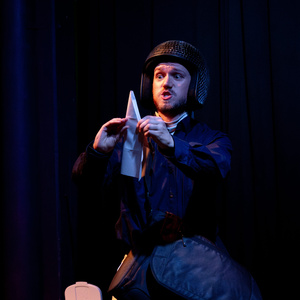
What he does have is enthusiasm and a love of giving people things. One errand involves the moon landing, and the flag that has to get there. The rest is a similar order of silliness.
Willinder has been doing the show for about eighteen months. Tech in Edinburgh went smoothly, and the run is twenty-four performances with one day off a week.
A two-person show disguised as a one-person show
He is alone on stage for the entire hour, pulling in audience members. That description is still misleading, and he corrects it himself. Melissa co-created every part of it with him, from nothing.
She also runs the tech, which makes her a live scene partner. He designed all the sound, and the cues fire at specific live moments. His original brief to her was unusually direct.
I told her I wanted to make a show that feels so vulnerable for me that you also feel vulnerable.
She was immediately in. He is unambiguous about how much he depends on her running it.
I don’t trust anyone else to tech it.
He values that her brain works nothing like his. They agree on what matters and disagree on how to get there. He says that keeps both of them alive on stage.
The helmet and the funeral song
They found a new game in rehearsal the same week we spoke. Eighteen months in, that surprised both of them. It attaches to a moment where an audience member is killed off, entirely in pretend.
Melissa suggested underscoring the death with Taps, the American funeral bugle call. Then she went further and built it into a mechanism. When he removes his helmet and holds it to his chest, she plays it.
When the helmet goes back on, the normal music returns. Which means he can now trigger it whenever he likes. The point is having one more thing to spring on each other nightly.
Audience participation, handled carefully
There is a great deal of participation, and it starts almost immediately. He loves it as a performer and finds it stressful as an audience member. So he offers a disclaimer, then withdraws it.
The show was built for people who love participating and people who do not. He is genuinely grateful that anybody turned up at all, paid or comped. Respecting their time is the stated principle.
If somebody looks remotely uncomfortable, he steps back and gives them room. His one boast concerns the people who arrive dreading it.
I usually don’t like audience participation, but by the end of the show, I really wanted to play.
Hearing that is close to the whole objective. It is the sentence he has been building the show towards.
Friendship, and a naive dream
The theme underneath the postal deliveries is friendship. The show came out of a stretch of years spent travelling and meeting people. Some of those connections lasted and some were brief, and both mattered.
What he and Melissa wanted to make was something about human connection. His ambition for it, which he calls naive, is specific and small.
He wants somebody to interact with a stranger and make a friend. He would like to run into that person a year later and be told about it. He describes that as the greatest thing he could hear.
Kobolds, gibberish and an electric plunger
The Kobold Show is his other Edinburgh commitment, as one of five. It mixes Dungeons & Dragons with clowning. He has played the game once or twice, so he arrived as the clown rather than the expert.
Kobolds are small gremlin-like lizard creatures, normally disposable villains for heroes to fight. Here they are the heroes, climbing a tower to get a wish granted. The entire show is performed in an invented kobold language.
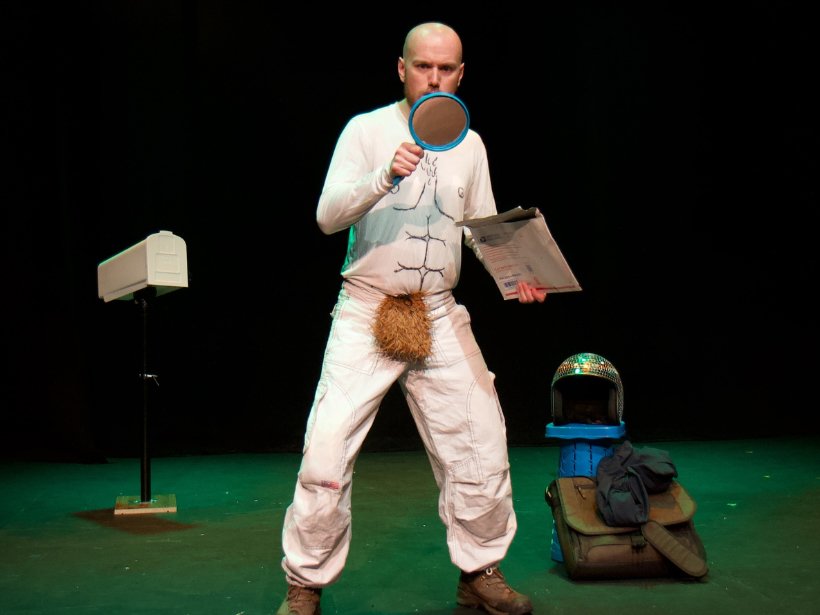
That forces a particular kind of playing. Nobody fully knows what anybody else is literally saying. Everyone has to be extremely expressive and simple, as you would be with a small child.
His character is Trindle Shanks Jr., the smart kobold, equipped with gizmos. One early sequence has the group stuck at a door. The strong kobold offers to force it, and Trindle insists on using his brain.
He produces an electric plunger from his bag and attaches it to the door. He believes it is a genius idea. It is not.
Yeah, just being, like, an idiot. It’s great.
The cast is split between Scotland and the United States. Almost all rehearsals happened over Zoom and Discord until days before the festival. Three Scottish performers already knew each other, which he says removed several moving parts.
Tim and Eric, Nathan Fielder, SpongeBob
His influences are, by his own description, weirdos. He grew up watching Tim and Eric with his father, mostly baffled. He rates Tim Heidecker for having a brain he will never understand.
Nathan Fielder is the other name, for committing absolutely to far-out material. Then there is SpongeBob, which goes back to the voices with his dad. He credits Tom Kenny and Stephen Hillenburg by name.
I wish life looked more cartoony like SpongeBob.
That is not a throwaway line given what he does for a living. His whole discipline is an attempt to make it so.
What is this show about?
A work-in-progress version came to the Fringe last year under a different title. It was substantially different, and there was a lot left to find. About a week into that run he turned to Melissa with a question.
What is this show about? Like, what are we doing?
Her response was to ask why he was raising it then. Long conversations followed, and a great deal was changed. He says they have had rehearsals that went existential and simply stopped.
The version playing this year is streamlined. The previews test a couple of things, and after that it is fixed. What varies is whatever the audience throws at him, sometimes literally.
Willinder describes his own show as really fun and really dumb. That is the pitch, and he does not dress it up. Underneath it is an hour built around friendship and human connection. It came out of a few years of travelling and meeting people. His stated dream for it is almost embarrassingly modest. He wants somebody to make a friend in his audience. He would like to hear about it a year later. That is a lot to ask of a postman sketch. The audience participation is the mechanism, not the gimmick. He appears entirely serious about it.
Time Travel Postman runs at the Edinburgh Festival Fringe from 5 to 31 August. There are twenty-four performances, with one day off a week. Willinder also appears in The Kobold Show.