
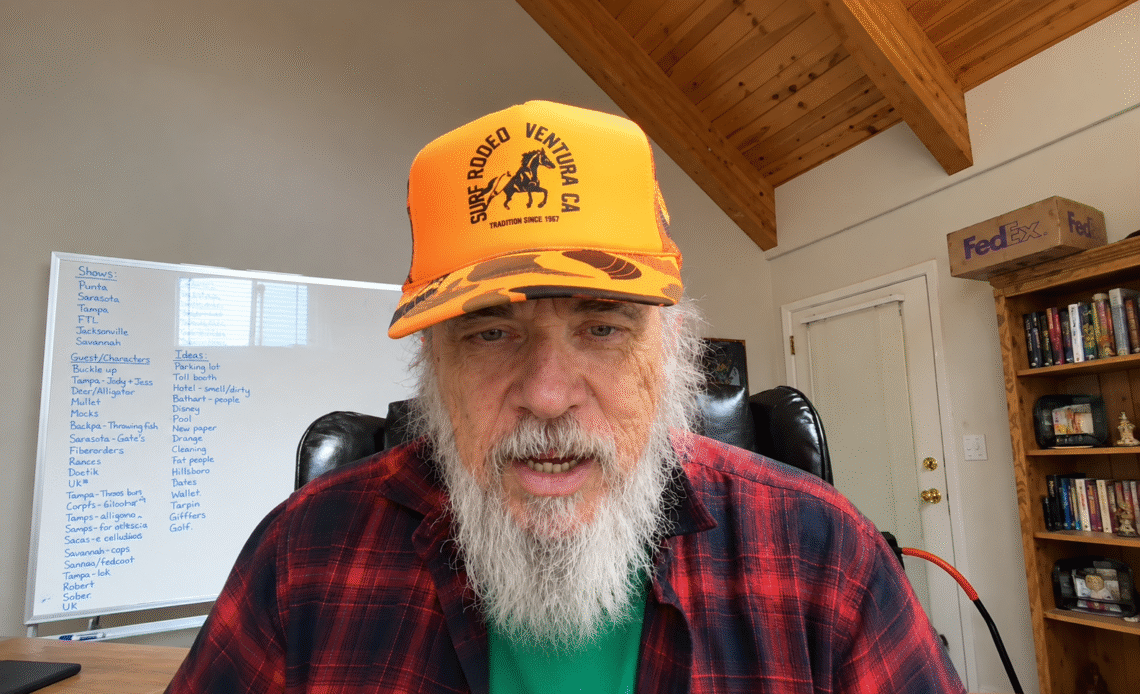
Larry Charles grew up in Brooklyn and dropped out of both college and film school. He started by selling jokes, then wrote sketches for the live show Fridays alongside Larry David, where he first worked with Andy Kaufman. A year writing for Arsenio Hall ended in him being fired, and he was on the Seinfeld staff the next day. He became one of that show's defining writers, won an Emmy for it, and later ran the room on Mad About You. From there he moved into film and directed Masked and Anonymous with Bob Dylan, Borat, Bruno, The Dictator and Army of One, along with the documentary series Larry Charles' Dangerous World of Comedy. His memoir, Comedy Samurai, came out this year.
Larry Charles has spent close to fifty years inside comedy, and he will tell you flatly that nobody, including him, knows why anything is funny. He wrote Seinfeld episodes that fans can still identify without checking the credits. He directed Borat sitting on the floor of an ice cream truck next to a chained bear. He stood on an unlit street in Liberia at night and asked a former warlord what human flesh tastes like. And for most of his early life, he was too self-conscious to get through a stand-up set without throwing up first.
How Seinfeld got written by people who did not know how to write a sitcom
The famous Seinfeld whiteboard was not a system, it was more of a survival tool. “The whiteboard was very important because we were not organized people,” Charles says. He and Larry David had come out of sketch writing, where a piece stood alone and connected to nothing. Sitcom scripts needed structure, and neither of them knew how structure worked. “There was no school to show you how to do it. We were kind of groping for what a structure is, and we really didn’t like sitcoms.” The early episodes ran on one principle: what is funny to us.
That principle has not changed in five decades. “There is no right or wrong when it comes to comedy. There’s only the laughter.” You can learn structure and rules, he says, and none of it guarantees a laugh. The real process starts in childhood: a thing said a certain way gets a laugh, the laugh reinforces the instinct, and the instinct eventually runs without conscious thought. It never gets easier. “The more you know, the more you suffer,” because the more comedy you have absorbed, the more often you catch yourself recognising that something has already been done.
If the funny part is instinct rather than craft, then a director’s job is mostly about protecting other people’s instincts. Charles does not treat his own imagination as the ceiling. “My imagination can only take it so far, and then you want to hope that somebody like Michael or Sasha can take it to that next level.” Borat worked because Sacha Baron Cohen had lived inside the character for years. “It wasn’t just the mustache or the suit or the accent. He knew what underwear Borat wore and what kind of socks and what he had in his pockets.” Aladeen never got that runway. The script came from other writers, and Cohen had a couple of months rather than four or five years, so he worried about the accent and the costume instead of the fundamental question. “He never really solved the problem of who is Aladeen.”
If the idea of a performer not knowing why they’re funny interests you, Sevrin Willinder only found out he was a clown because someone else in the room spotted it first.
Why stand-up scared him more than a Liberian warlord
That faith in instinct came from somewhere uncomfortable. Charles never wanted to be on stage. Alone up there his voice tightened, so selling jokes became the workaround. His taste was formed in the late sixties and early seventies, “a very fertile time for comedy” full of rule breakers. The Fireside Theater made surreal records out of voices and sound effects. Andy Kaufman went on stage actively trying to make audiences angry. Charles was hooked on the ambiguity, “where you weren’t sure if it was supposed to be funny or not,” and wrote Fridays pieces that denied the audience a big laugh. His father had been a failed comedian, and part of him still wanted the room on his side. He wanted to alienate people and be loved by them at the same time, and that contradiction became his sense of humour.
Decades later, the same instinct for discomfort sent him somewhere most directors would not go. Dangerous World of Comedy depended on going where other people would not. “Anybody could go to France, but I want to show that only we could go to Somalia.” Turkey produced the worst trouble, none of it in the final show, after questions about censorship brought people around demanding the tapes. The interview he had wanted for fifteen years was General Butt Naked, the Liberian warlord he first saw profiled in Vice. It happened on a dark street at night, hours after his plane landed, with a crowd gathering in the shadows and one security guard. His first question was what human flesh tastes like. Barbecue pork, he was told.
None of that frightened him as much as an audience does. Charles stays calm in physical danger and credits Brooklyn for it. What terrifies him is a microphone. “I used to throw up before I would go on stage quite often.” Winning awards was worse than losing, because winning meant speaking. The year he and Elaine Pope won their Emmy, they had Jerry read the speech.
The moment that redirected everything was similarly undramatic. By 1990, Charles had gone six months without getting a joke on Arsenio Hall. His contract was ending, he had a baby, and he was walking the Hollywood Forever Cemetery next to the Paramount lot wondering what else he could do with his life. Standing outside a trailer with a cigarette, asking for a sign, he watched Jack Nicholson drive slowly past, sunglasses on, Lakers cap on. Charles was wearing sunglasses too. They looked at each other, both burst out laughing, and Nicholson said three words: “Yeah, it’s funny.” Charles read it as a message about detachment. It is all a game, so relax. He was fired shortly after, and Larry David called the next day about Seinfeld.
“No hugging, no learning”: the rule that shaped Seinfeld
Seinfeld gave that sensibility somewhere to live. The formula Charles was reacting against had a fixed shape: characters misbehave, everything resolves, everyone hugs and learns something. Seinfeld was the negative of that. Things do not work out, people pay a price, and there is no redemption, “because life is often without redemption.” Audiences got the catharsis of watching people behave selfishly, occasionally getting punished, never improving.
He applies the same logic to film, including his own. The Dictator’s redemption ending was a struggle for him. “The great comedy movies, the main character doesn’t learn anything at the end.” Borat ends as delusional as he began, and Clouseau does not get smarter in the sequel. A comic character learning a lesson reads as a false beat, and audiences feel it.
Writing that way is hard to do by committee, which is why he has a ready comparison for AI. The Mad About You room, he says, was AI before the technology existed: fifteen people synthesising ideas into one flavourless product. “It’s not idiosyncratic, it’s not personal, it doesn’t have the passion, it’s basically derivative of other things.” He would rather be handed the script and left alone than manage fifteen personalities who disagreed with each other. The one advantage he grants the machine is that it does not argue back.
The film work stripped things down even further. Borat and Bruno were shot without the standard apparatus. “Not once on Borat or Bruno did I ever have a chair. I never had a trailer.” He sat on the floor, often hidden, sometimes for hours, because these scenes could not be broken into short takes. The Bruno campfire sequence ran about eight hours without stopping. What made it worth it was the performance. Cohen stayed in character all day, inches from real people, with no cutting and no way out when someone got angry. Charles calls that Oscar-worthy as a technical claim rather than flattery.
His own equivalent skill is what he calls channeling. Working with Bob Dylan, he would take a brilliant monologue attached to nothing and build a scene around it so seamlessly that “you couldn’t tell where Bob’s words ended and my words began.” He did the same with Larry David, with the poetic dialogue of The Tick, and on Entourage. The mechanism he cares about throughout is tension: build it, then release it. When the bear is real and the crowd is hostile, the audience feels something that cannot be faked.
If tension is what makes a gag land, Hannah Ponturo takes it further: the joke and the horror are the same thing.
The fights with studios, from the six-hour Borat to the buried Larry David film
Everything he protects on set, the studio tends to shorten afterwards. Roughly a million feet of film was shot for Borat. Charles cut a six-hour version and believed in it as “a one-of-a-kind document.” The studio was never releasing that, and the theatrical cut came in at 86 minutes. Once the film was a hit he wanted the long version out as a gift to the audience, with the money already made. Cohen disagreed and the studio was protecting an asset.
On Army of One he was thrown out of the editing room, the shortened release failed anyway, and he has since posted his own cut and disowned the theatrical one. Underneath these fights is a disagreement about plot. Executives want one, and Charles argues audiences do not. “When you’re servicing a plot, you are guaranteeing that there’s going to be long stretches where it’s not funny.” Larry David’s compromise was the only acceptable version: have a plot, but make the plot as funny as everything else. He extends that to performers told to dumb down their sets. Pandering registers collectively, audiences disengage, and the show is forgotten on the way out.
What he is defending, in the end, is emptiness. Charles resists the standard description of his best-known show. Seinfeld was not about nothing. It was about nothingness. He compares it to the Abbott and Costello show and its Beckett-like emptiness: the characters accomplish nothing, go nowhere, and apart from Kramer none of them is looking for meaning. That is why he keeps returning to Buster Keaton, who refuses cheap emotion and learns nothing by the end. Chaplin traded in sentimentality. Keaton simply risked his body.
He is clear-eyed about his own context too. American comedians can say almost anything, and he thinks that safety breeds complacency. Hearing that comedy clubs in India have been attacked over jokes about the government, he draws the uncomfortable conclusion: where speech still costs something, people are listening, and that pressure fuels the comedy.
One piece of his own work is still being kept quiet, and it is not the government doing it. Charles made a documentary about Larry David that HBO has never released. He does not own it, HBO does, and David is too valuable to the network for his objection to be overruled. “If he doesn’t want it to come out, it’s never going to come out.” He says he has moved on, though he would still recut it to restore material he took out at David’s request. His argument is simple: with Curb finished, audiences would find the real person more interesting than the character.
Watch Larry Charles Talk About His 40 Years Comedy Career