

Blake J. Harris is the author of Console Wars, about the battle between Sega and Nintendo, and The History of the Future, and now Emperor of Nothing: The Making of Larry David, a biography written over six years of conversations with Larry himself.
Blake J. Harris never wrote down a single question in six years of talking to Larry David. “I just talked to him,” Harris told us. The result is Emperor of Nothing, a 550-page book that covers 75 years of Larry David’s life. We talked about how it was written, what Larry taught Harris about storytelling, and what the Seinfeld finale got wrong.
Jump to: The email that started it · Writing it like a movie · From commodities to Console Wars · The premise has to be funny · Fixing the Seinfeld finale · A Seinfeld nerd
The email that started it
The book began with an email in August 2020. Harris pitched it as something other than a typical biography. “I thought of it more as a biography of his work, which I know made him feel a little better because he thinks he’s has a boring life.” It would be an ensemble story, with Larry David as the protagonist and the people around him, from Jeff Schaffer to Alec Berg, as part of the cast. “It took the spotlight off of him a little bit.”
Did Larry know what he was signing up for? “I don’t think he would have if he knew up front that it was going to take six years,” Harris says. “But it was a slow gradual process.” Harris’s approach was simply to keep it interesting for him. And Larry was relaxed about the deadline in a very Larry way. “So many of my conversations with him he would say you know if you if you don’t want to finish the book that’s okay with me.”
Writing it like a movie

Harris wanted readers to feel they were living through Larry’s life without knowing how it ends. “I want to write narrative non-fiction where you feel almost like you’re watching a movie,” Harris says. “He was really a 25-year-old guy who was worried that his life wasn’t going anywhere. And I think a lot of us can relate to that feeling.”
“He’s definitely his own worst enemy throughout much of the book.”
Blake J. Harris on Larry David
The structure borrowed from Mad Men. In most biographies the subject is on every page. In this one, there are sections Larry is not in at all, including a 12-page chapter on Jerry Seinfeld, the origins of the Improv and Catch a Rising Star, and the detail that the Improv’s temporary piano player in its early days was a guy called Dusty, who turned out to be Dustin Hoffman. “That’s what I want in a book,” Harris says: single characters used to tell the larger story of an industry.
It also changed how Harris saw the history of the form. Stand-up, it turns out, barely existed as its own thing before the 1960s. When Larry first went to open mic nights, “it wasn’t just for comedians. It was for singers and all these other, you know, jugglers.” Harris thinks that if Larry had been born 20 years earlier, he would not have been a comic at all.
Harris writes with an imaginary reader in mind: a grandmother who knows nothing about the subject. The goal is a book that reads “almost like a summer beach read, but the material can be dense”.
From commodities to Console Wars

Harris’s own route into writing was not quick. After college came eight years trading sugar, coffee and soybeans, from 6:30 in the morning until 2:15 in the afternoon, followed by screenwriting with a partner that never sold. Around turning 30, Harris accepted that writing might never pay. “But I also realized that I just love writing. So I’m never going to stop writing.”
So Harris wrote something purely for joy: the story of Sega versus Nintendo. In January 2012, Harris met Seth Rogen and Evan Goldberg, who signed on to write the foreword and develop an adaptation. “I remember calling my wife and saying like, ‘Oh my god, my life has changed.’ And four days later, I was back at the finance job trading commodities.” The book, Console Wars, did change everything. Since leaving finance, Harris has worn shorts every day, even in the Colorado winter.
The screen version had a rocky path. A documentary got into South by Southwest in 2020, and a TV series was due to be announced there, until COVID cancelled the festival. The series never happened and the rights went back to Harris.
The premise has to be funny

One of the most useful things Harris learned, especially for stand-ups, is how Larry thinks about comedy. “It’s so premise driven, which is not how most comedy is,” Harris says. “Most comedy is riffing and making jokes, and there’s nothing wrong with that. That that’s funny. But for for Larry, the premise itself has to be funny.”
“The dialogue writes itself if the premise is funny.”
Larry David’s rule, as told by Blake J. Harris
In the early Seinfeld episodes, before Larry was officially running the show, he gave the actors line readings, because some lines lead to others and the punchline has to land at a specific pace. Curb Your Enthusiasm went the other way. The scripts are detailed outlines, 14 pages for an episode in the final season, and the dialogue is found in improvisation. Harris once asked Larry whether he would want the finished dialogue handed to him in advance. “He said I would not do the show,” Harris says. The fun is the discovery.
“He just loves figuring stuff out.”
Blake J. Harris on Larry David
Larry’s favourite Seinfeld episode, Harris says, is not one of the famous ones but “The Busboy”, one of the least popular. It was the first time two separate storylines collided and paid off at the end, and it shaped how he wrote from then on.
Larry Charles wrote for the first five seasons of Seinfeld. Read our interview with Larry Charles for the view from inside that writers’ room.
Harris saw the same streak when Larry wrote all ten episodes of the Producers season of Curb before he ever asked Mel Brooks for permission. Why not ask first? Larry told Harris he had to write what was in his head.
“There’s almost like a certain purity that he has to write with.”
Blake J. Harris on Larry David
Fixing the Seinfeld finale
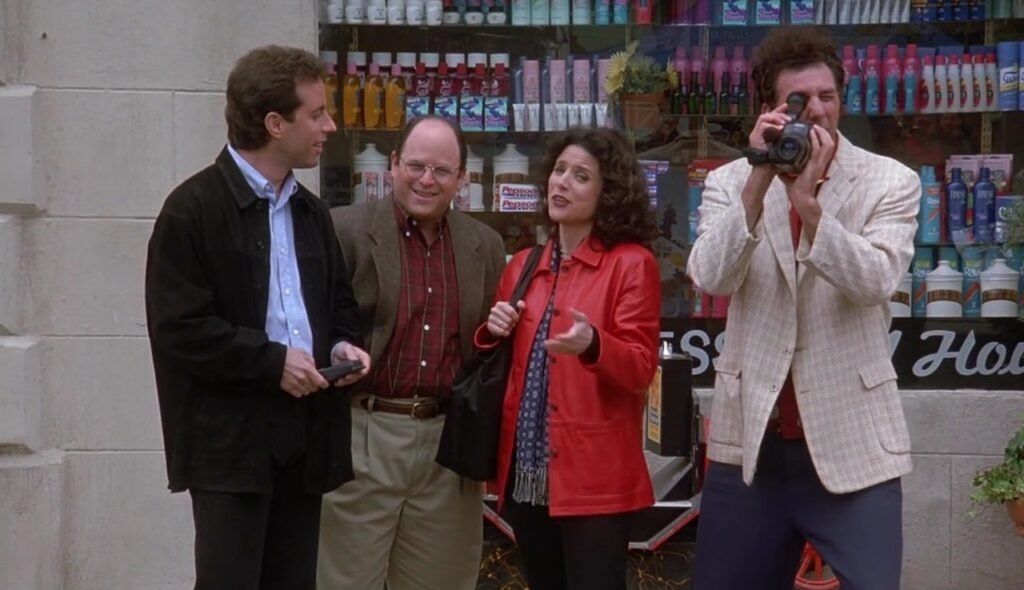
Harris thinks Larry was always a better storyteller than stand-up.
“I think above all else, Larry David is just a great storyteller even more than he is a great comic.”
Blake J. Harris on Larry David
So it is fitting that the biggest story in his later career was a correction. The Seinfeld finale, made after Larry had left the show, gave all four characters one single story, and left them sitting passively in a courtroom.
Harris told Larry something that Larry agreed with: in nine seasons, the four characters had never all agreed on anything, yet in the finale they all agreed to mock the man being mugged. Decades later, Larry and Jeff Schaffer rewatched the finale for the first time in 24 years and used what they saw to write the Curb finale. The episode is called “No Lessons Learned”. “The existence of that episode and the fact that it corrected the wrongs of the Steinfeld finale is the lesson learned,” Harris says.
Leaving Seinfeld after season seven is the part Harris still cannot get over. If someone offered to finish Emperor of Nothing for a million dollars, Harris says, the answer would be no. “It was my baby like it needed to be written by me. So I can’t believe that he actually walked away from Seinfeld.” Larry later described going back to record George Steinbrenner’s voice in season eight as being like “watching someone else raise your children”.
Even Larry’s own success stories come with a catch. Every story he tells about himself, Harris says, ends with him undercutting it, like a Curb episode with a little cloud in the sunshine.
“He can’t allow himself to win in his mind.”
Blake J. Harris on Larry David
A Seinfeld nerd
Harris was not a neutral biographer. The high school yearbook quote was from Seinfeld. Every episode went on VHS. There was a party when the show ended, and the college admissions essay was about May 14th, 1998, the night Seinfeld ended. “I can’t believe in retrospect I got into college that somebody actually took me seriously.”
Asked for a Mount Rushmore of books, Harris named Dave Eggers’ A Heartbreaking Work of Staggering Genius, for showing how to break the rules with serious subject matter, the writing of Bill Simmons, Jonathan Safran Foer’s Everything Is Illuminated, The Disaster Artist, James Andrew Miller’s oral histories, and memoirs by Tina Fey and Amy Poehler.
Curious how working comedians write? See how comedians write their jokes.
And Larry, at 79, is still at it. Harris had dinner with him recently, and he is working on something new.
Follow Hop For Pop at @hopforpop and @thecomicsunseen. For more on Larry, read our interview with Larry Charles, and browse all our interviews.