
“Don’t get mad, get funny.” That’s more or less Judy Carter’s whole philosophy, and after decades of teaching comedy to comics, CEOs, and at least one Harvard Medical School dean prepping for a TED Talk, she’s earned the right to say it simply.
She didn’t just write a book about stand-up comedy. She wrote two, presumably because the first one made too much sense and needed a sequel. A startling number of comics you already know learned to build a joke from her pages before they ever built one on stage. So when we asked her how she thinks about crafting a punchline, we weren’t expecting a short answer, and we absolutely didn’t get one.
She walked us through why misery is comedy gold (“comedy is tragedy plus time”), why she thinks roast comedy has curdled from Don Rickles charm into something closer to punching down for sport, and why Chris Rock had to quietly retire his entire act, study old comics at a television museum, and rebuild himself from scratch before he became Chris Rock.

She broke down Joan Rivers’ obsession with laugh density, one laugh every ten seconds, sometimes every three, and explained why the least confident person in the room, ironically, usually kills it on stage. Oh, and she also helped write jokes for a presidential campaign. Yes, really.
By the end of this one, you’ll understand why she opens her own website with the line “humor is a superpower.”
Bring snacks for this one, it’s a ride.
Emphasising the power of first laugh on stage. What was your first laugh like, in a room full of strangers?
I think I got my first laugh making jokes about having a speech impediment. When you do a joke about something that’s wrong with you — something you might have a lot of shame about, like being made fun of because you have a stutter or you can’t pronounce words — and then you make the joke about yourself, it’s not only this feeling of being accepted and loved, because when people laugh it’s like love.
They’re saying, “We agree with you. We’re open to you. We love you.” It’s also a healing that happens. In The New Comedy Bible I tell people that what’s bad about your life is good about comedy. We take the bad things about our lives, we make a list of them, and then we go, “Now, what’s funny about that? How do I find the funny in that?” That’s how it happens, and that’s how your act becomes original.
You wrote in The New Comedy Bible that the more miserable you are, the funnier your act can be. Can you unpack that?
There’s a saying, “Comedy is tragedy plus time.” Now, when something terrible happens to you and you’re sobbing, that’s not the time for someone to say, “Hey, find what’s funny about it.” You’ll probably want to punch that person in the face. What you want to do is give it some time, go to therapy, deal with it. But then there comes a point — let’s say you have a terrible breakup and you’re just crying all the time about somebody who broke your heart.
Then you get a laugh on stage and it’s so good, because the whole audience is taking your side. When I would do a joke, “Oh, we had one thing in common. We were both madly in love with him,” I’d get a laugh, and it’s the truth, and now I can move on. When you can laugh at whatever your problem is, it’s a way for you to move on emotionally from it. The laughter is revenge — and if you’re getting paid for it, that’s the best.
You’ve said that everyone should know comedy because it makes them a more confident person. Where did that idea come from?
Everybody wants to be funny. I’ve worked not only with stand-up comics but with CEOs of big companies, the head of Harvard Medical School who wanted to do his TED Talk, politicians. The biggest fear we have of getting up in front of people and talking is that we’re going to bore them to death. Nobody wants to be boring.
If you learn a couple of little stand-up techniques to get laughs, it means the audience is listening — they’re there with you. When you present an idea and it’s funny, that’s what politicians do. In the last US election I had a whole group of people gather to write jokes for Kamala Harris, and we got some great joke placements into her speech. When you’re funnier you get more followers, more hits on social media.
That’s why at the top of my website, judycarter.com, I say humor is a superpower — because it just cuts through all the BS.
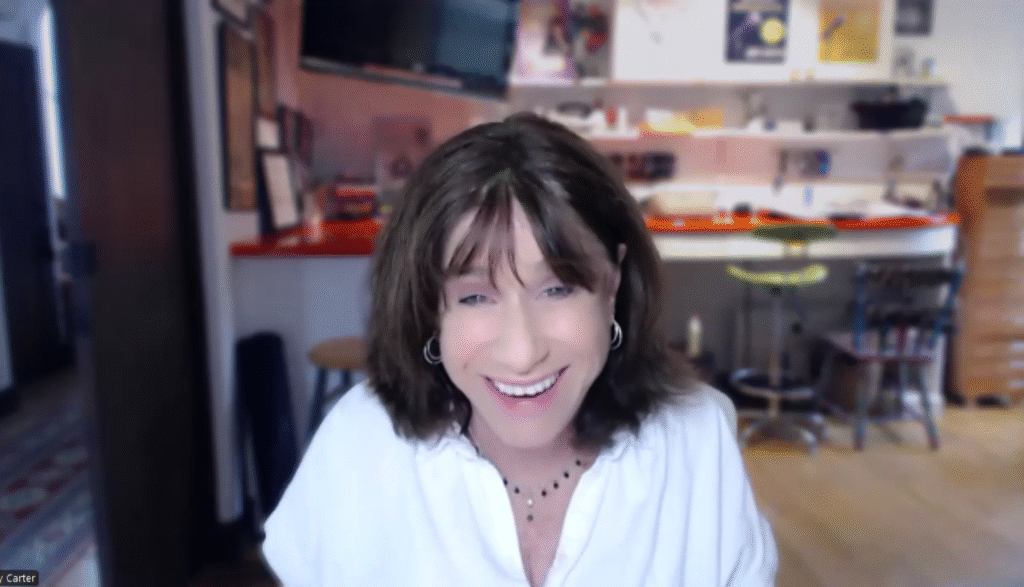
You’ve written that if you try to figure out what everyone finds funny, you can never be a good comedian — you have to find what YOU find funny. How does one discover that?
As you go through the day, look for funny things. If you look for things that don’t work — “Oh, these potholes in the road, I’m just so angry” — you’re going to find them. I say, don’t get mad, get funny. Go through your day, take pictures of funny signs, take pictures of things you find weird or stupid.
Then you’re looking at life the way a stand-up comic does. It’s healthier for your mental health when you find the funny. And you’re lucky, because now you can just broadcast them with your phone. You’ll start to get followers. People go, “I heart that. I like your material.” You’ll see — oh, when I talk about my dog and how I love my dog too much, everybody loves me.
And when I talk about how much I hate my father, I’m not getting as many. So you go, maybe I should focus on being a dog lover. That’s how you start finding your audience. One of the biggest mistakes in the creative process is people censor themselves too soon. You get an idea and the inner heckler in your head goes, “Well, that’s a stupid idea. No one’s going to like that.” That’s for later on. In the beginning, you shouldn’t be censoring yourself. You need to find all the things you find weird or stupid or scary or funny, and then you’ll find your people.
Crowd work is very popular right now. Does it require practice, or do you have to be naturally funny?
Crowd work is very hot right now. One of my favourites is Nate Jackson. For anyone unfamiliar, crowd work is where the comic departs from their prepared material and just goes — “Hey, where are you from? What do you do? How long have you been married, sir?” They narrow in on somebody, and in that conversation they start getting laughs. Jessica Kirson’s career blew up because she started posting from the Comedy Cellar in New York — a tiny club that holds about 30 people. She’s brilliant at it.
It’s an act of courage: you ask a question, and maybe you have something funny to say, but maybe you don’t. Then a conversation starts and the tension builds — when are you going to throw a zinger? How do you learn to do it? You just do it. You do it at open mics. The other thing I highly suggest is take an improv class — improv teaches you how to go into characters, how to be present in the moment.
Jimmy Carr uses the technique of repeating the audience’s answer back to buy himself time. Is that a deliberate craft move?
Yes, repeating is a very good technique. First of all, if someone in the front row says something, half the audience didn’t hear it. By repeating it, everybody hears it. And by repeating it, you also give yourself time to think of where you’re going. It’s a delay tool.
Roast comedy — Don Rickles was the king. Do you have to be inherently charming and lovable to pull it off?
It used to be that way. Now Jeff Ross is the roast master and he’s brutal. It’s changed. I think because the US president is such an A-hole, so awful and so mean, roast comedy has changed. That idea of having to be likeable and lovable is gone. It’s just become brutal. If you saw the roast of Kevin Hart, it was brutal — lowest common denominator, nothing charming about it. I’m not a fan of it. I’m not a fan of punching down.
I think roasting is inherently a guy thing. Guys grow up going, “Screw you — hey, let’s have a beer.” Women are more sensitive about fairness. I can’t laugh if I feel something’s not fair. So if people want to learn to roast, I’m not the girl to teach them.
Tony Hinchcliffe made a joke about George Floyd at Kevin Hart’s roast. That was a moment where even dark-comedy fans said too far. What’s your take on that trend?
What’s going on now is people going, “How can I out-shock the next person? That’s how I’m going to get known. I’m going to say something so shocking that it’s going to go viral.” It’s working for a lot of people. I’m not going to say it’s not an effective tool to get noticed — but it’s just not my thing. As comedians we all have to go with what feels right for us. I’m about uplifting people.
I am about putting down people who really deserve it, and not punching down and I’m not going to make fun of a disabled person. It’s just offensive to me. The comedians I do love are people like Wanda Sykes — she does a lot of personal stuff about her own family, a lot of anti-Trump material. Comedy is personal now: who are your people? Who are you going to attract? You can’t make everyone like you.
Ricky Gervais does punch-down comedy but seems to get away with it. Why do you think that is?
If they have an English accent, I guess. It’s just not my thing. It’s too easy. Here’s the thing with comedy: sometimes when you see what a comic is doing, rather than the passion or the meaning behind it, they’re doing it just to shock, to get a reaction. I go, “Well, why don’t you do something to get my reaction because you’re telling me something insightful, or something deep, or something to wake me up, or something to get me to laugh at something I’ve been crying about?” When you can do that, you’ll have my respect.
Physical comedy — Charlie Chaplin, Richard Pryor — used to be foundational. Why is it dying out?
There are still people doing it. One of the funniest things I’ve ever seen is an old Steve Martin magic act where he just pulled everything out of his crotch. Mike Birbiglia does long-form storytelling stand-up in theatres — he’s a genius and he acts a lot of it out. It’s more of a theatre piece. But I do agree with you: I love physical comedy, I love when people add things to their act — dancing, movement — and you just don’t see it enough.
If you’re a comic starting out now, that’s a way you can end up with a special, noticeable brand: by adding one of your other talents to it. There’s a lot of pressure to just do what everybody else is doing.
You’ve talked about the density of laughs — the laugh-per-minute rate. What do you mean by that?
I posted something on Instagram once saying you need a laugh at least every 10 seconds, and a lot of comics went, “That’s impossible.” Then I found Beth Stelling, who gets a laugh every three seconds. We put it up with a time clock: laugh, ba, ba, ba, laugh, ba, ba, ba, laugh. That’s what it takes. Joan Rivers had one of the densest laugh rates ever. She had this genius of taking out every unnecessary word. A comic would go, “So there I was at the train station.” No — just “train station.” Foomf, everything else is out.
Every superfluous word taken out so she could get to the joke quicker. Then a quick setup, the punchline, and a surprise punch, and three more surprise punches. We call those tags in comedy. She’d do the setup, the payoff, tag, tag, tag, tag. Just when you’re about to throw up because you’re laughing so hard, she’d do something else.
Joan Rivers used to repeat her premise — “I hate her. I absolutely hate her. I hate her.” — and each version got a laugh. Chris Rock does it too. What’s the craft behind it?
Chris Rock will repeat his premise — and a lot of comics don’t even have a setup. If the setup pulls people in, like Chris Rock going, “You know what they say? Crack is ruining the ghetto. Yeah? Did you hear that? Crack is ruining the ghetto — like the ghetto was such a great place to live, and then crack came in and cleaned it all up.” He repeats the premise several times. Wanda Sykes does that too — and it turned out she wrote for Chris Rock.
Chris Rock’s own story is that he wasn’t getting anywhere in stand-up. He was middling and wanted to be a headlining comic, so what did he do? Stopped doing his act. He went and studied comedy and went to the museum of television arts and sciences and looked at all the old comics. Then he redid the way he did comedy — and he hit hard.
You’ve said that comedy can help someone become more confident. But how does a new comic even get on stage without confidence in the first place?
Here’s what I found when I was teaching comedy: the most confident person doing it for the first time — the one who was sure of themselves — didn’t do as well as the person who came in going, “I don’t think I can do this. I don’t know. I’m terrible. I’m not funny.” When you’re not confident, what you don’t see is that most people are not very confident. Let’s face it, it’s hard being a human. We’re all going to die. We’ve all faced tragedy and loss.
Confidence — having high self-esteem — is actually fake. It’s not real. I’ve never been a confident person, but I’ve always done things in spite of not having confidence, and then I’m always like, “I can’t believe I did that.” If you’re feeling unconfident and thinking you’ll wait until you are confident — that day is never going to happen. The time to do something is now. Today. Just take one action. Post something funny. Just do it. That’s how we become successful in life: not by waiting to be confident, but by taking little actions that add to our feeling of competency.
Hannah Gadsby has an unbelievable stage presence — she could recite a boring story for an hour and the room would still be locked in. How much stage time does that take to build?
Hannah is an interesting example. I did a tour of workshops in Australia, and she was one of the people I met. She is a very insecure woman — not one of these “I’m so confident” people. But she has something integral about her. There’s something whole about how she accepts who she is. She’s never fit into what it means to be a woman — she’s never been the classic beautiful, skinny, straight woman — and she doesn’t shy away from any of it. There’s an acceptance of who she is that is so compelling, because all of us are faking who we are. We’re all trying to make people like us.
We rearrange parts of ourselves to present the more likable part. Because of the way Hannah looks, she doesn’t have the heteronormative look — and she owns that. That’s why we can’t take our eyes off her, because we all want to be her. We wish we could just be accepting of who we are, even though we’re older, or we have stretch marks, or we’re overweight, or short, or too this or too that.

So many comedians have been inspired by your work. Who were YOUR comedy idols growing up?
As a little girl, of course, it was Lucille Ball. At my point there were no women out there. Talk about physical comedy — talk about her. I sometimes pretended I was her, and I think all of us funny girls kind of emulated Lucille Ball. She was so funny and goofy, and everybody loved her. She was willing to make herself look ugly and do stupid things, and that was such a breakthrough. In those days the rules for being a woman were so proper and tight.
That was my first look at, “Oh, God, she’s so funny.” And then Joan Rivers — she’d be on panel with Johnny Carson and I’d watch as a little girl going, “How is she that funny off the top of her head?” Later I found out that was all planned, but the magic was she made it look like I could have a conversation with her and she’d just be hilarious. I wanted a friend like that. When I started doing comedy, there were very few women on the road doing it. Those were the women who helped me have the courage to do it and gave me a path forward.
Tell us about your new book, Making Money Being Funny.
It’s called Making Money Being Funny — because when I found out that headlining comics were sleeping in their cars because they weren’t making enough money to afford a hotel room, I just thought, “There’s something really wrong with this.” I decided to find out: is it possible to make money being funny? There’s an old joke: what’s the difference between a comic and a pizza? A pizza can serve a family of four.
So I asked, who is making money being funny? And what I found was pretty shocking — it’s not the famous people. There are people who are in a niche of comedy. So I wrote a book to show people how to find their comedy niche, whether it’s being a Hindu comic, a Christian comic, a teacher comic, an engineer comic, a nurse comic. When you find that niche and you do the comedy for that audience, you can make millions.
And that’s Judy Carter, a woman who’s spent decades proving that your most humiliating moments are just punchlines that haven’t been written yet. She taught Harvard doctors and everyday open mic hopefuls the same lesson: the joke isn’t despite the misery, it’s because of it.
If you walk away from this remembering just one thing, let it be her math on confidence: the guy who thinks he’s terrible usually beats the guy who thinks he’s got it figured out. Comforting, honestly, for the rest of us mortals still afraid of the mic.
Go pick up Making Money Being Funny, and while you’re at it, take her advice. Stop getting mad. Get funny instead.
Listen to the full episode here: Judy Carter