


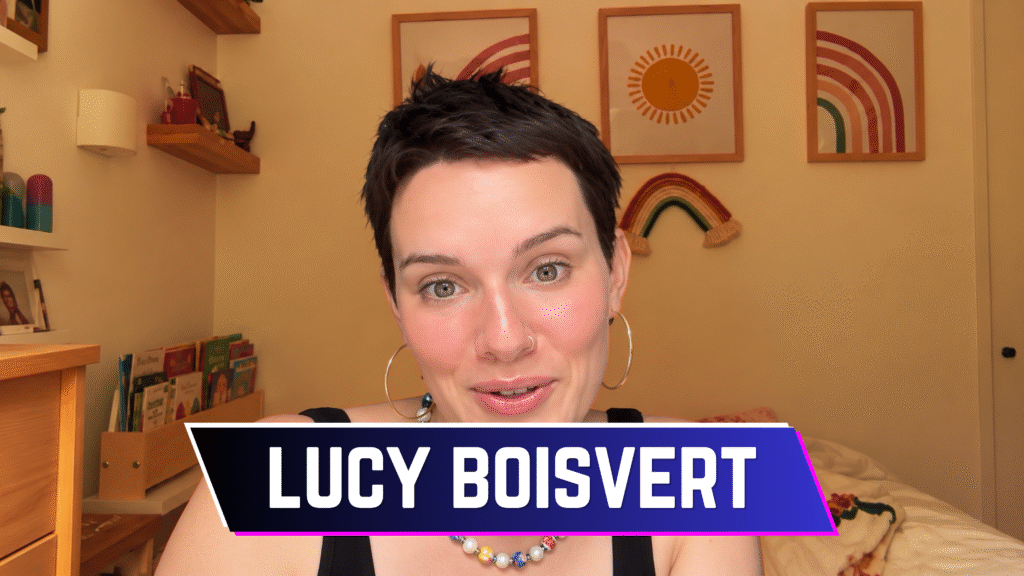
Lucy Boisvert is a New York-based writer, director and performer with Infinite Monkey Theater Co., where she works with her creative partner Fletcher Michael. She grew up in Alaska and rural Wisconsin, moved to New York at eighteen, and trained in sketch at the Upright Citizens Brigade and the Second City Conservatory. She co-wrote and directed Oops! We Lost a Nuke and performed in Did You Charge Your Phone for the End of the World?, both of which played the 2026 Edinburgh Fringe.
Lucy Boisvert has a view about creative block, and it is that there is no such thing. She has earned the right to hold it. With Fletcher Michael and Infinite Monkey Theater Co. she has put up around thirty shows in three years, and for one stretch she had three monthly sketch deadlines at once. When we spoke, shortly before she left for Edinburgh, she explained exactly how you write a joke on a day when nothing is funny.
A graduating class of eight
She grew up in Alaska and then in rural Wisconsin. “I grew up in a town of like 3,000 people. My graduating class from high school was eight people.” She was writing plays in early high school and staging them at a small local theatre by fourteen or fifteen. They were all serious, because she was a teenager. The first comedy came at seventeen: Mystery Crew, a Scooby-Doo parody about teenagers solving a murder, which she wrote and directed.
It ran for five performances in a converted church that held about seventy people, and most of them sold out. She is clear-eyed about why.
“That’s the nice thing about doing stuff in a small town. Nobody has anything to do. Even all the adults in the town are like, well, this is the thing that we’re doing.”
She remembers the thrill of hearing people laugh at her words, and has not got over it. “I’ve been hooked for a while on adults’ attention, and now I’m an adult and I still want adults’ attention.” She also found out early that she liked being in charge. “I love telling people what to do. I love directing for that reason.” The hard part was the other teenagers. She did too much of the producer’s job and annoyed the producer, and a scripted kiss had to become a kiss on the cheek because a younger cast member, whose father was coming to watch, said she could not do it. At the time she thought it was the most important thing in the world.
New York, and finding a creative partner
The move to New York, she says, “kind of started out as a lie”. At other people’s graduation parties everyone was naming their colleges. She had applied to one. So she gave different answers each time: Montana, a conservation corps, travelling. Then she started saying New York, it felt right, and she went, at eighteen, to do stand-up.
Stand-up turned out to be lonely. She wanted friends who liked the same things, so she signed up for sketch classes at the Upright Citizens Brigade. In those classes students read their writing aloud, and in one of them she and Fletcher Michael noticed each other’s work straight away. Liking someone’s writing is only the first stage, she says. Then you find out whether you can work together, and whether it lasts. She now writes either alone or with him, and with nobody else.
“He’s my creative soulmate, for sure.”
A friend recently told her, “I don’t have a Fletcher.” The two of them are different in useful ways. She describes herself as driven by having “something that needs to exist in the world so that it can stop terrorizing me and my brain”, with little sense of a longer timeline. He is the focused one. We spoke to Fletcher Michael the same day, and he said his whole method is working with people he trusts.
Her test of a good team is envy. She is a hard audience, she says, because she watches so much comedy. So when a friend’s work makes her wish she had thought of it, that is the highest compliment she has. “Everybody should be jealous of each other in a really healthy, lift-you-up way. I don’t want to feel like the funniest person in the room.”
“Creative block isn’t real”
Of her three jobs, writing comes easiest, directing second and acting last. Comedy writing was not always easy. What changed it was volume. Infinite Monkey’s sketch show Chimp Cocktail put up a new show almost every month for a year. At one point she was also on a house sketch team at UCB and studying at the Second City Conservatory, which made three sketch deadlines every month. “You get so overwhelmed that you just have to figure out how to do it.” She calls it learning to turn on the tap.
So when we asked about creative block, she did not hesitate. “I don’t actually think it’s real.” She has no patience for the myth of the writer who can only work drunk or miserable. “Nobody can only do their job when they’re drunk. That’s something that drunk people say.”
“The only way to be creatively blocked is to say, I have creative block. People aren’t getting construction block when they don’t want to go to their construction job. You just have to go to work.”
First drafts are bad, she says, and that is fine. You cannot improve something that does not exist. (Byron Bertram told us his own cure for a dry spell is other comedians, which is not far from what she and Michael do in a room together.)
How to build a joke from nothing
Her proof is a line in Oops! We Lost a Nuke that she is especially proud of, and that arrived in the least natural way possible. The script had a gap. A character says she has just been in a hoarder’s basement, “and down there I saw…” and then nothing. They needed a joke, so they sat down to make one.
They began by saying anything. Michael offered “a bear’s ear”. Everything was, in her words, embarrassing. Then they got methodical. What is in a basement? What would be in a basement in the 1950s? A foosball table. What kind of foosball table? Scary? Haunted? Eventually they reached it:
“I saw the most sexist foosball table I’ve ever seen.”
“How could you tell it was sexist?”
“Well, there were only men playing the tiny soccer. And not one of them asked me what I think.”
“We started from a place of, we need a joke,” she says. “It’s not always fun. Sometimes you just have to make a joke appear.” Others come faster. A character turning down breakfast needed a reason, she started the sentence “I really only eat…” and Michael finished it at once: “medicine”. He thought it was stupid. She put it in. If you want the mechanics, we have a guide to the setup, the punchline and the tag.
Oops! We Lost a Nuke: four characters, two actors and some puppets
Oops! We Lost a Nuke was her first time directing a play. “It is an exhausting show, and I mean that in the most loving way possible.” It is set in the 1950s and follows a married couple at the centre of a missing nuclear weapon, both of whom are having affairs. Between them she and Michael play both spouses and both lovers, swapping genders as they go, and in the final scene they play all four at once, in costumes split down the middle.
The decade was chosen on purpose. The two of them had wanted to do something with drag and gender-swapping for a long time, and the rigid roles of the 1950s gave them something to push against. “In order to make something fun for the audience, you have to set up something that is brittle enough to break.”
Staging it was a puzzle. A half-and-half costume only works from certain angles, and some characters can never face each other because they share a body. She rehearsed in rooms built for dancers so that they could watch what they were doing. Costume changes are covered by puppets, operated by Audrey Shaw and Collin Dennis, four each, and the play gives a reason for them: the radiation makes people see puppets. The physical style is big and cartoonish, borrowed from clown shows she and Michael have watched together. (Sevrin Willinder is one clown we interviewed at this year’s Fringe.)
Her taste for that world goes back to childhood. She was not allowed much television, but she had tapes of I Love Lucy and The Dick Van Dyke Show, with their big outfits and bright colours, and comedy that starts from a real relationship and pushes it into absurdity. She also watched the whole of the 1990s MTV sketch show The State on her father’s phone during long car journeys, years before she could follow it. Going back to it in her twenties, she realised it had formed her sense of humour.
The difference between stupid and funny
Both of the company’s Fringe shows rest on absurd ideas, so we asked how you keep absurd from looking foolish.
“The difference between looking stupid and looking funny is confidence. If you are doing a stupid thing and you are one foot out, you’re going to look stupid and cringy.”
Belief is half of it. The other half is structure and rhythm, which give the silliness something to sit on, so that the audience never starts worrying about the performer. “It’s no fun to watch somebody act for an hour, but it’s tons of fun to watch characters for an hour.”
She may go back to stand-up. She keeps a folder of jokes that are too small for a sketch or a play, and is working on ten minutes for fun. But she is honest about why theatre suits her better: “I like playing a character that’s not me.” Mark Ryder said the same, and CeeKay Brown, who does both, agrees that yourself is the hardest part to play.
You can follow the company at @infinitemonkeytheaterco on Instagram and at infinitemonkeytheaterco.com. For more from Edinburgh, see our Fringe coverage.
Watch Lucy Boisvert explain why creative block isn’t real
