
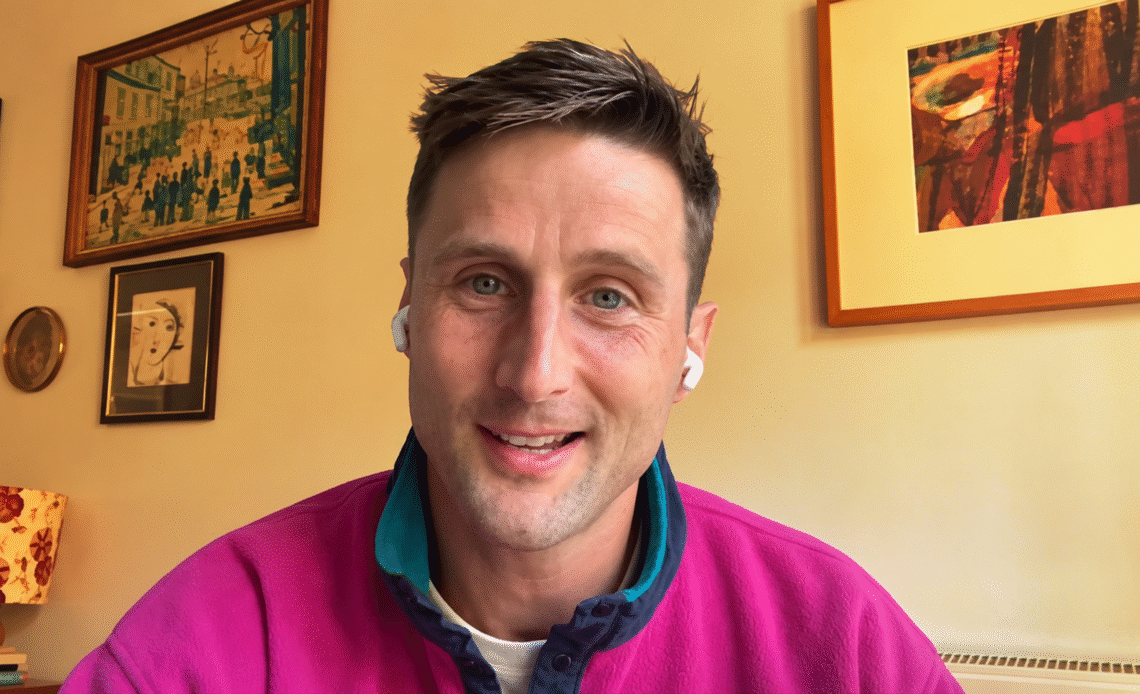
Mark Ryder is an actor and writer from Belfast, based in London. At eighteen he was cast as the young Liam Neeson in Five Minutes of Heaven, which won two awards at the 2009 Sundance Film Festival. He went on to play Cesare Borgia for three seasons of Tom Fontana's series Borgia, and has worked mostly in film and television since. He wrote and performs No Hard Felix, a one-man comedy about masculinity directed by Rute Costa, which ran at Just the Tonic at The Caves during the 2026 Edinburgh Fringe.
Mark Ryder had a place at university to study medicine. He was eighteen, from Belfast, and he had gone along to an open casting for a film called Cherry Bomb mostly because anyone could. He got a callback, and then heard nothing. So he sent the casting director an email to ask where he stood. He thinks that email may be the reason he is an actor at all.
The email that got him cast as the young Liam Neeson
The reply was a no. It also said: why not come down tomorrow and audition for a different film? He read for a very small part, was called back for a bigger one, and found out why. The film was Five Minutes of Heaven. Liam Neeson played the lead in his fifties, the story flashed back to the character as a teenager, and they needed someone who could plausibly be the same man.
“If I’d waited three more days and sent that email, my life could be so different. Maybe my entire career as an actor came down to this one email.”
He is frank that he had no technique. “I was so young back then that I didn’t really understand the technique of acting,” he says. What he did was watch videos of Neeson walking. “I watched his legs and just tried to feel how straight they were, how heavy his feet were.” The film won awards at Sundance, he got an agent, and he never went to drama school or to medical school. “I had one of those starts where it just happens completely by luck.”
His earliest stage memory is less dignified. As a boy in Belfast he was one of the basketball players at the back of a production of High School Musical, in a number where the whole cast had to bounce balls in time. Several of them could not. “There were basketballs flying everywhere.”
Tom Fontana, 5am, and learning to write about men
Screen acting, he found, is a strange job. You arrive for a couple of days, shoot, and vanish, and you might work a handful of days in a year, always on someone else’s schedule and with someone else’s words. He wanted to offer more than that, so he began to write.
He had a remarkable teacher. In his early twenties he was cast in Borgia, written by Tom Fontana, the creator of Oz. Fontana is in his seventies now, and Ryder says that for forty-five years he has got up at 5am and written, every day, whatever happened the night before. The lesson was about discipline as much as craft.
“Everyone has a little story they want to tell. But can you sit down and really get it done?”
Ryder’s own early efforts were, he says, “absolute crap. It really was.” He kept going: short films, then a web series. One subject kept coming back. “I wanted to write about men: what’s really going on in the hearts and the minds of men.” In particular he meant British and Irish boys and the laddish culture he grew up in, which in his case was rugby and the lads in Belfast.
No Hard Felix: a finance bro with a problem he cannot fix
That subject became Felix. He is a finance bro in the City of London who sees himself as an alpha male winning at life, and he has erectile dysfunction. However hard he works at being the man, he cannot fix it. There was no single model for him. Ryder would walk around the City watching how the finance men walked and thought: I want to play that guy.
Then he pushed it. His idea was that masculinity taken far enough “comes full circle” and starts to look like its opposite, the way bodybuilders posing or matadors do. And he gave Felix the one problem that would undo him. People often ask whether the show is drawn from personal experience. He says the character simply emerged.
The performance is broad and physical, and he names the source without hesitation. Asked how much Jim Carrey is in it, he said “quite a lot”: the faces, the bouncing around the stage, the silliness. Carrey is on his personal Mount Rushmore of actors, alongside Joaquin Phoenix, Daniel Day-Lewis and Jessie Buckley, whose performance in Hamnet he puts among the best he has seen. What he wants from all of them is humanity. Felix also has his own Instagram account, run in character, which Ryder says has had millions of views.
Underneath the clowning is a serious point. Ryder thinks men like Felix, the ones chasing money and power, do real damage in the world. He also thinks every one of them is hiding something. He mentions the photographs of Vladimir Putin bare-chested on horseback, and a documentary called The Work, in which men serving long sentences in a California prison speak about their feelings in group therapy, some for the first time in decades.
“Underneath those guys, I’m sure there’s parts of them that feel weak and feel sad and feel vulnerable. Every man has it, even the toughest, most powerful.”
The show is the story of Felix meeting that part of himself for the first time. Byron Bertram built his own outsized character, a Russian in a tracksuit, for very different reasons.
Why he chose comedy to say something serious
Given the choice, Ryder prefers drama. The parts of his own show that matter most to him are the poignant ones. But he has noticed that serious work about toxic masculinity, such as the television drama Adolescence, already exists, and that men themselves have said less on the subject than women have. He wanted to come at it another way.
Comedy, he says, opens people up. An audience that is laughing is with the character, so when the tone turns they are still listening. He tries not to separate the two into a funny section and a serious section. His aim is “to get everyone to come out a little bit softer, a little bit more open”, without preaching, and he wants people to have a good hour first. He is serious about the stakes, though. The pressure on men to seem strong is, he says, “what kills men, and that’s why we lose so many young men.”
We asked which was harder to write, the punchlines or his own insecurities. “Definitely the second one.” Those are also the scenes where, by his own account, he is at his worst in rehearsal: closed off, and shorter with his director. Jason Salmon’s rule for difficult subjects is that the humanity has to be the punchline, which is close to what Ryder is doing.
Handing your own script to a director
Ryder wrote the show and performs it alone, and he was clear that a third job would be one too many. He also felt that a show about masculinity, written and played by a man, should not be directed by another man. He asked Rute Costa, a director from Portugal.
“I had a draft and I thought, this is it. And she was like, it’s going to change so much. And I was like, nah, this is a masterpiece.”
It changed enormously. He admits he was “a little closed shell” at first and learned to give ground. His conclusion is one many actors resist: a good actor with a good director is better than a good actor alone, because left to yourself you fall back on habits. Two other performers told us much the same this summer. Irene Woo worked with a director on her debut hour, and CeeKay Brown is hiring one for hers.
Being alone on stage has its own character. “You’re just doing the dance with the audience,” he says. “They kind of become the other character.” There is nobody to let down if you make a mistake, and nobody to share the applause with, a point he makes with a memory from school. At eighteen, in Blood Brothers, he set out to act better than one particular classmate, and on the first night he noticed his own applause was slightly louder. On the next two nights the other boy’s was as loud or louder. A little ego is a useful tool for an actor, he says, and too much of it makes you unpleasant.
Twelve days at the Fringe, in character
We spoke five shows into a twelve-show run. The day before, he had woken with a fever and been sick, and gone on anyway. The show is physically demanding, and he was also spending several hours a day handing out flyers in a suit as Felix. The character had started to follow him home. At breakfast that morning his partner stopped mid-story to tell him to stop pulling Felix’s pout.
It has happened to him once before, during three seasons as Cesare Borgia, when he noticed he was walking into rooms with more authority than he used to. He is wary of actors who claim to lose themselves in a part, but thinks a small shift is inevitable if you spend more time in someone else’s head than your own.
Which is easier to play, himself or Felix? Felix, he says, easily. It is the reason he does not think he could do stand-up. “You’re standing up there as you. I get to stand up there as a character.” Several comics have told us the same thing from the other side, CeeKay Brown among them: the hardest character to play is yourself. He hopes to keep touring the show.
You can follow him at @_markryder on Instagram. For more from Edinburgh, see our Fringe coverage and all our interviews.
Watch Mark Ryder talk about Liam Neeson, Tom Fontana and No Hard Felix