
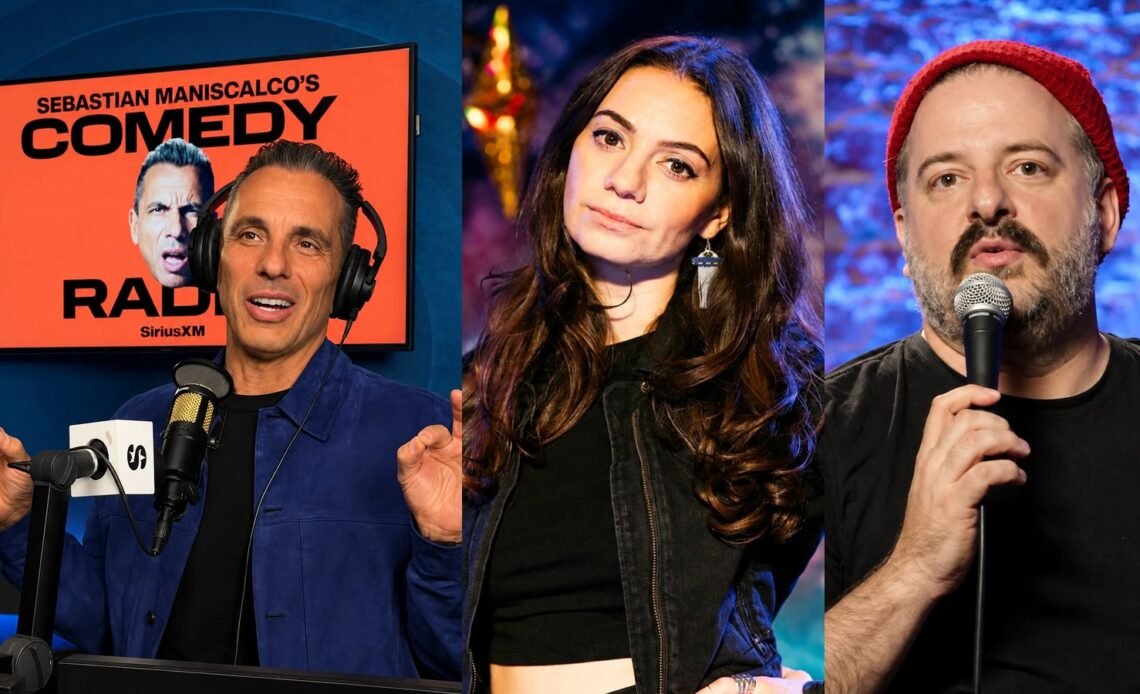
For more than a decade, SiriusXM’s Raw Dog Comedy was the satellite radio channel for working comedians: the people filling clubs on a Tuesday night, not the ones selling out arenas. In April 2026 it was replaced by Sebastian Maniscalco’s Comedy Radio. Six months later, a long list of comedians is publicly asking for it back.
On October 7 we spoke to two of the comedians leading that campaign, Liz Miele and Greg Stone, a few days after their videos set it off. Both had been among the most-played comics on the old channel. This is what happened, what SiriusXM and Maniscalco have said, and what the two of them told us.
Jump to: What happened · The numbers · Why the royalties matter · What SiriusXM and Maniscalco say · How the campaign was built · What happens next
What happened to Raw Dog Comedy
Raw Dog, later renamed Raw Comedy, played uncensored stand-up from comedians at every level. In April 2026 SiriusXM retired it and launched a round-the-clock channel curated and headlined by Sebastian Maniscalco in its place.
Nothing was cut to save money. The channel still plays comedy all day. What changed is who gets played. Liz Miele explained the arithmetic to us. The number of plays stays roughly the same, she said, but they are now shared among far fewer people.
“You’re taking from the 99% and concentrating all the wealth and exposure to the 1%. The 1% that does not need the money.”
Liz Miele
Greg Stone’s objection is that a channel for famous comedians already existed. “Raw Dog was the everybody channel,” he told us. It was not the clean channel and it was not the classics channel. In his view the new station has become a second classics channel, which he says “isn’t good for comedy and it isn’t good for Sirius”, because many listeners tuned in to hear new voices.
See our explainer on Instagram
The numbers
The figures differ depending on who counted and when, but they all point the same way.
- 808 to 383. One widely shared count puts the number of comedians in rotation at 808 in March and 383 in July.
- 812 to 275. The nonprofit Stand Up for Stand Up, using playlist data, counts 812 acts in April and 275 in September.
- Roughly 800 to under 300. This is the figure Miele has used publicly, and the one she gave us.
We compared the channel’s 100 most-played comedians in March with the same list in September. Seventy-five names had changed. Nine of the new entries are comedians who have died, among them Joan Rivers, Bob Hope, Norm Macdonald, Richard Pryor and Mitch Hedberg. Three of the comedians now protesting were on the list that was cut: Liz Miele at number 4, Margaret Cho at 15 and Greg Stone at 47.
See the full list of 75 names on Instagram
Miele is a fan of the comedians who replaced her, and said so. Her point is that their recordings are already available everywhere. “There is already a channel for the comedy greats,” she said. “This channel specifically was for uncensored working comedians.”
Stone made the same point about Margaret Cho being dropped. Plenty of people may not care for a given comedian, he said, but millions love her, and his wife saw her as the first Asian woman in stand-up who made it seem possible.
Why the royalties matter
Each time a track is played on satellite radio, the comedian is paid a royalty. Online, some people have described the protest as comedians asking for a handout. Both Stone and Miele reject that firmly.
“It’s not like they were tips. We are being paid. When I made a special, it cost $12,000 to make that special. The only way of making your money back is that you sell the album, you get the album on Sirius, and that’s how you start making money. The royalties were part of the workflow.”
Greg Stone
Twelve thousand dollars is cheap for a special, he added. Many cost twenty or thirty thousand, and some cost a hundred.
Miele has five albums in the SiriusXM library and has been played there for at least twelve years. When she lived in New York she was a regular guest on its talk shows. “I feel like I was a part of the Sirius family,” she said. “I made five albums. This is my work. I built that relationship.”
She also described what the money is used for. Comedians have no health insurance through work and no paid leave. If they are not on the road, they are not earning. The royalties, she said, are what let a comic stay home with a new baby, care for a parent who is ill, or stop touring for medical treatment. She regularly gives to fundraisers for comedians in exactly those situations. “This was the one tiny relief that we earned.”
There is a second loss, which is the format. Radio will play a six-minute story. Social media will not. Stone told us a friend had just cut one of his five-minute bits into a clip, and to make it fit, it became a different joke. Miele said her average joke runs three to four minutes, and that she will not rebuild her act around an algorithm that changes every few months. “Something like SiriusXM is a way that comics could be authentic, get played, make money, get exposure.”
It was also how listeners found people. We first heard several comedians we have since interviewed, Ian Edwards among them, through that kind of airplay. Edwards told us in his own interview that he had felt “mostly ignored” by parts of the industry for much of his career.
What SiriusXM and Maniscalco say
SiriusXM has responded twice. Its first statement, reported by Deadline on October 5, described the new channel as a fresh creative direction with a programming mix that keeps evolving, and said the company invests in comedians more than any other audio platform.
Its second, on October 7, went further. According to Deadline, the company said it ended Raw Comedy because the channel was underperforming, and that the decision was made before Maniscalco joined its lineup. It said it remains committed to a channel where “comedians at every stage of their careers can be heard”.
Maniscalco addressed it himself the same day. As TMZ reported, he said in Instagram Stories that he had nothing to do with the decision to end the old channel, that he supports his fellow comedians and remembers how hard the early years are, and that he is working with SiriusXM on a wider range of voices. He asked comedians to be patient. We covered his statement on Instagram.
Our interviews were recorded that same day, and the two accounts do not fully match. Stone disputes the claim that the channel was failing. “Everyone keeps saying the channel was failing. No, it wasn’t. The channel was doing great,” he told us, adding that he had this from people inside the company. He also believes Maniscalco had a choice about which channel to take over. SiriusXM’s statement says otherwise. We have no way of confirming either version.
Neither comedian was arguing that Maniscalco is not funny, or that he should not have a channel. “I’m trying to give him the benefit of the doubt,” Stone said. “I hope that he looks at that and goes, I didn’t really think of it that way, and then reinstates it.” Miele said he is welcome to play his friends. Her objection is to the removal of more than 600 other people.
She also made a point that cuts the other way from the online abuse she has received, from people calling the cut comedians failures.
“We know that you don’t do stand-up once and become Sebastian. It took Sebastian over fifteen years to be a household name. You are crippling the entire comedy economy, and how people grow, make money and survive, so that they can become the next Sebastian Maniscalco.”
Liz Miele
How the campaign was built
The protest looks large, and it started small. Miele told us that a handful of comedians spent a weekend messaging everyone they had ever worked with. They had a list of the roughly 600 comedians who had lost their airplay and the hundred or so who had replaced them. “Between me and three other comics, we were able to reach most of them, because we all work together.”
Since then Michelle Wolf, Patton Oswalt and Margaret Cho have spoken up, along with many less famous names, and some comedians who are still played on the new channel have backed them. That did not surprise Miele. The headliners’ opening acts are working comedians, she pointed out, and everyone is one step away from everyone else. “This is just a giant office and we all know each other.”
How does she feel about it? “I’m stressed,” she said. “But the biggest feeling I feel is just so proud of my community. It’s the best team project I’ve ever been a part of.”
What happens next
The comedians’ request has not changed: bring back Raw Dog, or restore the range of comedians it played. SiriusXM has not said it will do either. Maniscalco has said changes are coming and has asked for time.
Stone thinks the answer is to keep asking. “Maybe we’ve just got to be relentless, and just keep reminding them we need this.” He has also spent the week on the phone with comedians who lost the income. We asked what he would say to all of them.
“We’re going to be okay. Remember what really matters. And we always come back. We’ll figure it out.”
Greg Stone
The manager Barry Katz told us recently that comedy isn’t fair, and that the comedians who last are the ones who keep working when nobody is watching. We have also written about how comedians keep going after years of being overlooked. This story is a reminder of what the keeping going is paid for with.
Our full interviews with Liz Miele and Greg Stone are coming soon. For updates on this story, follow @hopforpop on Instagram.