
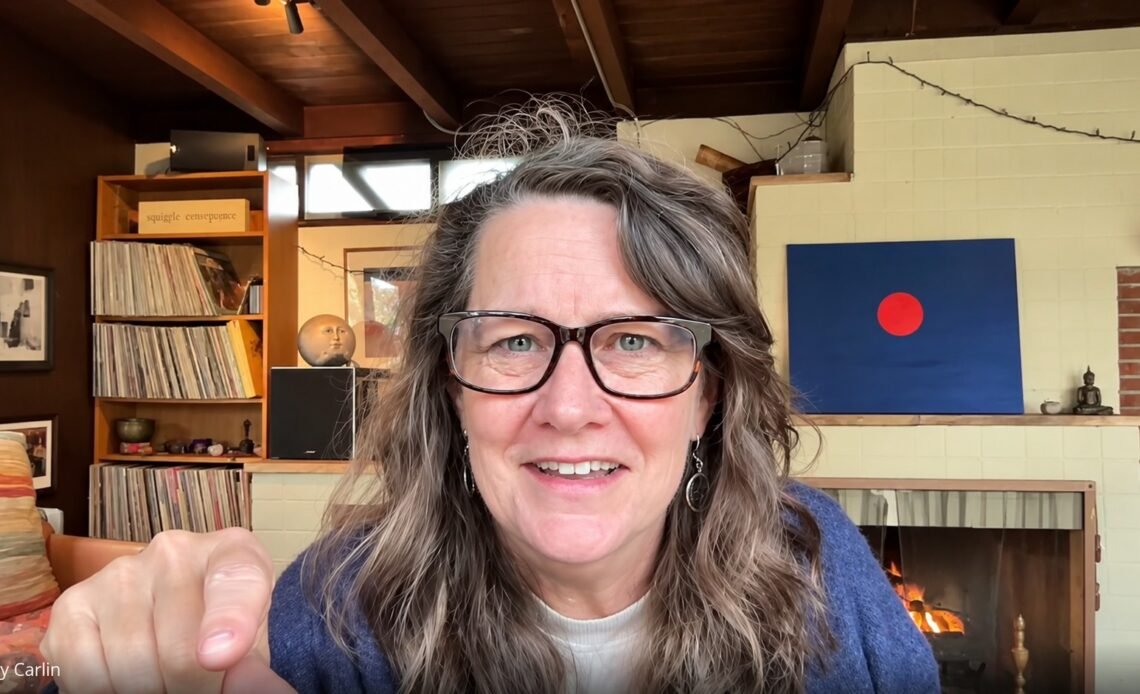
Kelly Carlin-McCall is a writer, performer and teacher, and the daughter of George Carlin. She is the author of the memoir A Carlin Home Companion: Growing Up with George, and an executive producer of the Emmy-winning documentary George Carlin's American Dream. She is the founder of Humans on the Verge and is writing her second memoir, with work in progress on her Substack, Sunbeams from the Cave.
Growing up with George Carlin did not mean hearing the jokes early. He never let his daughter see material while he was working on it. She met each HBO show the way everyone else did, in the audience, with no warning of what was coming. We talked to Kelly Carlin-McCall about those nights, about her father’s slump and comeback, about the comics he helped without telling anyone, and about the psychology she turned to in order to understand herself. It is a conversation about one comedian’s legacy, and about what it takes to step out from under it.
The introduction came from Liz Miele, who wrote to Carlin when she was fifteen and got a phone call back. Suggested reading: Liz Miele wrote to George Carlin at 15. He picked up the phone.
Only in its perfect form
Carlin, she says, always wanted people to check in with their own nonsense and think for themselves. That included his family.
“He never let me see his material as he was developing it. He wanted me to see it once it was in its perfect form.”
Kelly Carlin-McCall
So she would go to an HBO show cold, and there would always be one line that landed like a sledgehammer. She mentions the one about the American dream, and how you have to be asleep to believe in it. Even she would be in the audience going “Oh, Jesus Christ.”
“Suddenly, yes, a whole room inside of your consciousness opens and you’re suddenly seeing the world.”
Kelly Carlin-McCall
She points out what he was not doing in those moments. He was widening people’s view, she says, but never telling them to believe what he had to tell them.
The gift of naming things
Why did he connect with people in four different decades? Part of it was observation. The rest was what he did with it: he could organise those thoughts so that they were accessible, ironic and flat-out funny. She describes him as a man on the mountain who could look down and see the big picture, then move back into his own world, as he did in the 1970s on Class Clown, FM & AM and Occupation: Foole. Good humour, she says, makes us say, “Oh my God, that’s so obvious and I never thought of it that way,” while making us laugh at ourselves.
The job of the comedian, she told us, “is to point out the truth of our shared reality”. It is close to the reason our other guests give when they talk about him. Suggested reading: why George Carlin’s comedy survived the test of time.
The big club, and who was in it
She also gave us her father’s view of political correctness, which she thinks people only half remember. Donald Trump ran on being against it. But the first wave came in the late 1980s, in universities, and that is when Carlin began to push back, because he felt it was a way of policing people’s thoughts and their speech from the outside. He did not argue with what was behind it: seeing everyone as equal and giving the underdog a voice. “He believed in all of that motivation,” she says. “He just didn’t see that political correctness is the way to get there.” Imposed from outside, she says, it creates resistance, “which is exactly why Donald Trump happened”.
So she finds it funny when people tell her that her father would have loved him.
“My dad was a New Yorker. He knew very well who Donald Trump was.”
Kelly Carlin-McCall
Carlin’s stance on capitalism, she says, was that the people who hoard the wealth have all the power, and that greed runs them. It’s a big club and you’re not in it. He did not like “the white privileged power wealth class of the country”, she says, “and that is who Donald Trump represents”.
We put it to her that policing speech goes back further, to Lenny Bruce being arrested in the 1960s. Absolutely, she said, but it was motivated from a different place: a traditional mindset that did not want the boat rocked. Bruce was the pioneer, and Dick Gregory, Richard Pryor and her father all pushed up against it. That time, “it was actually coming from the right”.
When the government steps in
We told her what has been happening to comedy in India. In February 2025, police in two states registered cases over a remark made on the YouTube show India’s Got Latent, and people connected with the show were questioned. A month later, party workers vandalised the Habitat, the Mumbai venue where it had been filmed, over a set that Kunal Kamra recorded there. Between the two, we said, jokes that hurt sentiments and jokes about politics have both become dangerous, and a lot of comedians who used to do satire cannot do it any more. Her word for it was authoritarianism.
“When the government gets involved in controlling speech, then it’s no longer a democratic place.”
Kelly Carlin-McCall
People’s opinions, sentiments and tastes are one thing, she says. In America that is the marketplace: “Joe Rogan gets to be over there and Jon Stewart gets to be over there and everyone gets a voice.” It is different when a government decides to shut down a network, or pushes for someone like Stephen Colbert or Jimmy Kimmel to be fired, and businessmen go along with it because they want their deals to go through. “That’s when it starts to get dangerous.”
We pointed out that she can say Trump’s name openly, and that in India comedians are careful about sounding even a little opinionated. She asked how things were now. Worse, we said. But in the same three or four years, Indians have been discovering George Carlin and relating to him hard. She said it made her feel that her father’s legacy could do something in the world, if people can reach his material and see what full freedom of speech looks like.
“The more diversity of points of view there are, the healthier the system is, whether it’s your own psychology or the psychology of the collective.”
Kelly Carlin-McCall
Her argument comes from nature, which, she says, “is not full of the same tree”. It is the same nature her father said would shake us off. “We are part of nature, but we’re not cooperating,” she says, and nature eventually lets go of the parts that do not.
Who gets to quote him
His routines on abortion and religion sound current too, we said. She agreed. Christians wanting to rule other people’s lives was, for her, the height of hypocrisy in his work, and she says white Christian nationalism “has now got a full seat at the table which is terrifying”.
People on the left and the right have felt for decades that the government was broken, she says, and many who wanted to break it further bought into a personality. She has a theory about him.
“I think Donald Trump really wanted to be a comedian. He didn’t want to be president.”
Kelly Carlin-McCall
He loved being at rallies, making people laugh with politically incorrect jokes, she thinks. She had just seen a news show say that part of the reason some podcasters and young white men have turned on him is that they no longer find him funny, which she found sad. She calls him impractical and narcissistic. “You can’t tear it all down with a chainsaw and then expect your airplanes to keep running,” she says. But after the midterms she sees a turn, with corruption as the tipping point: “The people get fed up at some point.”
That is the irony for her of Trump voters who love her father. Carlin wanted them to check what they believed. “This guy doesn’t want you to think for yourself,” she says. “He’s not inviting you to be rational thinkers.” We said that people in India do the same, quoting Carlin only when the other side is in power. She recognised it. The right quotes him on political correctness, and uses his line about not trusting politicians against the left but never against its own. What they leave out is the next few sentences, about money. His point, she says, was that the system is “completely corrupted by money”.
We have been rereading 1984, and told her that George Orwell was born in Bihar, in India. She put him with the people who can stand outside and look, and said that humans have always swung between individual freedom and collective freedom. What is different now is that everyone is connected, and the conversation is bigger. “Ideas spread and that is the hope of humanity,” she said.
A news junkie with CNN on
Carlin was on the road constantly, so we asked when he took anything in. “He was a news junkie,” she says. Once CNN became a 24-hour station, it was on in the house. He read a lot and watched a lot, and she sees it running through the work from the beginning: the routines with Jack Burns that made fun of commercials, the disc jockey on Wonderful WINO radio, the Hippy-Dippy Weatherman. He was always inside the media, making fun of it.
Did his opinions ever get imposed on her? She was shaped by them, she says, but they already felt aligned with how she saw the world. Her father had rebelled against traditional culture. She was born in 1963 and raised in the counterculture, so there was not much left to rebel against. “We were raised by wolves,” she says of her generation. “We were on our own.”
Before the comeback
The 1980s were hard on him. A new generation had arrived, SCTV was making fun of him and he was feeling irrelevant. At home, she saw almost none of it. He did not share that kind of thing, and she was in her twenties and having what she calls a “rough, weird time” of her own. “When you’re in the middle of life, you’re just kind of living it,” she says.
For anyone who had lived inside the counterculture, she says, it was a difficult decade, with an actor as president and the fear of nuclear war. She compares it to the last ten years, “but like at a three”, when the last ten have been “at an 11”. She believes her father’s next leap was fed partly by his disgust with the Reagan era and scandals like Iran-Contra, and partly by age. He was in his fifties by then and, as she puts it more bluntly, people that age care less what anyone thinks. He said himself that he had finally found his true artistic voice. There was more aggression on stage and more bite. Carlin’s explanation was that people had gone to sleep and he needed to get their attention.
“As an artist, I understand it. But I found it thrilling and still do.”
Kelly Carlin-McCall
She remembers hearing his routine about the planet in 1992, when she was close to thirty. “It’s a lot to take in as a 30-year-old,” she says. We told her that Jammin’ in New York is our favourite, and that its observations about the things we share now turn up online as somebody’s original tweet. She used to chase people to credit him, and stopped, because it would make you crazy. She sees another side to it now: it shows, she says, “that his thinking has gotten into people’s unconscious”.
The comics he never mentioned
Carlin told nobody that he helped younger comedians, including his daughter. She found out after he died, first through Liz Miele. He had done it for Garry Shandling and for Lewis Black, two men who later came into her life, mentored her and became dear friends.
“Young comics come in and they learn the ropes from the older comics. And if you were mentored, you mentor back.”
Kelly Carlin-McCall
We suggested that nobody so famous would be that approachable today. She disagreed. There are probably comics doing the same thing now without making a fuss about it, she said, and named Judd Apatow, who co-directed the documentary about her father, as a very generous man. Suggested reading: stand-up advice from veteran comedians.
What makes us tick, what makes me tick
Her own field is Jungian psychology, and she gave us the beginner’s version. Carl Jung started out as a kind of mentee of Freud, quickly became his peer, then broke with him. Working with patients in a mental hospital, he kept seeing the same mythological themes in their fantasies, and then found them in the dreams of ordinary people. That led him to the idea of a collective unconscious: patterns that all of us share, beyond the personal ones.
She loves it, she says, because she was born with an instinct to look underneath the story. So was her father. “If you believe that you pick your parents, I picked the right ones for me.” But she did not take it up as a career. She went into it because she had been confused about her own life for a long time. She has had an anxiety disorder, dealt with addiction, and was, in her words, extremely codependent, which she traces mostly to her upbringing and her parents’ addictions.
“My dad looked out at the world and said, ‘What makes us tick?’ Whereas I looked out at my world and said, ‘What makes me tick?'”
Kelly Carlin-McCall
She knew right away in graduate school that she would not be a therapist. She went into life coaching, alongside writing and teaching, and says the thing she is most dedicated to is unleashing her most authentic self. If that helps others own theirs, she says, then she has done her work in the world.
We also asked her about joking through grief. She separates two kinds. There is gallows humour, which doctors and soldiers use to get some distance from what they have to face. And there are the jokes that come after you have sat with the loss. “You are renegotiating who you are to yourself and to the world,” she says of losing a parent. Only when you have found where you stand can you be devastated by it and also “tell the human truth about it which includes humor”. Suggested reading: comedians on dark jokes and where the line is.
Where they part ways
She sees the world mostly as her father did. Among his handwritten notes, she read one about the difference between self-interest and enlightened self-interest. He believed in the second, she says, but felt his job was always to point out the problems with the first. She wants to awaken the second. He used his sharp wit to “knock us awake”. Hers works another way.
“My style is a little different. I’m here to meet people where they’re at, try to open their hearts and their minds a little bit to find the common ground and then lay on a nice big piece of truth to them that they’re going to have to chew on for a while.”
Kelly Carlin-McCall
We said it reminded us of Daniel Sloss, who spends most of his show X getting the men in the room on his side before he turns to the subject he came to talk about. She did not know him, but recognised the method: once people feel safe, the nervous system lets the walls down a little. She said she would check him out.
The second book
Carlin died in 2008, and the book she is working on looks back at the eighteen years since. She first attempted a second memoir about ten years ago and was not ready for it. This one is about being a creative and finding an artistic voice, and about having to negotiate “this huge shadow of my dad”.
“To delineate myself from him at the same time as deepening my love and connection to him.”
Kelly Carlin-McCall
The first memoir began as standalone stories, became a solo show, and was then taken apart and turned into a book. This time she thinks she will go straight for a book. She is writing standalone pieces, going through her journals from the last eighteen years, and wants to include some of her actual dream work. There is no date yet. “I know the arc. I know the themes. I know what it’s about,” she says, and it has a good 70 per cent of her mind. She shares some of it on Sunbeams from the Cave.
Her father’s channels are run by a team. The YouTube channel went untouched for something like nine years until, about two years ago, she hired people to look after it. It now holds some live premieres, where she joins in with comments, and there are plans for the new year. She does not do social media the way she used to. She is burned out on it, and on the algorithm in particular.
You can read Kelly Carlin-McCall at Sunbeams from the Cave, on Instagram at @kellycarlinishere, find her teaching at Humans on the Verge, and watch her father’s work on the Official George Carlin YouTube channel. For more conversations like this one, see all our comedian interviews.
Enjoyed this interview?
Hop For Pop is researched, recorded, edited and written by one person, and it’s free to read. If this one made you laugh or taught you something, you can buy us a coffee.
Buy us a coffee ☕ $5Watch and follow
View this post on Instagram
The full video conversation is due on our YouTube channel by the end of the year. See our Instagram post about this interview, and follow Hop For Pop on Instagram at @hopforpop and @thecomicsunseen.