
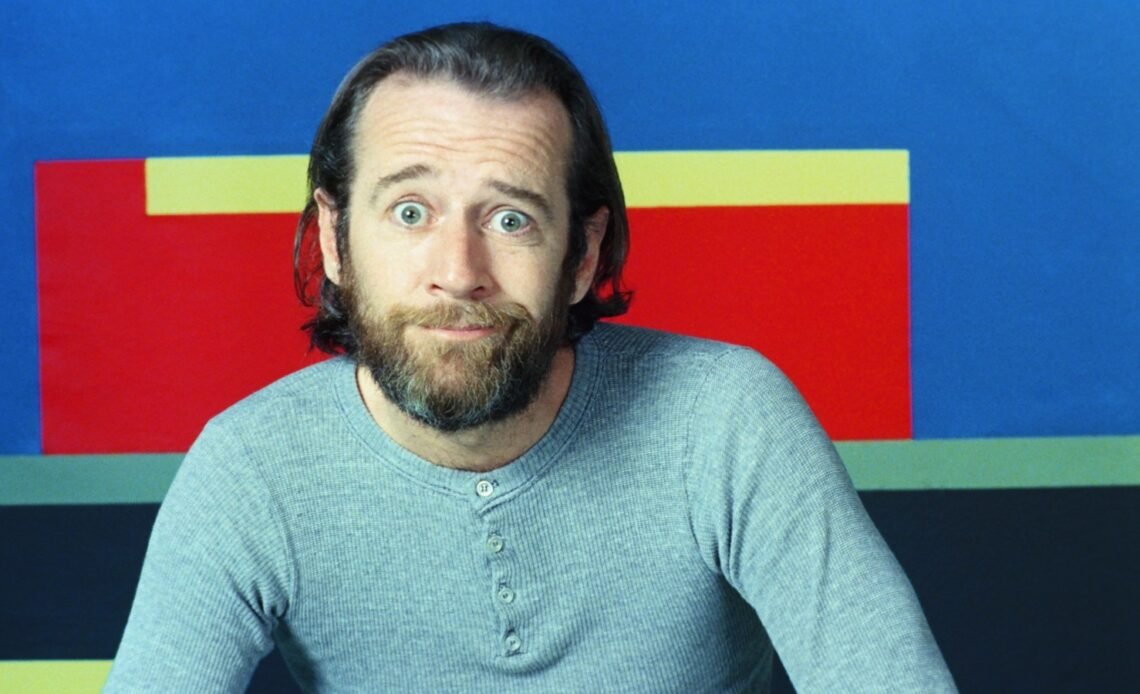
George Carlin died in 2008, and his specials still get passed around like new material. On Hop For Pop we ask almost every comedian who their heroes are. Carlin’s name comes up more than anyone’s, from Edinburgh Fringe debutants to a manager who has spent decades in the business.
So we went back through our interviews and pulled out what they said about him. A few reasons kept coming up for why his comedy has lasted. Some of them are ours too.
Jump to: He kept changing · He never took sides · Funny first · He told the truth · Breaking rules, delivering the goods · Not so crazy · Kind to beginners · Still being found
He kept changing, and stayed funny
Our own view, after years of watching him, is that Carlin had five distinct periods. First came the clean-cut television comic doing sounds, voices and impressions. Then came the Class Clown, FM & AM and Again! years, when he grew his hair, dropped the suit and started saying what he thought. After that came a slump and a comeback. Then the Jammin’ in New York era. Then the final years, darker and angrier than anything before.
What strikes us is that he was funny in every one of them. Plenty of comedians change their style. Very few manage it five times without losing the laughs.
The comedy manager Barry Katz described the same arc to us, from memory, in decades. Carlin’s early television work included a routine about Westerns, told from the Native American side. Then “10 years later he was in jeans with long hair.” Then “10 years after that he’s doing political humor.” Katz’s conclusion was simple.
“It always evolves. Everything evolves.”
Barry Katz
He added a fair caveat. You have to be willing to evolve, he said, but you do not have to. Plenty of great comics kept one style their whole career. Carlin’s difference was that he was willing to leave an audience behind to follow what he wanted to say. Read our interview with Barry Katz.
He never took sides
This is the part we think is most overlooked. Carlin did not do party politics. He went after the issue in front of him, whoever it belonged to, and he was as hard on the people in the audience as on the people in power.
That is a big reason his material has not dated. The issues he talked about, from religion and war to money and the way people use words to hide things, are still with us. Many of them are bigger now, and in many parts of the world. A bit written about one side’s politicians goes stale when they leave office. A bit about how people behave does not.
He made it funny first
Carlin had strong ideas, but he never just put them out there. He made sure they were funny first. That matters for two reasons.
The humour lightens a heavy subject enough for people to hear it. And the laugh is what makes the idea stay with you. People remember a punchline for decades. They forget a lecture by the time they get home.
Stacie Burrows, who brought her solo show to the Edinburgh Fringe, found Carlin at university along with Bill Hicks and Lenny Bruce. She put her finger on the balance.
“I like those comedians because they were funny, they were smart, but they had something to say about a bigger issue.”
Stacie Burrows
She compared them with a comedian like Jerry Seinfeld, who she finds very funny but who, in her words, is “not making a statement”. For her, Carlin was doing both at once. She had a huge poster of him in her room. Years later she gave his book Brain Droppings to her teenage son, who texted her late one night to say it was really good. She says the book is still on his bedside table. Read our interview with Stacie Burrows.
He told the truth
Tom Nemec heard Carlin before he could explain why he liked him. His brother owned Class Clown. Nemec went on to see Carlin live twice, though he never got to meet him. It took him until a couple of years ago to work out what had drawn him in as a boy.
“They were the first people in my orbit that I heard actually telling the truth. People on TV didn’t tell the truth. My parents didn’t tell the truth.”
Tom Nemec, on Carlin and Richard Pryor
He told us he was not really attracted to the laughs. He was attracted to the one or two honest things in each routine. That is what made him want to do comedy himself. Read our interview with Tom Nemec.
Brendon Lemon, an American comic with a British family, sees this as part of an American tradition. In the United States, he says, comedians like Carlin, Pryor and Lenny Bruce trained audiences to expect ideas from a comedian, not just punchlines. In his description, the American comedian sees something the audience does not, and brings it to them so they can see it too. Read our interview with Brendon Lemon and our piece on British versus American audiences.
Breaking rules, and delivering the goods
Carlin was not a polite rule-breaker. In 1962 he was in the audience at a Lenny Bruce show in Chicago when the police arrested Bruce. Carlin refused to show his ID and was arrested too. It is a story Stacie Burrows loves, because Carlin idolised Bruce and then, as she put it, carried on the job of speaking truth to the ridiculousness of the world.
Larry Charles, who went on to write for Seinfeld and direct Borat, was a young comic at the Comedy Store in Los Angeles when Carlin, Richard Pryor and Robin Williams were all performing there. He calls it a comedy education.
“All of those guys were breaking the rules in their own way, you know, and at the same time delivering the goods.”
Larry Charles
Charles also noticed something about how they worked. Carlin, Pryor and Williams were at their funniest on stage. Offstage, he says, they were not especially funny, because they put everything into the performance. Charles knew he was not built that way, which is partly why he started selling his jokes instead. Read our interview with Larry Charles, and for more on comics who broke the rules, see what Andy Kaufman taught comedians.
“Maybe I’m not so crazy”
For some comedians, Carlin was less a teacher than a reassurance. Greg Stone told us his comedy is about following the fear, talking about the things he is scared to talk about so that people in the crowd who share those fears do not feel crazy. He traces that straight back to Carlin.
“I was a weirdo, I was crazy. And I remember seeing George Carlin and being like, maybe I’m not so crazy.”
Greg Stone
We think this is also why Carlin’s long pieces in Jammin’ in New York still work on people who were not born when it was taped. He builds a list of things everyone has noticed and nobody has said. The audience recognises itself, and the laugh comes from relief as much as surprise. Read our interview with Greg Stone.
He was kind to beginners
The most moving Carlin story in our interviews came from Liz Miele. In 2001, at 15, she was writing to every comedian she admired, on her father’s advice, to ask how they got there. Only two wrote back. One was Judd Apatow. The other was Carlin, who telephoned her after reading her letter.
“He was like, hey, I’m George Carlin, I got your letter. Gave me a bunch of very simple advice. Write every day, get up on stage as much as you can.”
Liz Miele
He told her she could keep in touch, and she did for about eight years, first by post, then email, then phone. He sent her signed copies of his books. When she was 19 and struggling to build an hour, they met for coffee. He opened his computer and showed her how he memorised his longer pieces and how he organised his set list. She still calls it one of the most important moments of her life.
Since his death she has got to know his daughter, Kelly Carlin, who told her she had no idea how many young people her father had quietly helped. “Comedically Carlin is a guiding force,” Miele told us, “but as a human, he’s a guiding force.” Read our interview with Liz Miele.
The filmmaker and comedian Maija DiGiorgio has a similar story. Her documentary Bitter Jester, about the business of comedy, features Carlin. She told us he championed it, called to say he had watched it and thought it was important, and let her use footage from two of his specials. Read our interview with Maija DiGiorgio.
Still being found
Carlin turns up in the answers of comedians who never saw him live. Byron Bertram, the character comic, lists him among his idols alongside Norm Macdonald, Andy Kaufman and Bill Hicks. Read our interview with Byron Bertram. Stacie Burrows’s son found him through a paperback. Tom Nemec still listens to the albums his brother played.
That, in the end, is the test of time. Carlin kept changing, so there is a version of him for almost every taste. He never tied his act to one side, so the targets are still standing. He always made it funny, so people keep repeating the jokes. And he told the truth as he saw it, which is the thing every comedian in this piece said they took from him.
For more conversations like these, see all our comedian interviews.