
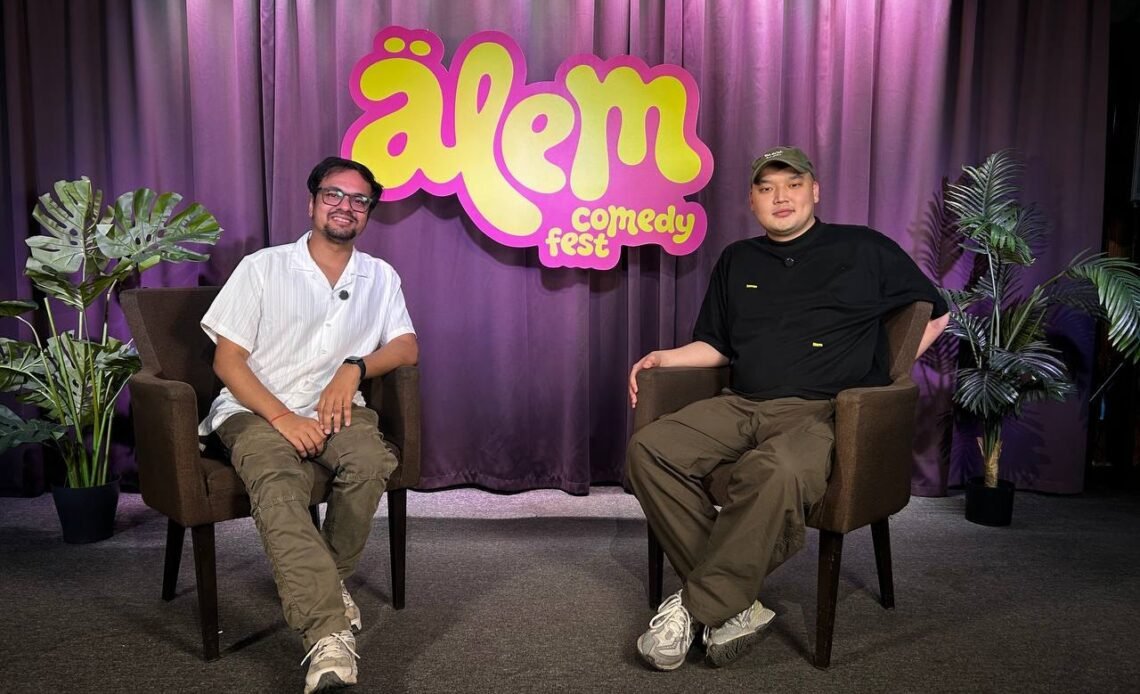
Nuraskhan Baskozhaev is a stand-up comedian and producer in Almaty, Kazakhstan, who runs Almaty Central Stand Up with his wife. He started performing in February 2020, a month before lockdown. The couple opened their first club in October 2022 and moved into the current 800-square-metre venue on 8 March 2023. The club also runs Alem Comedy Fest, Almaty's annual comedy festival.
Most stand-up in Kazakhstan does not happen in English. It happens in Kazakh and Russian, for an audience of perhaps 21 or 22 million Kazakhs worldwide. From that, Nuraskhan and his wife have built what he is fairly sure is the hub of comedy in Central Asia. We sat down with him at the club to ask how. The answer takes in comedians arriving from Russia, an open mic that has never charged anyone, a campaign aimed at Joe Rogan, and a firm view of what young comedians are missing. It is not discipline. It is curiosity.
A class clown who found stand-up on YouTube
Nuraskhan is 28. He still performs, though not much. Most of his work now is producing, helping comedians with material and preparing shows. He was always the class clown. He came across stand-up while teaching himself English on YouTube, and what struck him was how little it needed.
“One man or a woman, a stage, a crowd, and a microphone is enough. You can make people laugh. And more than just laugh, you can make people think.”
Almaty already had two small clubs. He found his way in through two or three comedians he spotted on Instagram, who performed in bars for 20 or 25 people with no microphone. They asked if he had material. He said yes, though he did not, and wrote his set about two hours before the show. It went well, and they gave him a weekly slot. (Plenty of comedians have told us how much rides on that first laugh.)
The bar crowd saw themselves as the underground, the “true standup”, and the clubs as the polished mainstream. “We kind of were rivals, but the standup club didn’t know that we were rivals,” he said. “Only we did know that we were rivals.”
A club built in a time of crisis
When mobilisation began in Russia in 2022, a lot of Russian comedians came to Almaty, and suddenly there was a critical mass of performers with nowhere to go. In October 2022 he and his wife opened their first club, called Stand By. On 8 March 2023 they moved into the current building, which is 800 square metres.
The new arrivals were frightened, he says, and the club put them under one roof with local comedians. Most later went home. Some stayed and are now part of the community. We suggested that the club had kept comedy alive at a bad time. He would not take the credit.
“We didn’t have a plan to save anything or anyone. It’s just that it happens. I think it happened because we were open-hearted and we had open arms and we were open to ideas.”
Comedy, he adds, is simply what he does well. “I’m not really much good at anything else.”
Free stage time, and a ladder to paid shows
What surprised us most was that the club does not charge comedians for stage time. A producer friend in Russia told him that day would come, once there were enough comedians to need a filter. Nuraskhan does not expect it. “We take care of comedians. Comedians take care of us,” he said.
Each week 30 comedians get three minutes each at the open mic, a 90-minute show. The host notes down the interesting new names. Those comedians come back for five minutes, then seven or ten, and eventually get invited onto the paid weekend lineup shows, which are the club’s main event of the week.
For a year or two, he and other comedians also held what he calls hours of authorship. They would sit with a comedian, follow their train of thought and test each joke. “Is it too much air or just water or too much words in an otherwise pretty solid joke?” He no longer has time for that, except for headliners who ask, but comedians there still ask each other for notes. Our guide to how 25 comedians write their jokes covers the same kind of work.
A million views in a language few people speak
Shortly before we spoke, the club posted a roast of a singer friend on YouTube, and it passed a million views in eight days. Reaching a million usually takes them months or a year, he says.
That matters because the audience is small. Kazakhstan has about 20 million people, and he estimates that 20 or 30 per cent of them do not understand Kazakh well. So why stay? He pointed to the comedians we had met at Good Night Comedy, who are funny in Kazakh, Russian and English. With comedy growing at home, he does not think most of them want to start from zero abroad.
Part of the reason is the language itself. He describes Kazakh as rich in archetypes and metaphors, and full of jokes that do not survive the trip into another language.
“There is a lot of really, like jokes or gags that are untranslatable to other languages, like, you have to know the language to really, really get the juice in that joke.”
We have looked at that problem from the other side in our piece on comedy in another language. As for where Kazakh comedy began, he points to aitys, the old tradition of improvised verse duels accompanied on the dombra. He compares it to a roast battle or a rap battle. Modern comedy took off after independence in 1991, when comedians realised they could make something that Moscow did not control.
Trying to bring Joe Rogan to Almaty
The club’s annual festival, Alem Comedy Fest, began in 2022 and has now reached its fifth year. This year they wanted a big name from abroad, and made a series of videos inviting Joe Rogan. Someone from his team got in touch to say a 20-hour flight was too long.
Then they approached Chris Tucker’s management, who agreed. The club went looking for sponsors to cover the fee. Nobody would pay. He is careful to say it was not the millions of dollars a Saudi festival offers. “It’s hundreds of thousands,” he said. “There is that kind of money in Almaty in Kazakhstan.” What comedy lacks, he says, is the trust of local companies.
His own wish list is Bill Burr, Jimmy Carr, who he calls his personal favourite, and Stewart Lee. For now, people across the post-Soviet countries travel to places like Istanbul, where his group saw Louis C.K. He wants that in Almaty. Being the regional hub is not something to boast about, he says. “It’s a great responsibility and we are happy to, you know, carry that cross.”
“Walking in between two fires”
We asked whether comedy is still controlled in Kazakhstan. He said it is, as it is in most places outside Europe and the Western democracies. There is no real problem right now, because everyone is careful. But there are two pressures: attention from the government, and what he calls a really big cancel culture among a public that has only recently got its hands on social media.
“As a comedian, you have to walk on that rope, thin rope, and try not to fall and balance always.”
He quoted Louis C.K.’s idea that a comedian shows the audience where the line is and then moves it, and said that is easier in the United States than where you can get into serious trouble over a joke. He mentioned a comedian in Russia sentenced to years in prison over a joke, and said every comedian who performs in Russian took the message. (We asked other comedians where they draw the line.)
He does see an upside. It forces comedians to be “very creative with their words” and with meaning. And he does not think comedy can be fully controlled, because anyone can do it. “You can be comedian with just a microphone and a little audience. You can be a comedian anywhere.”
On Bill Burr, whom we suggested has become more careful, he disagreed. Burr was “an enraged young man”, he says, and has simply grown up. And when a comedian at his club starts to preach, he does not tell them to stop. He teases them in the green room, and if they can defend the material with jokes, it stays. “As a comedian, you have to be a thinker. But there’s gotta be jokes. It’s gotta be funny.”
The problem is input, not output
Many beginners, he says, start with Greg Dean or with Judy Carter’s The Comedy Bible. Great books, he says, but read too early they make people think a joke can be crafted mathematically. He found his own voice by watching a lot of comedians and working out what he found funny. Formulas, he says, come naturally later.
Then he made his main point. Comedians talk about output, writing an hour or two a day. What many lack is input.
“They are not curious about the world. Like they don’t consume other content. They don’t watch shows. They don’t watch documentaries. They don’t watch good movies. They don’t listen to good music. They don’t have meaningful conversations. They don’t do anything spontaneous.”
“Comedy comes from experience,” he said, which is why comedians tend to get better with age. It frustrates him when young comics cannot name George Carlin or Richard Pryor. There is no excuse, he says, because an online community has spent years subtitling English-language specials into Russian. Eddie Murphy’s Raw was especially important to the local scene.
His own taste runs to “the thinking comedians” and “well prepared text”. He regrets that alternative comedians of the Andy Kaufman kind have mostly disappeared. “It doesn’t pay well right now,” he said. “It is much easier to just write jokes and go up on stage.”
As much stage time as you can get
How many open mics should a beginner do? There is no number, he says. The week we spoke, Almaty had 17 venues with shows. Get “as much stage time as you can get your hands on”, but watch for burnout and keep a balance between work and life.
Some people, he admits, should stop, though he never tells them so. He finished with a line he credits to Louis C.K.: being a comedian is a stupid decision, being a musician is a more stupid one, and becoming a dancer is the most stupid of all. It is a gamble, he says. “You really have to love this thing, really love this thing.”
You can find Almaty Central Stand Up at @central.standup.almaty on Instagram. For more conversations like this one, see all our comedian interviews.
See our Instagram post about this interview. Follow Hop For Pop on Instagram at @hopforpop and @thecomicsunseen.