
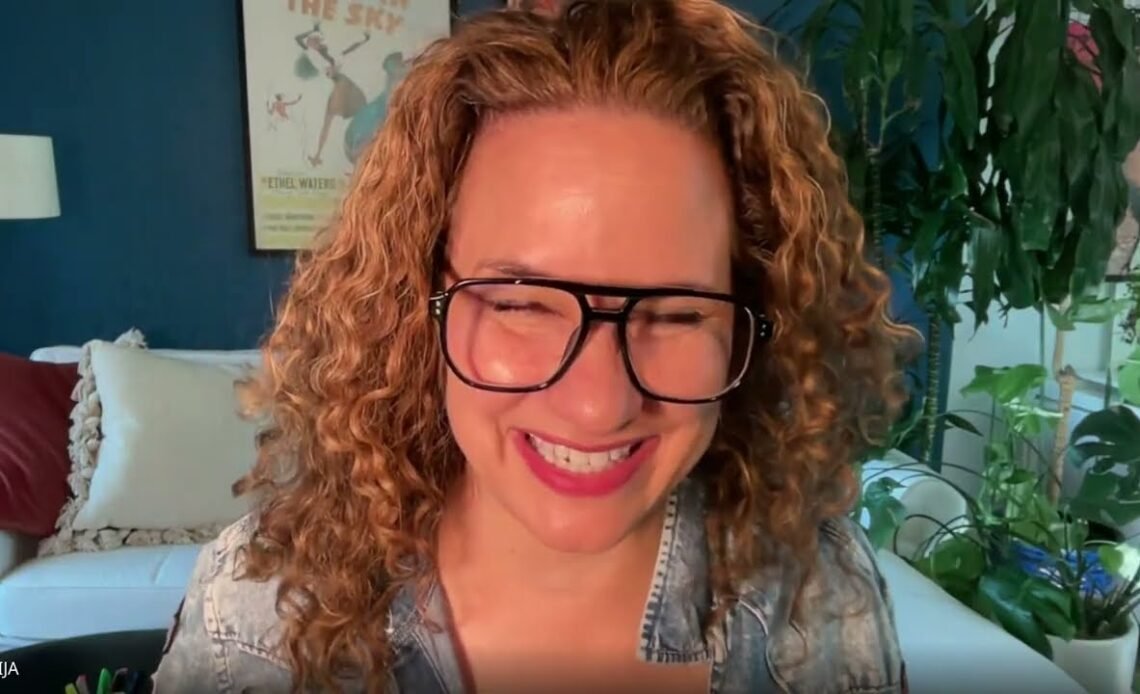
Maija DiGiorgio is a stand-up comedian and filmmaker from New York who now works between New York and Los Angeles. In her first year of stand-up she taped five national television appearances and performed at HBO's Aspen Comedy Festival. She wrote, directed and stars in the 2003 documentary Bitter Jester, which features George Carlin, Whoopi Goldberg, Chevy Chase and Richard Pryor among many others.
Maija DiGiorgio did not want to be a stand-up. She wanted to do characters and theatre. Then she tried a comedy club, had a very good first night and a bad second one, and spent years trying to work out why. Along the way she made a documentary about the comedy business that put her on the wrong side of some powerful people, and one of the most famous comedians who ever lived followed her down a New York street to tell her not to give up. We asked her what keeps her on stage.
“The worst thing that can happen is you’re funny”
People always told her she should do comedy, and she remembers standing on a Manhattan street corner explaining why she never would. Then someone persuaded her to try a stand-up club. She killed on the first night. On the second she was terrible. The third was worse, and the fourth only a little better. “And then next thing you know, I was obsessed with just trying to fix what was wrong.”
She calls it “a weird addiction”, and she warns the people she loves away from it. “Don’t try it because once you try it, the worst thing that can happen is you’re funny.” Plenty of comedians have told us about the first laugh that hooked them.
Saying it on a mic instead
A lot of her material starts with strangers telling her who she is. She is mixed race, half Italian, and people regularly ask what she is and then tell her she is wrong.
Those encounters leave her monologuing on the way home about everything she was too polite to say. She remembers Dave Chappelle telling her at the Boston Comedy Club that his life would be a hundred times better if he had a mic everywhere he went. She agrees.
“I don’t ever say really what I feel unless I’m on that microphone. It is really the best feeling and you can just be honest and the room laughs. So they co-sign it, you know?”
She also guards against sounding like her friends. In the Boston Comedy Club years she hung out with Greer Barnes, Tony Woods and Chappelle, and she noticed that comedians who spend enough time together start to share a rhythm. So she would read back a new bit and ask whether it sounded more like Tony than like her. “How would I make it Maija? Like, how do I Maija-ize it?” A flow on stage is good, she says, but “it’s best to take it back to the lab, dissect it” and ask whether she really believes it. Our piece on how comedians write their jokes has other versions of that process.
A fast start, and a long exile
Her early career moved quickly, with the Apollo and then Def Comedy Jam. After Def Comedy Jam, she says, she went from nobody liking her to everybody liking her, and she did not trust it.
She describes what followed briefly. She says many female comics at the time were pressured by club bookers for sexual favours in return for stage time, which she did not know was happening. She refused advances, fell out with comics as a result, was attacked in her apartment by one of them, and brought a sexual harassment lawsuit against a major New York radio station. The result, as she tells it, was that she was dropped by most of the clubs in New York City for “causing problems”.
Years later, someone who had quit the office of her representative asked to meet her in Central Park and told her she had been blackballed. When people called to book her, they were told she was crazy. Her uncle, a Tony Award-winning Broadway choreographer, had warned her about exactly that. “That’s how they control you in this business,” she recalls him saying. “They make you think you’re crazy.”
“So then you get this label that you’re crazy and it’s just because you speak your mind.”
She contrasts that with men who have been quickly forgiven for far worse. “I did nothing, but just say something that was honest and it cost me decades.” Our piece on how comedians keep going has other stories like it.
Bitter Jester, and two blocks with George Carlin
The film began with a digital camera and some film-school habits. She especially wanted to film Greer Barnes and Tony Woods, because she thought them overlooked, and Rich Voss, whom she calls one of her favourite people on the circuit. The best comedians, she felt, “weren’t easy to control”.
It was not a smooth shoot. She says tapes went missing and she was thrown out of rooms. Her partner on the project, Kenny Simmons, a former boxer, helped her get press access and celebrity interviews. A confrontation between Simmons and Jerry Seinfeld, at a time when Seinfeld was making his own documentary about stand-up, ended up on the cover of the New York Post. She adds that Seinfeld and Colin Quinn later spoke well of the film.
The famous names, she says, were kind, among them Phyllis Diller, Whoopi Goldberg, Kevin James and Norman Lear. Then the film was pulled after its festival run, leaving her with hundreds of hours of footage of great comedians, many of whom have since died.
Carlin had championed the film. Her crew once abandoned plates of an expensive Las Vegas buffet they had saved up for, because Carlin was on the phone to say he had watched the film and thought it was important. He even gave her two of his specials to use footage from.
After the film was shut down she had no way to reach him, so she queued at one of his book signings with a DVD of her latest cut, thanked him, and walked away. She was two blocks down the street when she realised he had left the bookstore and followed her.
“He said, I just want to tell you you can’t let them get away with what they did. You got to stand up and you got to stick it to them. Don’t back down.”
“You hold onto that advice,” she says. “You have to keep fighting.” It was Robert Townsend who eventually got her back on stage. She met him while filming at an event, told him she had stopped doing comedy, and he looked up her work and, as she puts it, cursed her out for about 35 minutes until she agreed to go back. She credits him and Sinbad with helping her rebuild.
New York helps you. Los Angeles takes your joke
She is blunt about the difference between the two cities. “New York is the only city I’ve worked in where people help you.” In New York, she says, somebody hears a good line and tells you to write it down, or offers a tag. In Los Angeles she finds the opposite. “There’s so much theft in Los Angeles.”
Her advice to new comedians is to look for real audiences rather than rooms full of other comics. She got more from the new-talent spots in Black comedy rooms than from ordinary open mics, even when they booed her. One of her first jokes, which Townsend later called one of the most poignant she had written, was cut because other comedians told her it would not work. “Even though an audience has loved it, they actually convinced me to give up my best material.”
Read the room, even if you plan to break it
“Reading the room is probably more important than anything,” she told us. She once asked a young comic who opened with raunchy material whether she would start a conversation with a stranger that way.
Her example of control is Tony Woods, whom she ranks among the best comedians working, and from whom she says Chappelle learned. Woods, in her account, could deliberately drop an audience, make them think he was terrible, and then bring them all the way back. “So even if you’re planning on breaking the room, still got to read the room.” It connects to what we have written about comic timing.
At her first television taping, at the Apollo, the crowd tried to boo her off, so she shouted at the room to be quiet. It stopped, and she had to get very funny, very quickly. A real moment with a heckler, she says, makes it hard to go back to written material, so you have to be subtle about coming back in. Our piece on surviving a bad set has more on rescuing a room.
Pryor, and an opening of the soul
For DiGiorgio, Richard Pryor is the greatest of all time, and her reason is not his edge. “You didn’t have to agree with him, but he could make you connect to his fears as just a man.” She does not think shocking people makes anyone an artist. Comedy, as she puts it, is “an opening up of your soul”.
“It’s not because I can say the most toxic stuff on the mic to freak everybody out. And I’m being an artist because I’m saying the most toxic thing.”
She sees the same searching in Chappelle when he is working something out. She talks about Pryor’s idea of woodshedding, working a piece over and over until the reality of the moment makes the audience wonder what is going on. “And it’s pretty magical.” Lately, she says, it has been “really nice to just connect”. “And they stay with you when you’re really being real.” Comedians drew similar lines in our piece on where to draw the line.
“Why can’t I give them a show?”
“It’s not a talent-driven business. And this is the hard fact I’ve had to come to.” In her view it runs on social media numbers and ticket sales, agents protect their own clients, and genuinely talented people lose out because they will not bend on things they disagree with.
She also thinks showmanship has become something to be ashamed of. She was told a comic should stand behind the mic and do nothing, and she still often works without one. The physical comedian Don Reed told her that Sammy Davis Jr. once said people discourage you from doing what they cannot do themselves.
“Well, the audience just paid $100 each person minimum for the night in a basic comedy club. Why can’t I give them a show?”
Her closing advice was to trust yourself and be authentic. The connection with an audience is what kept her going. “Stage isn’t bad. It’s the business that’s been rough.” The hardest part for her was leaving it.
For her credits, biography and more of her quotes, see Maija DiGiorgio’s press kit. Our full conversation is below.
You can find Maija DiGiorgio at @maijasaidwhat on Instagram. For more conversations like this one, see all our comedian interviews.
Read our Instagram interview with Maija. Follow Hop For Pop on Instagram at @hopforpop and @thecomicsunseen.