
Tom Nemec is sixty years old. He has been doing standup for about thirty-five years. He has been sober for thirty-six, since 1990. He was twenty-four when he stopped drinking, and started performing shortly after. By forty he had held a hundred and seventy-five different jobs.
A Cat in a Box is his first one-man play, directed by Jim Mendrinos. It is about his childhood, his family, and the dysfunction inside both. He has been trying to tell this story his entire life. For years he fed pieces of it into standup sets. People kept coming up afterwards to check whether any of it was real. Hurricane Sandy is the turning point of the show. His house was ruined in 2012 and nobody in his family came. They live thirty minutes away. He has spent two and a half years writing it properly. He started in lockdown, and told nobody.
We caught up with Tom to talk about Carlin, Hurricane Sandy and a Footlocker on a lawn. We also covered why he waited until sixty to tell this properly.
The story nobody believed
He is direct about how long this took. Sixty years old, and only now getting round to it. The half-versions went into standup sets for decades. The reaction he remembers most is people quietly checking afterwards.
Oh, that didn’t really happen, right? That didn’t really happen.
That question is part of why the show exists. A comedy club audience files dark material as invention. He wanted a room that would take it as reported.
Why it had to be theatre
He is not dismissive of standup, having given it thirty-five years. His objection is about what happens after the show. Nobody, he says, walks out of a comedy club having recognised their own childhood.
Theatre, they cry. They come up and hug you afterwards.
That difference is the entire argument for the format. In a club it is fun and games and then it is over. In a theatre people leave carrying something home.
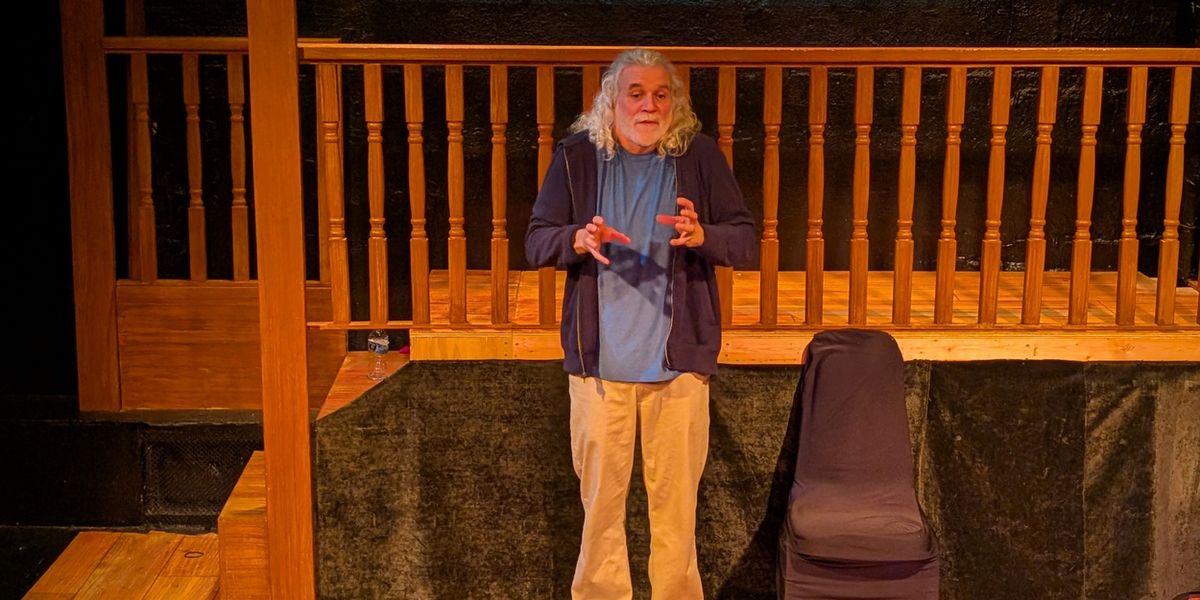
The laugh of recognition
The laughs in this show do not arrive where you would expect. He notices people laughing hardest when he is at his most serious. He compares it directly to the rooms he knows from AA.
People share appalling things, and the room laughs. It is not approval, and it is not cruelty. It is the sound of other people knowing exactly what you mean.
They laugh out of the darkness.
That is the register the show is written in. It asks for recognition rather than sympathy.
Smiling, and not smiling
He is deliberate about which lines carry a smile. His mother working through the sale circulars for weeks is one. She hunted for a cheaper price, never acted on it, and complained throughout. That one he delivers grinning.
Other lines get no smile at all. One is something he said to his father as a child.
Daddy, when I’m 18, if you’re not dead, I’m gonna kill you.
That one he delivers with a straight face. The show depends on knowing which is which.
Nine years in, and still emceeing
He did open mics and got on stage often in the early years. He also kept disappearing. The wake-up call came from another comic at a gig, who asked who was hosting.
Dude, you’ve been doing this nine years. I’ve only been doing it six and I’m featuring.
He describes the problem plainly as an inability to follow through. The hundred and seventy-five jobs by forty are the same pattern in another form.
Pryor, Carlin, and telling the truth
He admired Richard Pryor and George Carlin for decades without understanding why. The answer only arrived a couple of years ago. As a child, they were the first people he encountered who told the truth. Television did not. His parents did not.
And I wasn’t attracted to the laughs — I was attracted to one or two little things they said that were honest.
His brother owned Class Clown, which made Carlin the first comedian he ever heard. He saw the show twice and never met him. People tell him he resembles Carlin, and in Scotland they say Billy Connolly instead.
Sandy, and the phone that did not ring
Hurricane Sandy hit in 2012 and ruined his house. He told his sister, and the family responded with jokes. Then he came home and waited for somebody to arrive.
He sat on his front steps and watched the street. Every neighbour had friends turning up with breakfast and coffee. One neighbour had not spoken to his father in years, because his father hated him for being gay.
Tom, my father came and got me.
Nemec worked out that nobody was coming to get him. That was the moment the lie collapsed.
We were never really a family. We were just kind of roommates.
Nobody had taught any of them how to be one. He decided then that he had to tell this before he died.
The Footlocker on the lawn
He owned a Footlocker holding everything he had ever done. After Sandy the whole street was piling ruined possessions out for the crane. He dragged the Footlocker out and put it on the pile.
He threw all of it away. He still does not know why. He describes it, without hedging, as a very self-destructive thing to have done.
Set against that is the earliest good night he remembers. It was a showcase at Rascals in New Jersey, five minutes long. Even the manager told him it had been a strong set.
The night he lost the room
Years ago he was recording a show in New York and it was going well. Then he moved into the family material and the audience went with him no further. He could not work out why until he watched the tape.
I watched the video and I saw my face change.
His whole mood had shifted, and the room felt it. Saying it with a smile was beyond him at the time. He now thinks he should not have been performing that material yet. He was not emotionally equipped to hold it.
That has changed. His father was a crazy drunk, and he can say so at peace now. The same sentence used to leave him tight and angry.
Reliving it, nightly
Performing the show does put him back inside the events. Sometimes something lands and he finds himself laughing with the audience.
Folks, these are tears of laughter.
Some people understand that line and some do not, which he accepts. He has another version for the same moment.
I’m laughing about it now, but on my way home I’m gonna be crying.
Both are true simultaneously. That is roughly the thesis of the hour.
Lockdown, Zoom, and a director
He started writing during lockdown without telling anyone. He read monologues at Zoom open mics and changed nothing between readings. The point was to get the words out of his mouth at all.
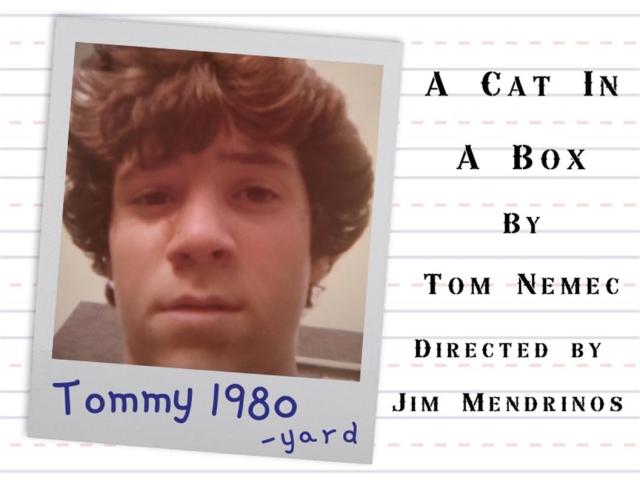
Some scenes still take a run-up, even now.
All right, Tommy, just do this. It’s gonna be over in a few minutes.
When Jim Mendrinos came on as director, Nemec set the terms immediately.
I don’t want anybody to tell me what to do, and I don’t want anybody to write anything for me.
Mendrinos agreed it was his show, and said he was there to guide it. Nemec credits him with being excellent at exactly that. The most common note was that a piece worked but did not move things forward. He concedes that most of the time this was correct.
Why a cat, and why a box
The title has an obvious reading about nobody checking on you. Nemec’s own explanation is more literal. Put a kitten in a box and feed it there, and it lives in the box.
Take the cat out when it is grown and it behaves strangely. People ask what is wrong with it. You explain that it was raised in a box, and everyone softens.
That’s so sad, the poor cat.
The same generosity does not extend to people. An adult describing a dysfunctional upbringing gets a different answer.
Get over it. You had a roof over your head.
The gap between those two responses is what the play is about. The title does the argument in four words.
The spot on the kitchen wall
Asked for his favourite part, he chooses his father’s death. He did not care for the man, and his life genuinely changed. For years as a child he had prayed for him not to come home.
The call came while he was in the kitchen with his mother. He turned to face the wall and smiled. For years afterwards he would touch that same spot every time he passed it.
His request to anyone coming is modest. Come and say hello afterwards, particularly if the show landed close to home.
Nemec spent thirty-five years putting fragments of this into comedy club sets. The rooms laughed, and then everyone went home unchanged. Theatre, he says, sends people out carrying something. That is the whole reason he moved the story across. He is not asking for sympathy, and the show does not seek it. A Cat in a Box runs fifty minutes and covers sixty years. He would like you to say hello afterwards. Especially, he says, if you recognised yourself in any of it. Those are the people who tend to have more to say. He has waited a long time to hear it.
A Cat in a Box plays theSpace at Surgeons Hall, Theatre 3. The run is 7–15 August 2026 at 14:05, and lasts fifty minutes. Written and performed by Tom Nemec, and directed by Jim Mendrinos.