
Whisper Theatre’s Britt Anderson and Richie Schiraldi are married, and they have three shows. Well-Balanced Dads is the duo one, and it involves acrobatics. The Mothman Cometh is Richie’s solo hour, performed entirely in the dark. Arachne Athena is Britt’s, and Athena coughs up spider webs. They run Whisper Theater, formed in 2019, and have made eight shows.
Britt came from South Carolina to Chicago to study improv. She wanted Saturday Night Live and found clown instead. Richie grew up playing sports and did not meet theatre until his final year of school. He is now a competing circus artist in wheel gymnastics. Both hold master’s degrees in physical theatre. They met when he performed on a variety night she ran. They have been training together for about eight years. This is their fourth year at the Fringe. Their first was 2019, and they did three performances. Eleven people came to the first one.
We caught up with both of them to talk about cryptids, crocheted webs and broken toes. We also covered the dinner where they nearly gave up theatre entirely.
A clown wig on a tricycle
Britt was performing long before anyone called it that. She is the youngest of three, and her mother still tells one particular story. It involves a clown wig, a tricycle, and a lap of the house.
The audience was her mother and her mother’s friends. The objective was making them laugh, and it worked. She knew early that she wanted that.
She was a writer first, and read constantly as a child. Theatrical performing started at about thirteen, cast as the little old man in James and the Giant Peach. What she liked was playing anything other than herself.
Chicago came later, for improv. The plan was sketch comedy and eventually Saturday Night Live. Clown, collaboration and slapstick intercepted her, and she went to grad school for physical theatre instead.
A senior thrown into a musical
Richie’s route in had nothing to do with theatre at all. He grew up playing every sport his mother could enrol him in. He describes it as a team-oriented, collaborative childhood.
He did not know what theatre was until his last year of school. His family had moved, he knew nobody, and he got badly depressed. The theatre department took him in.
They cast him in a musical, having never seen him sing, dance or act. The reasoning offered was that he was a senior who looked older than the freshmen. He is unsentimental about how that was phrased.
He is unsure whether he liked being in a musical. He did get stage combat, a solo song, a dance and a stage kiss. That felt like a complete package, and something registered.
He studied theatre locally, and the college introduced a physical theatre programme in his first year. Juggling, tumbling and clowning followed.
Oh, this is theatrical sport. This is speaking a language that is somewhere inside of me.
— Richie Schiraldi
His final year was spent in Italy on mask work and ensemble devising. Then Chicago, where he taught circus and became a circus artist. Grad school taught him to use circus as a language rather than a display of tricks.
Heels Over Head, and the same grad school
They met because Britt ran a physical comedy variety night in Chicago. It was called Heels Over Head, at iO Chicago, and she ran it for four years. Richie started performing on it.
Both wanted the same thing from circus and heightened physicality. They wanted it inside a story rather than presented as a trick. After about a year of friendship, both got into the same grad school programme.
That is where they started working together, and where they started dating. They now describe the training partnership in years rather than shows.
It helps that we’re married.
— Richie Schiraldi
Whisper Theater followed in 2019. Eight shows so far, as soloists, as a duo, and with other Chicago ensemble members.
Eleven people, then forty
Edinburgh 2019 was the first Fringe either of them had attended. They brought two grad school pieces: his movement show about dreams, and her show about three bouffon women clowns. Neither had any idea what they were walking into.
The first show drew ten or eleven people, most of them friends. The second doubled. So did the third, which was also their last, finishing at forty or fifty.
We were absolutely smitten.
— Richie Schiraldi
He now calls the festival a monster, and exhausting. He also thinks being new and modestly successful meant they only felt the magic. Britt’s takeaway was more technical.
At Edinburgh Fringe, you have a chance to become a comedy scientist.
— Britt Anderson
Her point is about volume. Nowhere else offers that many repetitions in that short a window. You can try anything, in front of an unusually diverse audience.
Nearly quitting, then a farce
The pandemic came close to ending it. Richie remembers a specific dinner where both of them started crying. Zoom theatre was not a substitute for what they do.
Is this it? Is that theatre?
— Richie Schiraldi
They were, by his description, a breath away from stopping. Then Britt made a suggestion that turned it round.
We should write a farce.
— Britt Anderson
The heightened, upbeat physical comedy they built became the container for everything. Circus could sit in it naturally as a physical language. So could the stupid characters they liked playing.
He describes it as everything going dark, and then a small flame. They kept feeding it until it became the three shows they are running now.
Yoga mats in a one-bedroom flat
The physical training carried on in impossible conditions. They cleared the furniture out of a one-bedroom flat and put down yoga mats. Floor acrobatics happened there, mostly to keep their bodies moving.
Each also worked outside the flat. Britt joined a playwrights’ circle. Richie joined a group called Manifesto, built around defining what you think art is.
He made a lot of Zoom theatre aimed at physicality, playing with fast-forwards and reverses borrowed from silent film. Britt experimented with camera and lighting. Neither claims it was good.
The lasting outcome was both solo shows. Britt wrote Arachne Athena across four years, starting then. Richie’s Mothman existed as eight or nine competing characters before it settled.
Killing darlings
Both are practised at the specific pain of cutting good material. Britt describes the stubbornness that precedes it. She will be certain a moment works and keep hunting for the right delivery.
The hard part is admitting that certainty was wrong. A mentor gave her a reframe she now uses.
Maybe you’ve got this great idea, but it’s not for this show.
— Britt Anderson
The idea is not necessarily bad. It just has to be pinned for the next thing. She adds that you do not have to fit everything you are into one hour.
Richie’s version of the same lesson is about recovery. Bombing in a room taught him to listen and adjust in real time.
You get to find the failure and then fine-tune it into success.
— Richie Schiraldi
He now reckons audiences cannot tell when something has gone wrong. The next moment lands, so the previous one reads as intentional.
Broken toes, and plans A, B and C
Injuries are a working condition rather than an accident. Richie competes in wheel gymnastics, spinning inside a large metal ring. He was at a world championship for it in July.
Training for that produces regular damage. He has walked into rehearsal with a broken big toe and asked how the show survives it.
He also teaches children to rock climb in the States. At summer camp two months ago he strained a vocal cord shouting over the noise. He lost his voice entirely the week before a talk-heavy show.
They started working out which of his lines were essential and how Britt could deliver them. His voice returned the morning before opening.
So basically, Well-Balanced Dads is me working around Richie’s injuries that he gets from doing his other work.
— Britt Anderson
She has her own list, including a bad toe sprain and a back thrown out mid-performance. That one happened during a deliberately stupid dance move. The show continued and her character became slightly stiff.
Eight years of training together means they can decide silently on stage. There are contingency plans for injury, for concrete floors, for outdoor gigs and for low ceilings. Sometimes the call between plan A, B and C is made five minutes before curtain.
The Mothman Cometh
The Mothman is a cryptid, first widely reported in 1960s West Virginia. A bridge collapsed, people swore they had seen a creature, and it became a harbinger of doom. It resurfaced in Chicago in 2016 and is now a pop culture fixture in the States.
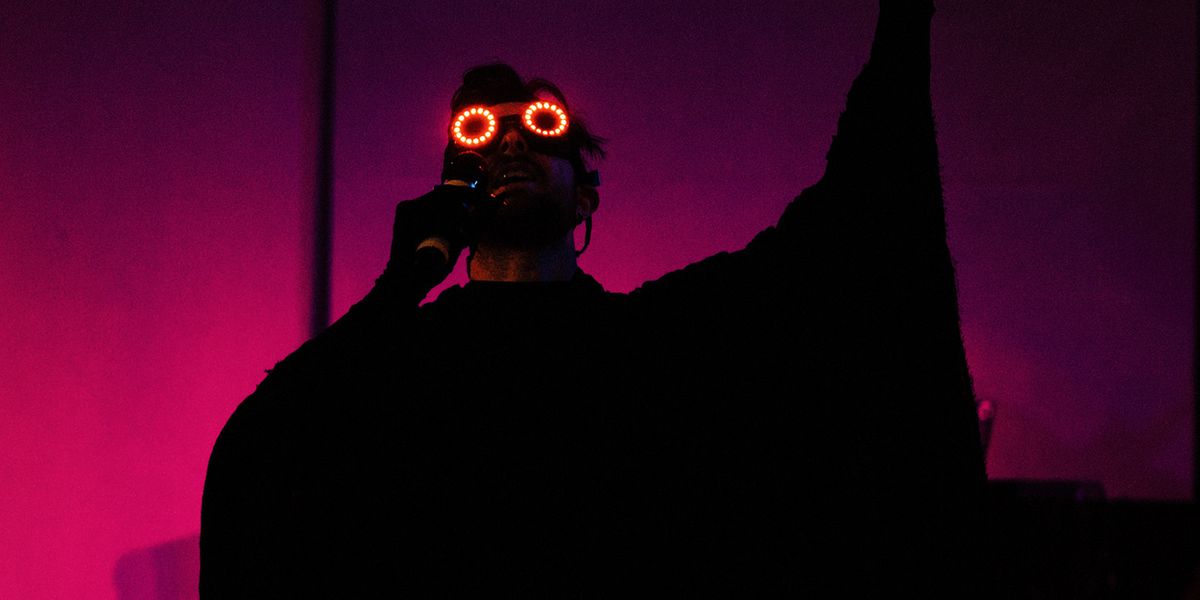
Richie plays it for an hour, in the dark. The only light is a pair of LED goggles serving as glowing red eyes. The audience is recruited as minions of darkness.
There are games, rituals and happenings, all about embracing darkness collectively. Some of it is deeply serious and some of it is extremely stupid. He establishes the register early and deliberately.
The Mothman is sort of a Muppet, so that it’s not so scary.
— Richie Schiraldi
That framing lets the show approach fear, anger and loneliness without becoming unbearable. At one point the audience shouts out what frightens them, popcorn style. Some nights that goes on a very long time.
The darkness itself does work he did not entirely expect. People drop their defences faster when nobody can see them. He sings too, as Mothman gets possessed by songs with dark messages hiding inside them.
The costume, largely invisible, is a black spandex unitard and a hand-stitched cape. There are Japanese tabi shoes that split the toes. People have called it a horror comedy, and he stresses the second word.
Everybody has a flame
The title promises a reckoning, and the show delivers a gentler one. Mothman spends the hour refusing to be vulnerable and losing that argument. By the end the audience shows him his light.
Richie’s explanation of what that means is unguarded. Everybody carries a flame, and nobody can always keep their own lit.
Maybe I can follow one until mine’s reignited.
— Richie Schiraldi
The alternative is noticing somebody else’s dimming and sharing your fuel. He thinks that is the moral of the whole thing.
Arachne Athena
Britt’s show puts Athena in the present day, out of retirement. She has decided to restore order and justice for all mortals. She has also launched a memoir and hired a marketing team.
The show takes the form of her book reading. Then she starts coughing up spider webs and cannot work out why. She has been cursed to keep coughing until she admits the injustices she committed as a judge on Olympus.
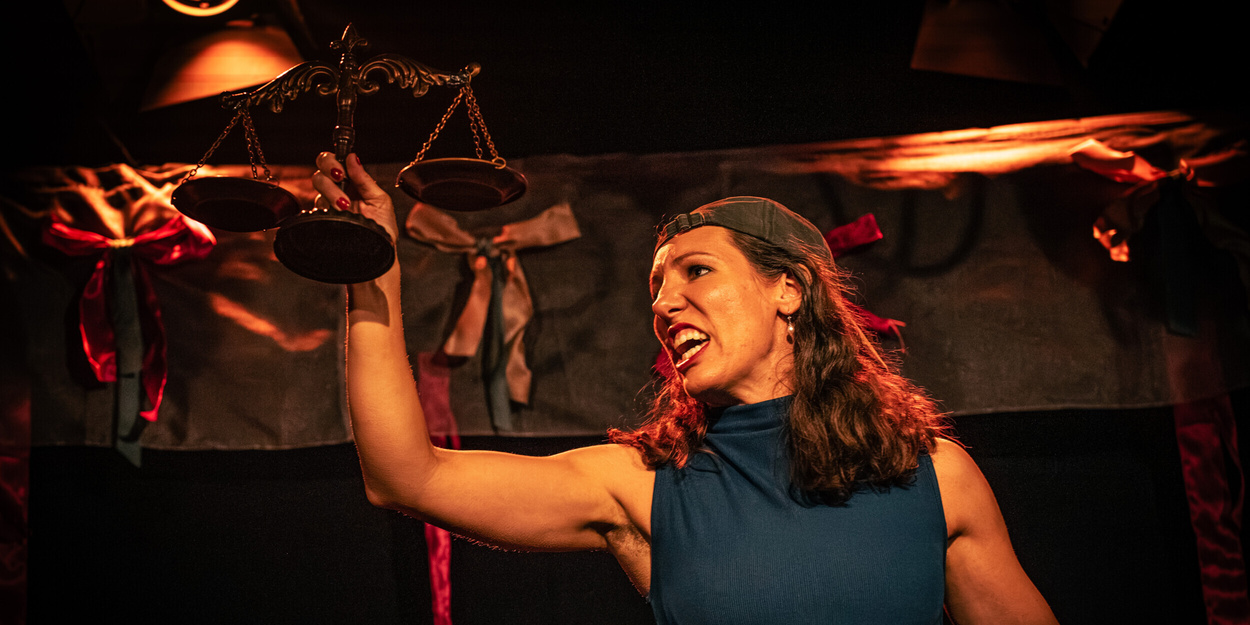
What follows is a long flashback, retold honestly this time. The myth underneath is Arachne, the mortal weaver who claimed to be the best in the world. Athena took exception, there was a contest, and Arachne ended up a spider.
Britt plays every character, including Arachne and several surprises. The argument between them is about who gets to define justice. Athena believes it descends from Zeus and her family, and Arachne believes mortals make it themselves.
What is art’s role in creating justice or upholding justice?
— Britt Anderson
She calls it a dark comedy, mostly for want of a category. In practice it is physical comedy, body horror and storytelling fused together.
The webs she crocheted
The difficulty of the character is that she feels entirely justified. A goddess of justice does not readily concede fault. Britt draws a comparison she leaves open-ended.
People often set out convinced they are right and know why. Then bureaucracy or nepotism or lobbying pushes them off the path. They lose sight of what they were fighting for in the first place.
What holds Athena accountable is the webs, and Britt crocheted every one by hand. By the end they are everywhere. Certain webs appear unexpectedly, lit by blacklight, which shifts the whole scene.
That lighting change is the signal. It marks the point where the storytelling stops being light and Athena has to look at what she did.
Well-Balanced Dads
The duo show is about two fathers who are best friends and neighbours. Their children have just left for college and neither knows what to do. They are bored to tears and unsure what being a dad means now.
They also happen to do acrobatics, which Richie is careful to explain properly.
It’s not so much like, ah, look, the dads are acrobats.
— Richie Schiraldi
The acrobatics are the emotional vocabulary. A heightened moment means they flip over each other. A good joke gets celebrated with a trick.
The audience is taken on a camping trip, playing hitchhikers and fellow campers. It is heavily interactive throughout.
It’s a show for anyone who is a dad, wants a dad, or has a dad.
— Britt Anderson
They are firm that the acrobatics never fail on purpose. Danger would make an audience worry about the performers rather than the characters. When they do fall out of a trick, years of training mean you probably will not notice.
The tonal split across the three shows was deliberate. They made the two dark ones first and then wanted something dumb.
Well-Balanced Dads is not just dumb. It is very dumb, in a good way.
— Britt Anderson
It also sends people out teary and wanting to phone their fathers. The company mission covers laughing, crying, singing along, and thinking about something afterwards.
What each loves in the other’s show
Asked for his favourite moment in Britt’s show, Richie chooses the emotional climax. It involves Athena playing Arachne playing Zeus, as a burlesque piece standing in for one of the weavings. The weavings are staged through song and dance rather than held up for inspection.
The piece gets raunchy, and it enrages Athena. What follows collapses the distinction between the flashback and the present. He says the room goes sober and leans forward.
He runs tech for the show and has watched it being written over years. Describing it, he starts getting emotional.
I get to watch my partner thrive in an emotional Olympic event.
— Richie Schiraldi
Britt’s answer about Mothman is lighter but no less technical. What she admires is his ability to give an audience the confidence to do things they never would. They never notice he set it up.
What she watches for is the exact moment the room commits. It arrives at a different point every night, sometimes early and sometimes late.
It feels like the audience is one group laughing and moving and feeling together.
— Britt Anderson
Richie describes the same instant from inside it.
It feels like a moment of grace when the entire audience clicks in.
— Richie Schiraldi
He says the number does not matter, whether it is ten people or eighty. He also says he does not want to force anyone, because sometimes a show is simply not for you.
Britt notes the two shows announce it differently. In Mothman it arrives as laughter. In Arachne Athena, it is the moment the room goes completely quiet.
The three shows divide neatly between them. Richie’s is dark, loud and lit only by a pair of goggles. Britt’s is dark, quiet and ends in a room holding its breath. The one they made together is the silly one, deliberately. They wrote the two hard ones first and wanted relief. Well-Balanced Dads still sends people out wanting to phone their fathers. Their stated mission covers laughing, crying and singing along. Between the three shows they appear to have all of it. Eleven people came to their first Fringe show in 2019. They have not stopped coming back since.
Well-Balanced Dads, The Mothman Cometh and Arachne Athena all play the Edinburgh Festival Fringe. Arachne Athena opens on 17 August. All three are produced by Whisper Theater.