
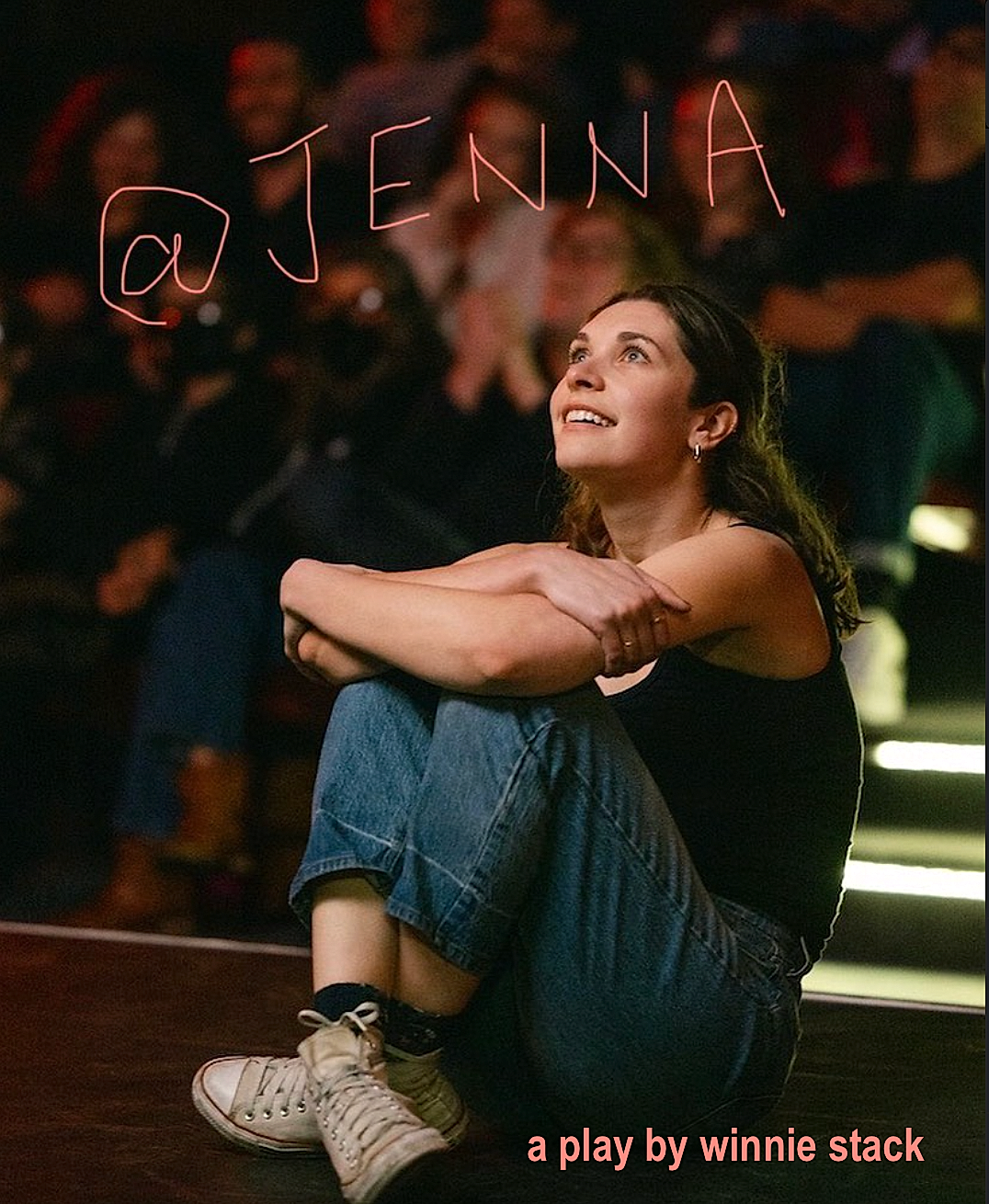
Winnie Stack started keeping a journal at nine, and kept it religiously. She wrote down as much detail as she could. She drew a picture beside almost every entry. She suspected even then that she would read them again one day. She did not expect to build a play out of them. @Jenna is that play, and the first Winnie Stack has ever written. The New York performer has acted since she was five. Her first stage memory is crossing her eyes as a mouse, and hearing the room laugh. She has done theatre and sketch comedy since. But this is her first time alone on a stage with her own story.
The material is her childhood, from elementary school through college, told through the journals themselves. Real entries, real drawings, home videos and photographs all appear on screen. . The object was Pam Beesly, and by extension the actor Jenna Fischer. There is also a tree.
We caught up with Winnie to talk about journals, stage fright and anthropomorphised trees. We also covered what happens when you hand a room of strangers your eleven-year-old self.
A five-year-old, crossing her eyes
Her first show was Country Mouse, City Mouse. She was about five. She remembers almost nothing about it except one moment. The director let her cross her eyes on stage, and she pulled a face like a little mouse.
And I remember that being well-received, and I remember thinking — I’m into this.
She loved the comedic roles from then on. Part of the appeal was knowing her parents were laughing somewhere in the audience.
The play Winnie Stack had already half-written
@Jenna is the only play she has ever written. She is cheerfully aware this is an odd thing to advertise.
This is the only play I’ve ever written, which maybe is not great for marketing.
It is autobiographical, and she says it partly wrote itself. The raw material is a set of journal entries she rediscovered a few years ago. Half the show, by her reckoning, was written twenty years ago by a child.
Nine years old Winnie Stack, and obsessive about detail
The journaling started at around nine, and it was not casual. She was obsessed with recording as much detail as she could. Almost every entry came with a drawing, and there were stickers throughout. Those drawings now feature heavily in the show, and she finds them revealing. She always half-knew she would read the journals back one day.
And it has been fun — and completely cringey and embarrassing and insane.
What she did not anticipate was an audience reading them with her. That came later, and from an unexpected direction.
The podcast that gave her the idea
She performed on Mortified Live, where people read chunks of their own journals to a room. The audience arrives knowing exactly what they are there for, and she found them generous. Afterwards she talked to strangers about the crushes that had shaped their childhoods and the overlap was striking. So she went back to the journals and found more and there, it occurred to her that the entries could sit inside a larger structure.
A crush with no available language
She was ten or eleven, and nothing registered as significant at the time. She simply knew she was completely obsessed with one person. The entries track the shift from a vague inkling to total immersion. She followed the character, then the actor, then the career.
Everyone else was into Zac Efron and High School Musical and playing handball and Neopets. I was obsessed with a thirty-year-old woman on TV.
She is clear that she was too young to name what was happening. That gap is a large part of what the show is about.
The tree in the backyard
The journals are personified on stage, and so is a tree from her childhood garden. She thoroughly anthropomorphised it growing up, and told it everything.
He’s who I told everything to — the only living entity that knew my true, honest feelings.
In the show the tree is played by two friends, both of whom have their own Fringe runs. Her old theatre teacher appears too, along with a school play called Desperate Princesses. It was a parody of Desperate Housewives, performed by children in enormous wigs. Most of the jokes sailed straight over the cast. The adults in the audience got every one of them.
Winnie Stack is handing it all to strangers
A journal is written for nobody. The tree was a private audience of one. A Fringe room is neither. She says the first performance left her feeling strange and badly exposed.
My initial feeling was — oh my God, I’ve revealed too much. I’m going to be judged.
Then she realised that the discomfort was not a flaw in the show. Embracing it is the entire point, which makes the whole thing feel empowering and cringey at once.
Honest first, funny second
She was asked whether she worked to make the embarrassing parts read as funny rather than stupid. She says she deliberately refused to draw that line.
I tried to focus more on what is the most honest I can be.
If the result is uncomfortable, she takes that as evidence it is working. Some people will wonder why she would show any of it. She is writing for the ones who are open to it instead.
What the show actually looks like
There is a lot of physical comedy, and a lot of multimedia. The real journal entries and drawings go up on screen. So do home videos and childhood photographs. The venue is small, and the show is built on direct storytelling. She describes it as close to a one-to-one experience.
She is not alone up there in the strictest sense. An actor offstage feeds lines through a microphone, and she is grateful for him. But she is the only person the audience can see. After twenty years on stage, the fear has not gone anywhere.
Doubt, freedom and the dancing
She admits to real stretches of thinking the show might not work. Judging your own story from the outside is close to impossible. She has had to learn to be kind to herself, and to trust other people’s notes. The doubt turns out to be useful, because it keeps sending her back to edit.
It feels extremely freeing and cathartic — and scary, all wrapped up into one.
Improv helped, mostly as practice in letting go and enjoying it. Her favourite part of the show is the dancing, which she choreographed herself. She is refreshingly unconvinced by her own choreography.
But the dancing helps me get out of my body and remind myself that it’s just fun, and it’s supposed to be fun.
The best feedback, she says, has nothing to do with the show at all. It is the strangers who stay behind to tell her about their own first sleepover, or first kiss.
Stack is performing @Jenna twenty-seven times this August. That is twenty-seven nights of handing a room her eleven-year-old self. She says the fear has not gone anywhere, and she does not expect it to. What she is after is the other thing that arrives alongside it. The pockets where it stops being exposure and becomes something closer to relief. She has built the show so that those two feelings cannot be separated. The most embarrassing parts are the most honest ones. That is the whole bet. Strangers keep staying behind to tell her their own version. It appears to be paying off.
@Jenna plays studio at C ARTS, C venues, C aquila. The run is 5–30 August 2026.