
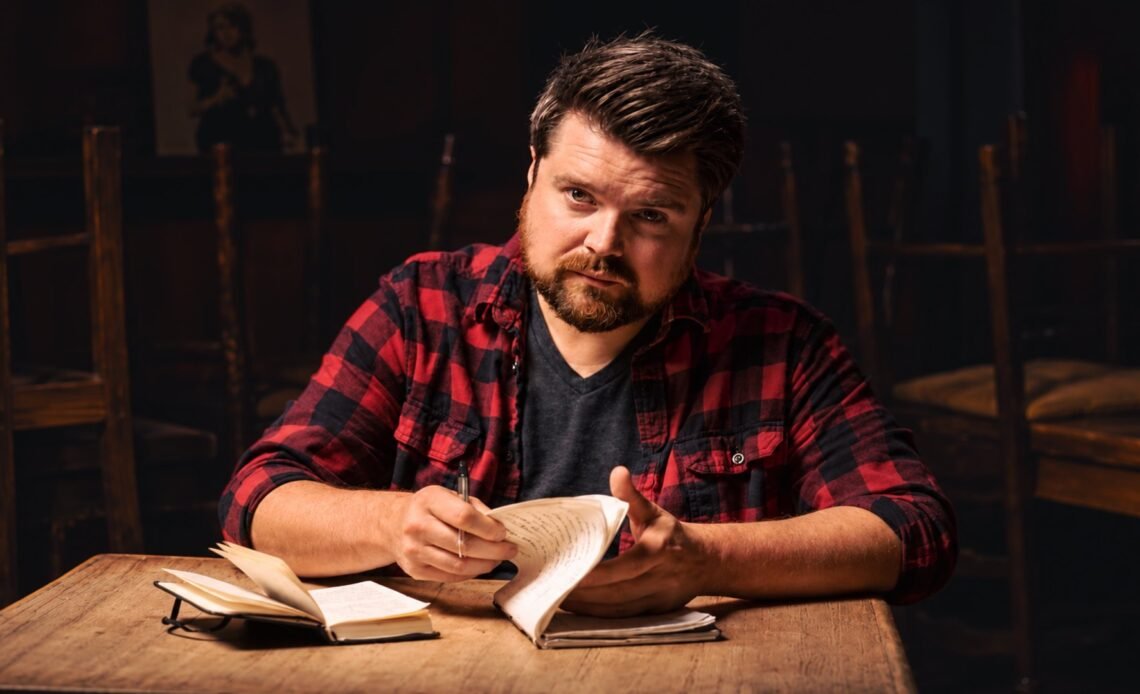
Simon King is a stand-up comedian and actor, born in England and based in Vancouver, Canada, where he has lived since the age of five. He did his first open mic on 8 February 2000 and has been a full-time comedian since August 2002. His specials include Furious (2016) and As Good As Or Better Than (2023), directed by Rory Scovel. Robin Williams once described him, in writing, as "truly a gifted comedian".
Simon King talks faster than almost anyone in stand-up, and on stage he is loud enough to drop the microphone altogether. So it is a surprise to hear him say that his favourite comedy is clean, absurd and built on one-liners. Ten years into his career he was ready to quit. One bad night in Vancouver, and one sentence from the friend running the room, changed his mind. We asked him about that night, about the special he recorded in a rage, and about the letter Robin Williams wrote for him.
A fire hose of jokes
His first time on a stage came at seven, in a musical his mother was acting in. He got a laugh, and remembers thinking that the stage felt comfortable. (Other comedians have told us about the first laugh they ever got.) After years of theatre, bands and sketch, he saw live stand-up for the first time in a Vancouver club in October 1999. On 8 February 2000 he went up third at an open mic, the order picked out of a hat. He does not remember what he said. He remembers coming off stage “being like, I need to do that again. Whatever that was, I need to do that again.”
In 2002 a night job was getting in the way, and his manager gently pushed him to leave it. On 8 August that year he took over a small 30-seat room and gave himself a rule: headline it every week with new material. Most Thursdays that meant a fresh 20 minutes in front of the same 20 or so regulars. “It taught me that comedy has absolutely no rules to it and you can do whatever you want.” Early on, he says, he did not realise an audience needs a break. “I was just like this fire hose of jokes and energy because it was all bottled up in me.” Before the pandemic he was doing 300 to 400 shows a year, and he puts his total at close to 10,000 sets.
Nothing written down
King calls himself an instinct-based comedian. “I don’t sit down and write jokes out on paper. I go up and I improvise and then remember.” He takes a notebook on stage, riffs, and writes things down afterwards. The result is what he calls accordion-style comedy, going “out to this crazy extent and then come in and then go out”. It is a very different method from the ones in our piece on how comedians write their jokes.
He used to do a format he called Steel Trap, riffing on topics the audience had written down before the show until he had covered every one. “Some of it was great and some of it was garbage.” “My best work always comes from me going up and being like, I wonder what will happen.” There is more on that kind of thinking in our guide to improv for stand-up comedians.
The hard part, he says, is phrasing a big idea “in a way that 99% of people are going to understand and then 85% of people are going to find funny”. And he does not believe a comedian should start from the audience at all. A famous comic once told him he was only being funny for himself. King agreed.
“I’ve never gone on stage thinking, how can I make the audience laugh? I’ve always gone on stage thinking, what do I want to say?”
The night he stopped caring
The industry has always been the hard part for him. Comedy competitions in San Francisco and Seattle led to the HBO US Comedy Arts Festival in February 2005, when he had been full-time for less than three years. Suddenly he had managers and agents in Los Angeles, and people who wanted to plug him into shows rather than send him on the road. “It really kind of broke my brain a bit.” When that fell away he recorded the album Unfamous at the end of 2009 and planned to stop.
In about June 2010 he was closing a show in a small Vancouver room. The line-up was strong and every comic before him had struggled. He went up with his set from Unfamous, and it was working. Halfway through, he stopped. He did not like what he was doing, and for the first time he said on stage what he actually thought. The room went with him, then against him, then back again. Afterwards he apologised to his friend who was running the room for being unprofessional. The answer has stayed with him since.
“If you do that every time, you might be a good comic one day.”
An older comic had taught him something similar in 2006, when a couple walked out of a set that was going well. “Good,” the older comic told him, and asked why he would want people who would never agree with him to like him. “As independent and creative and unique as you are, it means that not everybody’s going to be on the same wavelength. And that is okay. In fact, that is a sign you’re doing it right.” More comedians on getting through the hard years are in our piece on resilience in comedy.
Furious, and the sun
Furious came out of the Los Angeles years: driving for hours to empty gigs, meetings that went nowhere, and being slotted into shows for his voices and impressions. He was angry at the industry, he says, and at himself for not being honest. The special was never meant as a major release. It was meant as a bootleg, to mark that point in his career, and he cut a lot of it because it was too intense.
“What you’re seeing in that special is not a character. It’s just me without control. It’s just me going, I don’t care anymore and I need to say these things.”
We told him our favourite part was the opening, in which he walks out without saying hello and, within a minute, has the audience agreeing that we should destroy the sun. Then he turns on them, because of course we need the sun to live. It is a lesson in mob control, he explains, of the kind any demagogue uses, and a warning to pay attention because the night will not go where they expect. It also sets up his rhythm. Comedy is beat-based, he thinks, and a crowd will follow a hard idea once it knows the pattern: “this part goes fast, this part goes slow, this part gets dark, this part gets light”.
Hard subjects, no victim
King’s act goes at race, gender identity and his own mental health. He calls humour “an incredible delivery system for a message” and “an incredible way to break down defences”. Some premises in his old notebooks took ten or fifteen years before he had the skill to do them properly. Where other comedians draw the line is the subject of another of our pieces.
“I treat stand-up like woodworking. Like the idea that you could be the best woodworker in the world, but if you don’t have the chisels and the tools, it doesn’t matter.”
He admires what Bill Hicks meant to comedy but not the “you people” approach. He takes himself down before he attacks anything, and he is open about his own privilege. In one bit he says white privilege is not money but “the fact that I just don’t think about my race”. In As Good As Or Better Than he talks about suicide and his own state of mind, and the new material he is working on covers his OCD, anxiety and depression. People often talk to him about them after shows, and he jokes that he has “hugged an inordinate amount of crying people” in his time.
Stand-up only, online
He ignored social media for years. About four years ago his father died, and while grief kept him off the road he gave himself six months of posting every day. Many comedians who do well online are not posting stand-up, he noticed, and it can hurt their ticket sales. So he posts almost nothing else. “I’m a comedian for comedy fans,” he says. He accepts that “I probably could have another couple hundred thousand followers had I done something else.” His messages now come from Carlin, Burr, Sykes and Chris Rock fans, which is the trade he wanted. We have looked at social media against the stage before.
The letter from Robin Williams
King met Robin Williams in the early 2000s, when Williams was in town filming Insomnia and dropped into a local room. Within five minutes, King says, the two of them were holding each other up laughing. King invited him to a small open mic at a French Canadian restaurant. The night Williams came, not one audience member turned up. He stayed and talked with King for the best part of 40 minutes anyway. A few weeks later he came back to a packed room and saw King perform for the first time.
A few months after that, King needed an O-1 visa to work in the United States, which meant letters of recommendation. He asked his managers not to bother Williams. They did anyway, and he is glad now. He still has a copy of the letter, and read us part of it: “I’ve been incredibly impressed by his unique talent. From everything I’ve seen, Simon is truly a gifted comedian.” He never saw Williams in person again. When Williams died, he told his wife: “I feel like I lost the best friend I hadn’t made yet.”
The new special, and his Mount Rushmore
The new special is taped and in final edit. He recorded about an hour and twenty minutes, which has to come down to around 55 minutes to an hour, with a longer version planned as well. He is choosing between two titles and will let the cover art decide. It opens with the line “I don’t want to be here”, and he calls it a very dark special, with a middle section on capitalism, money, wealth gaps and internet use. It was made entirely in Canada, with a Canadian label. He wants it out before the end of the year but has not fixed a date.
We ended by asking for his Mount Rushmore of specials. He chose Brian Regan’s I Walked on the Moon, which he listens to with his son; Doug Stanhope’s Beer Hall Putsch, for its depth and its sense of mortality; Maria Bamford’s Ask Me About My New God, for the way it moves between dark and light; and George Carlin’s Jammin’ in New York, for the way it balances heavy political subjects with absurdity. None sounds much like him. “I just love good comedy.” The full set of credits, quotes and his biography are in Simon King’s press kit.
You can find Simon King at thisissimonking.com and at @thisissimonking on Instagram. For more conversations like this one, see all our comedian interviews.
See our Instagram post about this interview. Follow Hop For Pop on Instagram at @hopforpop and @thecomicsunseen.