
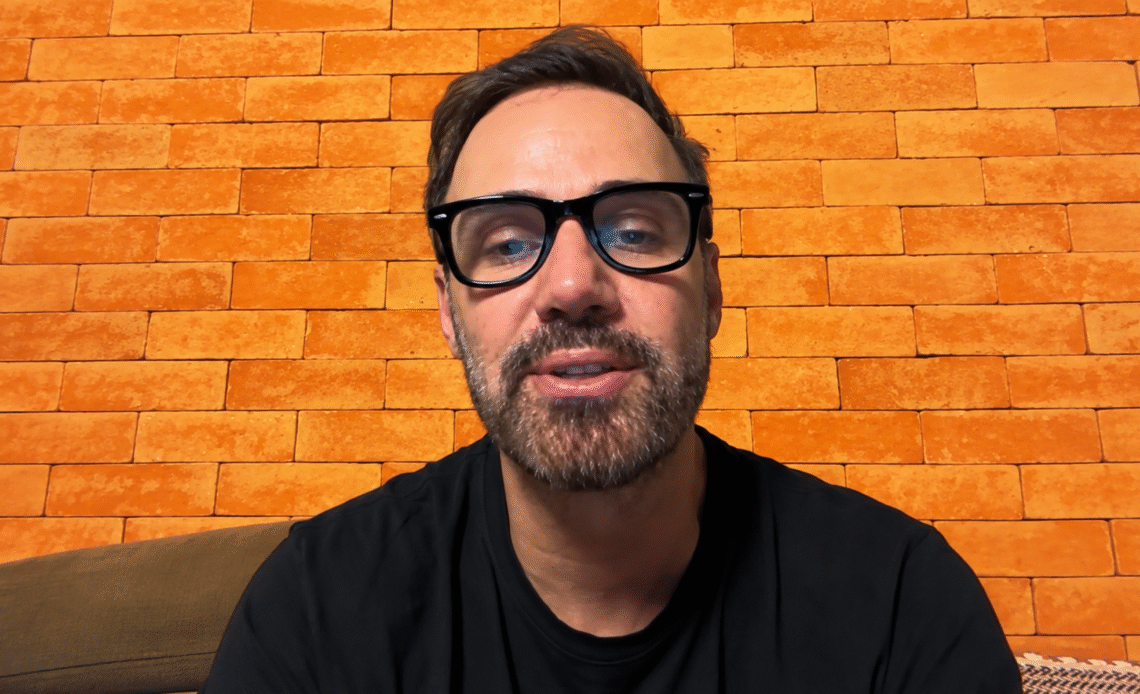
Diogo Portugal is a Brazilian comedian from Curitiba and one of the pioneers of stand-up in Brazil. He began with characters and impressions, then switched to stand-up about twenty years ago, at a time when he had to explain to audiences what stand-up was. He helped launch Risorama, the comedy festival within the Festival de Curitiba, in 2004 and still runs it, and he created Fritada, the Brazilian roast. He has performed in English in New York, Miami and Tokyo. His current show is Impróprio Para Políticos, "not appropriate for politicians".
In February 2026 a Brazilian appeals court acquitted the comedian Léo Lins, who had been sentenced the year before to more than eight years in prison for jokes in a stand-up special. Diogo Portugal’s response was to book him. Lins went straight onto the bill at Risorama, the festival Portugal runs in Curitiba, and the press came looking for an explanation. He gave them a line he has used for years: a joke is not your opinion.
The night he took the microphone off the stand
First, the name. It is Diogo, not Diego, though he lets Americans say Diego because it is easier. Portugal is a family surname and Diogo was his great-grandfather’s name, which means a lifetime of explaining that he is called Portugal and comes from Brazil. Asked who he supports when the two countries play each other, he sidesteps and names his club instead: Coritiba, from his home city.
He did not plan to be a comedian. A friend was moving to Europe and threw a going-away party to raise money, and asked Portugal to do a few minutes for the guests. “I said, but I’m not a comedian,” he remembers. He was funny for his friends, he told him, not for an audience. The friend insisted. “He believed in me more than I did.”
It started politely. A few jokes, some impressions, a character his friends liked, and not much laughter. Then something small happened that he can still describe exactly.
“I remember the time when I grabbed the microphone and took it out from the mic stand, and then I was more confident. I started talking to people, I was more loose, and then people started laughing. I remember this exactly.”
He has not performed behind a stand since.
Stand-up before Brazil had comedy clubs
More gigs followed, but there was nowhere to do them. Brazil had no comedy clubs then. “We were always performing in places where we were not supposed to be,” he says. A jazz band would announce a break and the comedian would go on. “People weren’t there to watch me. They were there to see another thing.” Today the country has plenty of clubs, and he owns a venue in Curitiba himself. Fabrizio Copano tells a similar story about Chile, where the scene began on the second floor of a tango club.
For years his act was characters, wigs and impressions of politicians. He had seen stand-up as a seventeen-year-old exchange student abroad, but at the time he was a bass player with a band and his head was elsewhere. About twenty years ago he made the change that he calls the biggest challenge of his career.
“No wigs, no characters, nothing. Just me, with a clean face, talking to the crowd.”
Almost nobody in Brazil was doing it. “I remember that I had to explain what stand-up comedy was.” He would tell people it was a kind of storytelling with a punchline in every sentence, and they would still not quite follow. (Byron Bertram went the other way, and found fame only when he put a character on.)
The band taught him more than he expected. Making a room dance and making a room laugh are, he says, the same problem. “If you do it right, people will dance. If you do it right, the exact timing, the exact surprise of the joke, people will laugh. Otherwise, they won’t.” The difference is that a band can rehearse. “There’s no rehearsing for comedy. You write the joke, you have the idea, and you try it.” We have a longer piece on why timing decides whether a joke lands.
Risorama, and why the unknown comics often win
Portugal is open about where his ideas come from. “I never invented a new thing,” he says. He sees something he likes abroad and asks why Brazil does not have it. Risorama came from watching Just for Laughs in Montreal and admiring how many people it gave a chance to. His version starts in Curitiba every year and then tours other cities.
The formula is deliberate. He books the biggest names in Brazilian comedy and puts them on the same night as newcomers he thinks will be famous in two or three years, the way a football coach mixes established players with a talented beginner. The audience buys tickets for the stars. Very often it is not the stars who get the biggest laughs.
“He has an advantage, because nobody expects anything from him. So he goes there and he kills it, a guy that nobody heard about.”
That, he says, is the real pressure of being well known. People arrive expecting you to be funny, so you have to keep writing new material to surprise them. “It’s always running after your own tail.” Nor does experience make the stage safe. “You’re never safe. And if you think you’re safe, then you’re wrong.” The night you feel unstoppable is the night you bomb.
Starting the Brazilian roast
Fritada, his roast, was another import. He likes what agreeing to be roasted says about a person. “When you accept to be roasted, it’s proof that you don’t take yourself so seriously.” In Brazil that is still rare. Getting a politician or a famous actor to say yes is hard, and many comedians turn down a seat on the panel too, worried the material is too heavy or that they will be cancelled for it. The ones who do best are the ones who do not care about that.
He has no time for the complaint that roasts are insulting. That is the point of them. He remembers Lisa Lampanelli answering a groaning crowd with: “Come on, this is a roast. What do you expect?” He also notes how often a roast has made a career, citing Anthony Jeselnik and Nikki Glaser, whose profile rose sharply after the Tom Brady roast. Not everyone agrees: Judy Carter told us she is not the person to teach anyone to roast.
Léo Lins and the joke that went to court
Léo Lins is a close friend, and Portugal calls him Brazil’s master of the acid joke. In 2025 Lins was sentenced to eight years and three months in prison, plus a fine, over a special that made jokes about disabled people, fat people, gay people and other minorities. An appeals court overturned the conviction in February 2026. Portugal has been sued over jokes himself, by politicians and others, though never on that scale.
When the acquittal came, he invited Lins to Risorama, and journalists asked how he could.
“I said, hey, he was acquitted. He’s free. He’s a comedian. He does jokes. He’s got to be at the festival, so we can celebrate the joke. Because a joke is not your opinion. It’s just a joke.”
His argument is that a comic does not create the terrible things he jokes about. They are already in the news, which is why the audience recognises them, and the joke is built from exaggeration and absurdity on top. If the comedian is guilty, he says, “everybody in the audience should be arrested together, because they laughed at the joke.”
None of this means he thinks everyone should try it. New comics see Lins or Jeselnik and decide they can do the same. “That’s a trap, because they still don’t have the muscles for this.” The experienced ones have been booed, have survived it, and have built up to that material over years. When a beginner bombs with it, he hears the same excuse. “Then they say, oh, the system is against me. Sometimes it’s not. Sometimes you’re not ready yet.” Jason Salmon gave us five rules for joking about a sensitive topic, and three of them are “be funnier”.
Not appropriate for politicians
He writes from two places. Some ideas arrive in the shower and come from his own life, such as a trip with his wife, which he then exaggerates into a story. The rest come from the week’s headlines, which he turns into jokes for his YouTube channel. That habit became his current show, Impróprio Para Políticos, timed for the Brazilian election. He is not gentle about the subject. Left or right, he says, it is one scandal after another and a promise that things will improve. “We’ve got to do jokes about that, because this is what we have left.”
The show before it was about artificial intelligence, under a title that translates as Artificial Stupidity. “We tried natural intelligence and it didn’t work. So let’s go for the stupidity.” Before that came Não Me Cobre Coerência, “don’t demand consistency from me”, so named because its subjects had nothing to do with each other.
He still has nights that make him question the whole career. His answer is to work out what went wrong and not to complain about it, and he has help: a long-time collaborator, now the director of the roast, who tells him when he is rushing a joke he used to tell better. Sometimes he goes back and watches old recordings to find the timing again.
He also takes the jobs many comics avoid. He writes custom sets for companies, including a recent show made entirely for lawyers, and he has performed in English at the Tokyo Comedy Bar, in New York clubs including New York Comedy Club and The Stand, and at the Miami Improv, opening for his friend Rafi Bastos. English is the hard part. More than once in our conversation a word escaped him. Other comics we have interviewed work across languages too, among them fellow Brazilian Manu Maciel and Stephan Dyer.
Next he plans to record Impróprio Para Políticos as a special and to start a second Instagram profile for his English material. He thinks he will probably call it Diego.
You can follow him at @diogoportugal on Instagram and watch his weekly material on his YouTube channel. For more conversations like this one, see all our comedian interviews.
Watch Diogo Portugal talk about Brazilian comedy, roasts and jokes on trial