
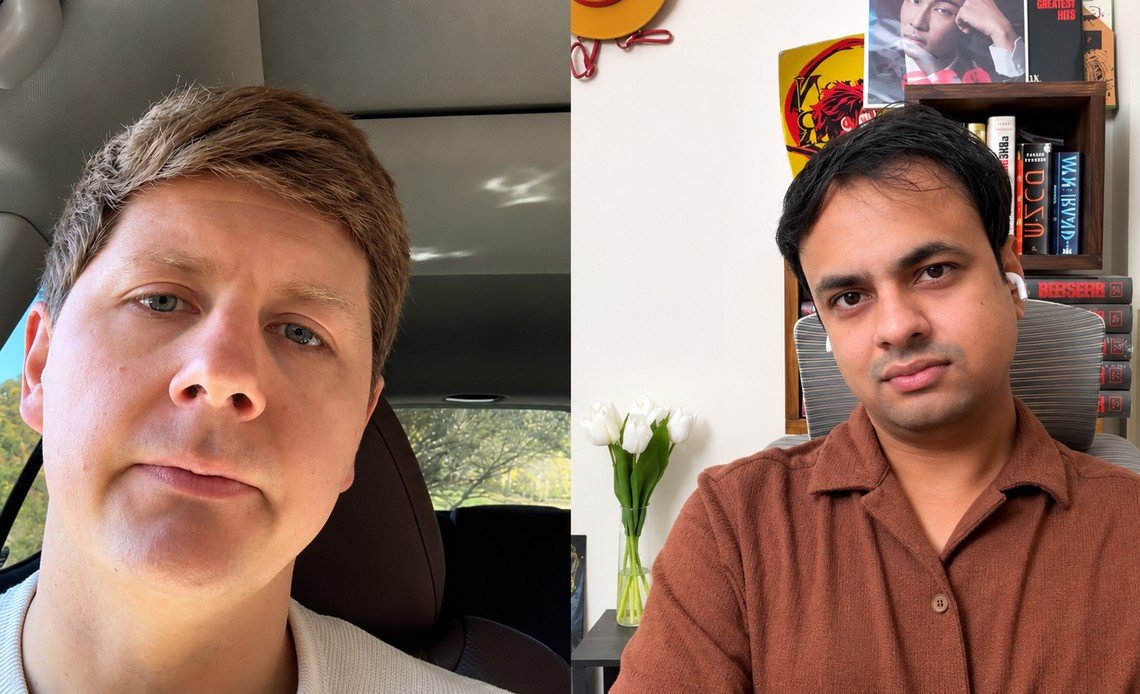
Joel Byars is a stand-up comedian and the host of the Hot Breath podcast, which has interviewed hundreds of comics over more than ten years, from Nate Jackson to Bo Burnham. He joined Hop For Pop on Instagram Live, from his car, to answer viewers’ questions about starting and surviving in stand-up.
Joel Byars has interviewed hundreds of comedians on the Hot Breath podcast, and he says the number-one piece of advice from them has never changed: get on stage. He joined us on Instagram Live from his car outside his in-laws’ house, because it was nap time inside, and for nearly two hours he and Kishan, our host, worked through viewers’ questions, from forgetting your next joke to producing your first show and going full-time.
Jump to: Getting started · Brain farts and bad nights · Finding your voice · Producing your first show · Clips and social media · Building a career · Ten years of Hot Breath

Getting started
The question Byars hears most is how to get on stage the first time. His answer is to lower the bar first. Go and watch an open mic, and see what everyone else is doing.
“Just go watch an open mic and you will see how bad people are at comedy.”
Joel Byars
Once you see that you can bomb in front of four people like everyone else, he says, the fear shrinks. What doesn’t work is assuming you can wing it because you were funny at work. Byars rehearsed constantly in his early years, saying his set while driving and while washing dishes, and his first set lists were word for word. He even transcribed his set by hand before shows “to try to just burn it into my brain”.
Classes can help you learn faster, he says, but they cannot replace stage time. If you are taking a class hoping to skip the stage work, “I would recommend just not taking the class.” And a good tight five takes far longer than new comics expect: months at least, he says, and maybe years before you have one you are proud of.
Brain farts and bad nights
What should you do when you forget your next joke? Keep talking. New comics often stop and announce it, the same way they tell an audience when a joke has not worked. But the audience doesn’t know.
“The audience has no idea if something works or not unless you tell them.”
Joel Byars
Byars learned this the hard way. Early on he would freeze, and the room would go awkward. Now he talks his way through, about the coffee shop, the barista grinding beans or whatever is happening, until his brain catches up. He used to do a Tuesday show in a coffee shop where that was exactly the kind of heckling he faced.
He has had the lights shut off on him, keys jangled at him and plenty of hecklers. The lesson he draws is not to give up on a joke after one bad night. We suggested trying a joke in front of 10 to 15 different crowds before deciding, and he agreed, adding that even then you can shelve it rather than kill it.
“Sometimes your jokes are funny, but you’re not a good enough performer to sell them yet.”
Joel Byars
Everyone goes through this. When COVID kept him off stage, his first real break in about ten years, Byars thought he had forgotten how to do comedy. It came back like riding a bike. For more on this, read how comedians survive their worst nights on stage.
Finding your voice
Mitch Hedberg was Byars’s favourite comic when he started, and for a while he sounded like Mitch. Most comics sound like their favourite comic at first, he says. He did one-liners for years before he developed longer bits.
That is still his advice for storytellers: learn one-liners first. Understanding set-up and punchline, and how to create an expectation and then break it, makes everything else better. If you have a five-minute story, cut it to a minute and see how it does on stage before you try the long version.
His own longest bit, a story in his first special about crying at his wedding, began as separate jokes about the proposal, the planning and the day itself. Over time he found the links between them. Another way to grow a joke, he says, is to look at it from every angle, “who what where when how why”.
As for voice, the answer is to write about what genuinely excites you rather than what you see working for others. When we mentioned that Larry Charles had told us to write jokes that make yourself laugh, Byars agreed, and gave a rule he uses for advice in general: take it from people you want to be like.
“Take advice from people that you aspire to be like.”
Joel Byars
Producing your first show
Byars produces a Funny Friday show with a theatre, and he listed the mistakes he sees most in new producers. The first is booking only your friends, whether or not they are the funniest. A show grows by word of mouth, so people have to enjoy it enough to come back.
The second sounds obvious: start on time. Waiting 30 minutes for two more people punishes the ones who turned up. His Friday show runs 90 minutes and starts and ends when it says it will. The third is the venue. Pick a place that already runs events and markets them, so the show is a collaboration. “That’s the quickest way for a show to fail is if the venue is not as invested in the show as you are.”
And if you are hosting, your job is not to kill. It is to set a fun mood for the comics after you. Doing as much time as the headliner has a name in the States: “host-lining”.
Clips and social media
Should new comics post crowd work? Byars passed on advice from a comic he had interviewed: don’t post stand-up for the first few years. A joke from a month ago can already embarrass you. Talking-head videos and sketches are fine, and you can try a bit by saying it to your phone before you ever film it on stage.
When you do post clips, edit them yourself. Byars points out that Matt Rife, one of the biggest comics in the world, still cuts his own clips for the timing before sending them to an editor. And you don’t need a multi-camera shoot. Hot Breath started without video, on borrowed equipment, in a classroom where he taught comedy. “Start where you are.”
Building a career
Byars’s career advice keeps coming back to the same idea: focus on what you can control, and create what you wish existed. Produce your own nights, swap spots with other producers, and tell audiences how to book you. He ends his sets now with his booking website instead of his social handles, and has booked several gigs that way.
“One of my favorite phrases, work gets work.”
Joel Byars
Going full-time was gradual. He worked a day job and did comedy at night, up at 7 a.m. and out until midnight, for years. He saved a nest egg, took lower-paying jobs that left more time for comedy, and eased in over maybe seven or eight years. The rebook and the referral are where the money is, he says, and full-time changes things.
“Once it becomes your full-time gig, it’s no longer a hobby.”
Joel Byars
Comedy now, he believes, is more collaborative than competitive. Most opportunities come from peers, the comics at your open mic who in five years run the biggest show in town. “So it’s always important to be nice and be funny.”
Ten years of Hot Breath
Hot Breath started because Byars wanted a podcast that didn’t exist yet. Bookings have happened every way possible: social media, websites, going to see comics in person, joining their livestreams. The best are when the guest reaches out. Nate Jackson was a fan of the clips, and Byars interviewed him between his shows. The first time a guest’s team contacted him was Bo Burnham, promoting Eighth Grade. “We must be on the radar.”
Since the birth of his baby last year, he has stepped back from chasing guests. With a producer, he is now reposting his archive, because he realised he already has hundreds of interviews that can help comics. Near the end of the Live he also named his comedy Mount Rushmore. Read his picks, and other comics’, in our Mount Rushmore of stand-up.
Enjoyed this interview?
Hop For Pop is researched, recorded, edited and written by one person, and it’s free to read. If this one made you laugh or taught you something, you can buy us a coffee.
Buy us a coffee ☕ $5Follow Joel Byars on Instagram at @joelbyarscomedy and the Hot Breath podcast at @hotbreathpod, and book Joel at joelbyarscomedy.com. Follow Hop For Pop at @hopforpop and @thecomicsunseen. For more on starting out, read how to start stand-up comedy in 5 steps, or browse all our comedian interviews.