
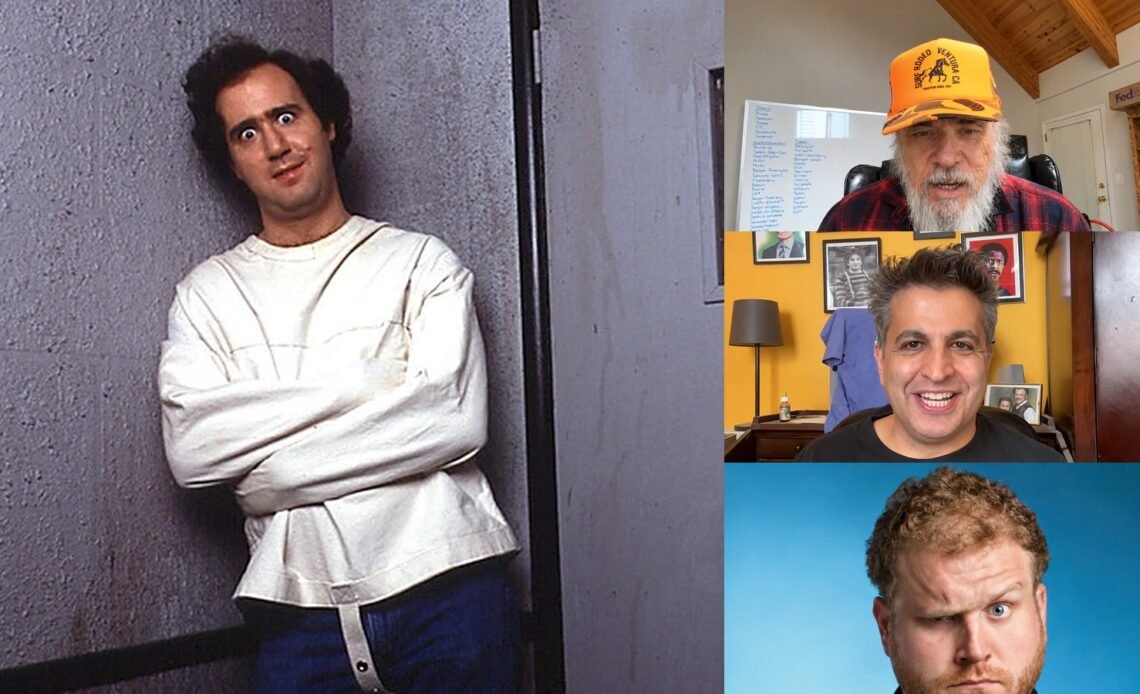
Andy Kaufman died in 1984, at thirty-five. Most of the comedians we interview were children then, or not yet born. He still comes up more often than almost anyone. We ask a comedian about their influences, or about a character they play, or about losing a room, and within a few minutes we are talking about a man who read The Great Gatsby aloud until the audience left.
This piece collects what comedians have told us about him: one who worked with him, one who has read four books about him, and several who have borrowed his methods without always meaning to. It also tries to explain why a performer who said he was not a comedian matters so much to people who are.
Jump to: Who he was · The bits comedians still bring up · What comedians told us · His descendants · What to take from him · Common questions
Who was Andy Kaufman?
Andy Kaufman was born in New York in 1949 and grew up on Long Island. He appeared on the very first episode of Saturday Night Live in 1975, and from 1978 to 1983 he played the mechanic Latka Gravas on the sitcom Taxi, a part built on a character from his stage act called Foreign Man. He died of lung cancer on May 16, 1984.
He did not like the word comedian. He called himself a song-and-dance man, and said he had never told a joke in his life. What he did on stage was closer to an experiment. He wanted a real reaction from the audience, and he did not much mind whether it was laughter, confusion, boredom or anger.
The bits comedians still bring up
- Mighty Mouse. On the first Saturday Night Live he stood beside a record player, let the cartoon theme play, and mimed a single line each time it came round. The rest of the time he waited.
- The Great Gatsby. He would open the novel and begin reading it to the audience, and keep going.
- Milk and cookies. After his 1979 show at Carnegie Hall he put the whole audience on buses and took them out for milk and cookies.
- Tony Clifton. A rude, untalented lounge singer whom Kaufman insisted was a separate person. Clifton was booked separately, and was sometimes played by Kaufman’s friend Bob Zmuda so that the two could appear in the same place.
- Wrestling. He declared himself Intergender Wrestling Champion of the World, wrestled women from the audience, and began a feud with the professional wrestler Jerry Lawler that ended in a slap on David Letterman’s show in 1982. Years later Lawler confirmed that it had been planned.
- Crying on Letterman. In 1980 he went on David Letterman’s morning show looking unwell and spent about twelve minutes close to tears, telling a story about losing his job and his family. He scolded the audience for laughing, then walked into the crowd asking for spare change until staff led him away. None of it was true, and viewers wrote in to complain that Letterman had been unkind to him.
- Fridays. In 1981, on the live sketch show Fridays, he stopped in the middle of a sketch and refused to say his lines. A scuffle broke out on air. Viewers could not tell whether it was real.
What comedians told us about him
Larry Charles: “You’re going to have to fake your own death”
Larry Charles, who went on to write for Seinfeld and direct Borat, was a young writer on Fridays when Kaufman hosted. He had been a fan before that. Growing up, he told us, he was drawn to the rule breakers. “Andy Kaufman would come on stage and he was doing anti-comedy. He wanted the audience to boo him. He wanted the audience to get angry with him. And I thought, that is fascinating.”
After the show the two of them talked. Charles asked how he could possibly top what he had just done.
“I said, what are you going to do next? You’re going to have to fake your own death.”
Three years later Kaufman was dead, and that conversation was one of the first things Charles thought of. A vegetarian who did not smoke had died young of lung cancer, and he was the one performer everybody expected to stage exactly that. “It made people suspicious, knowing the kind of comedy that he did.” Charles says the doubt lasted until people saw the family grieving.
“He was so good at keeping people confused that when he actually died, the natural response was: oh, he’s not dead. It’s a joke.”
Charles also told us what Kaufman did to his own writing. On Fridays he and a few other writers wrote pieces that refused the audience a big laugh, to see them confused and to ask what funny is. But his father had been a failed comedian, and part of him wanted the room’s love too. He says that pull in two directions is where his sense of humour comes from. Read our interview with Larry Charles.
Paul Farahvar: “Alt comedy before there was alt comedy”
Paul Farahvar, the Chicago lawyer who became a comedian, had just finished his fourth book about Kaufman when we spoke. He calls Taxi one of his favourite shows of all time. His summary of Kaufman: “It was alt comedy before there was alt comedy. He kind of created that niche.”
Farahvar admires him and does not romanticise him. Kaufman, he says, cared so little about approval that it became bad for him. The wrestling was meant to anger people, and it worked. By Farahvar’s account it hurt his ticket sales, and his manager told him to stop.
We asked whether a comedian today has that freedom. He was direct. “I don’t have the freedom to anger a crowd like that.” He will sometimes say something he knows a room will dislike, to take them somewhere and then win them back. But that lasts one to three minutes, he says, and not twenty. “I don’t think anyone could do that now. Just angering people.” See our press kit for Paul Farahvar.
Stacy Price: Kaufman the philosopher
Stacy Price plays about five characters in her solo show, and she named Kaufman and Christopher Lloyd in Taxi among the performers who taught her what commitment to a character looks like. Performers like that, she said, “give you the ability to be brave”.
Her reading of Kaufman is that he was a philosopher as much as a performer, fascinated by what an audience is. What does it mean to be approved of, or laughed at? “Let me see if I can make you hate me. Let me see if I can make you walk out.” She is honest that she does not have that in her. She wants the room to stay. What she takes from him is narrower and more useful:
“It’s not not caring. It’s just not giving it any weight.”
If he were in the room, she said, she would ask him one thing: did you ever read your reviews? Read our interview with Stacy Price.
Byron Bertram: the Tony Clifton model
Byron Bertram spent twenty years doing stand-up as himself in Vancouver before he created Sergei Putinski, a blunt Russian immigrant, and found an audience. We suggested that Sergei was his Tony Clifton, and he agreed. Kaufman had died before Bertram discovered him, but he watched the old videos and says he was “super inspired by just his craziness”.
The lesson he took is the practical one. A character can say what the performer cannot. “It gives you leeway,” he told us. “You stand out, you’re different.” Read our interview with Byron Bertram.
Jack Grady: blurring reality and show
Jack Grady is a comedy magician who has also boxed a juggler for an audience and once wanted to be a professional wrestler. He first met Kaufman through the film Man on the Moon, at about fourteen, just as he was getting into comedy. What stayed with him was how much a comedian is allowed to do. Kaufman, he said, was “blurring the lines of reality and show, and that’s something I love”.
He has also met the cost. When he spoke publicly about his struggle with addiction, some of his followers assumed it was a bit. “People were like, this is a weird joke. And I’m like, it’s not a joke.” That is Kaufman’s problem in miniature: once an audience has learned not to believe you, they do not know when to start. See our press kit for Jack Grady.
Almaty: why almost nobody does it now
When we spoke to the comedians behind an English-language stand-up night in Almaty, Kazakhstan, we said that Kaufman-type performers seem to have disappeared. Their explanation was about money and effort. That kind of comedy asks an audience to pay close attention, it does not pay well, and it is harder than writing jokes. A comedian carrying that weight looks around, sees everyone else doing better without it, and puts it down. See our press kit for Good Night Comedy.
Barry Katz, who has managed comedians for forty years, made a related point to us. When nobody else can do what you do, he says, there is no stopping you.
Kaufman’s descendants
Plenty of the performers we have interviewed work in territory he opened, whether or not they mention him.
- The character who never drops. Lauren LoGiudice performed stand-up in character as Melania Trump for three years, and says it took clown school to undo the habits. Chloe Matonis plays a soldier sent back from 2075. Rebecca Wolf built a show around a husband who is a stuffed pig.
- The stunt in public. John Jacobs found his full potential in a ski mask outside the White House.
- Staying inside the failure. Clown training has a word for the moment a bit collapses: the flop. Brendon Lemon told us the skill is staying in that feeling and not running from it. Sevrin Willinder learned the same thing at clown school. Kaufman lived there.
- Total commitment to a silly idea. Lucy Boisvert says the difference between looking stupid and looking funny is confidence, and Fletcher Michael says the nature of comedy is commitment.
What comedians can take from Andy Kaufman
- Commit completely. Every comedian above said this in some form. A half-committed strange idea is embarrassing. A fully committed one is a show.
- A laugh is one reaction among several. Kaufman treated confusion, tension and even anger as results. Most comedians will not go that far, but a set with only one note is flat. Farahvar’s version is to let a room dislike you for a minute and then bring it back.
- A character buys you room. Clifton could be awful in ways Kaufman could not. Sergei can say what Bertram cannot.
- Care, but give it no weight. Price’s line is the most usable thing anyone has said to us about him. You can want the audience to stay and still not let their verdict decide what you make.
- Know what it costs. Kaufman lost bookings, was voted off Saturday Night Live by its viewers in 1982, and was not believed when he was dying. Grady was not believed about something far more ordinary. If you teach people that nothing you say is real, you will one day need them to believe you.
If you would like the opposite school, the comedians who built everything on the written joke, start with our breakdown of how Williams, Carlin and Gervais construct a joke and our guide to comic timing. Kaufman knew those rules. His act depended on the audience knowing them too.
Common questions about Andy Kaufman
Was Andy Kaufman a comedian?
He said he was not. He preferred “song-and-dance man” and claimed never to have told a joke. He is usually described now as a performance artist who worked in comedy clubs and on television, and as the starting point of what later became alternative comedy.
What is anti-comedy?
Anti-comedy is a performance that deliberately withholds the expected joke. The humour, if it comes, is in the awkwardness, the commitment, or the audience’s own confusion. Larry Charles described it to us as comedy “where you weren’t sure if it was supposed to be funny or not”.
Who was Tony Clifton?
Tony Clifton was a loud, insulting lounge singer created by Kaufman, who always maintained that Clifton was a real and separate person. Kaufman’s friend Bob Zmuda also played the part, which helped keep the story alive.
Did Andy Kaufman fake his death?
No. He died of lung cancer in Los Angeles on May 16, 1984. The rumour has lasted because faking his death was exactly the kind of thing he might have done, and because he had talked about it. Larry Charles, who once joked with him about it, told us that seeing the family’s grief settled the question.
For more conversations with working comedians, see all our comedian interviews.