
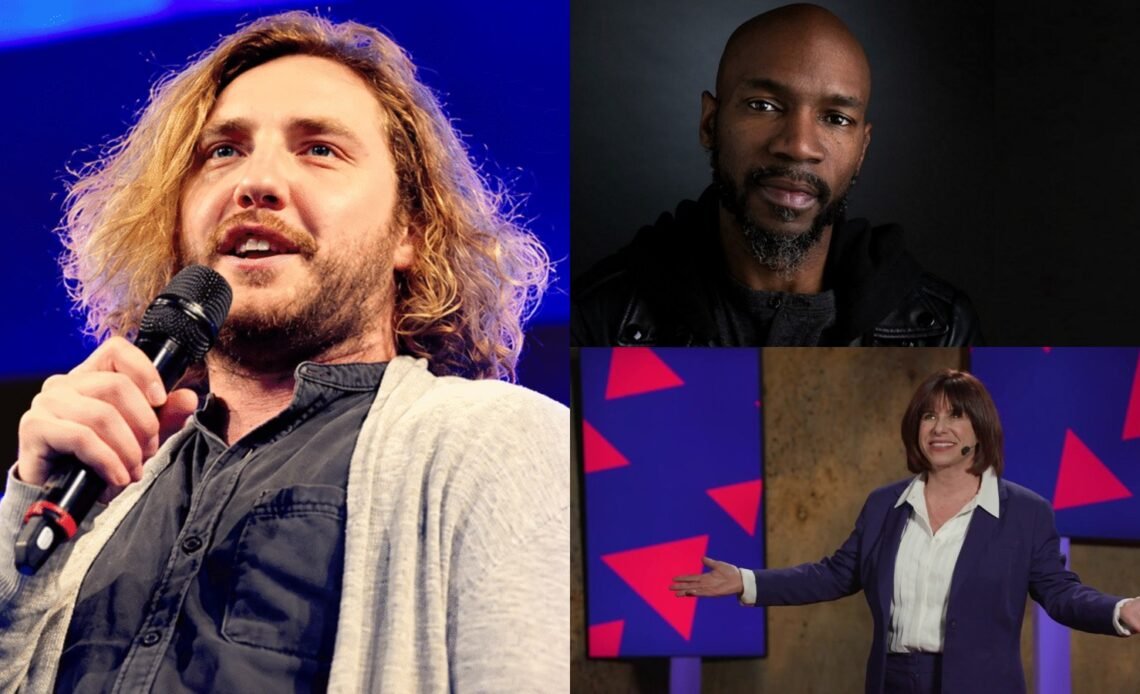
We ask almost every comedian the same question: do you remember your first laugh? Seann Walsh gave the shortest answer we have ever had. Asked what it felt like, he used two words.
“Strong drugs.”
Seann Walsh
Others needed longer. Some remember the room, the line and the character they were playing. Some remember nothing at all. A surprising number say the first one came years before they went near a comedy club. This piece puts 28 of their answers in one place. Read our interview with Seann Walsh.
Jump to: It feels like a drug · It feels like love · Before the first open mic · The first set · The ones who can’t remember · When the first laugh lies · Five things in common · Common questions
It feels like a drug
Walsh is not the only one who reaches for that comparison. Wayne Charles II, one of three American comics who shared a bill at the Edinburgh Fringe, put it this way.
“The first laugh was like a cool drug — a high you can’t quite explain, but you know you wanna chase it again and again.”
Wayne Charles II
His colleague Lauren LoGiudice remembers a particular night. “For me it was being at the first bigger show, more than 20 people in the audience, feeling like bombs going off.” Read our interview with all three.
Irene Woo got hers in a stand-up class, reading two pages of jokes off a sheet of paper. “I don’t think I even made eye contact with people. I was just reading from my paper. And some people in the class started laughing. There’s other things in my life that I’m proud of, but this felt like the biggest achievement for me.” She had to walk for a while afterwards because the adrenaline would not let her go home and sleep. We asked whether it was like a first drink. “A little bit, but better, because you don’t feel bad the next day.” Read our interview with Irene Woo.
Ian Edwards says that the first time he killed, he floated off the stage. He watched the whole set from somewhere outside himself and only rejoined his body afterwards. Does it still feel like that? “Laughter still makes me feel good. That’s why I still do it. There’s nothing like making people laugh.” Read our interview with Ian Edwards.
For Fletcher Michael it came as a writer. The first run of his sketch show sold out a small New York theatre: more than eighty people in a black box, standing room only, laughing at things he had written. “For the rest of my life, I’ll probably be chasing that feeling.” Read our interview with Fletcher Michael.
It feels like love
Judy Carter has taught stand-up for decades and written the best-known books on it. Her own first laugh came from jokes about her speech impediment, which was the thing she was most ashamed of.
“When people laugh it’s like love. They’re saying, ‘We agree with you. We’re open to you. We love you.’ It’s also a healing that happens.”
Judy Carter
She has built a method on it. “In The New Comedy Bible I tell people that what’s bad about your life is good about comedy.” Read our interview with Judy Carter, and see how 13 comedians turned their worst moments into comedy.
Krystyna Hutchinson’s answer was one word: “Euphoric.” She grew up in a difficult home and spent most of her energy trying to earn her parents’ love. “It turns out, working to earn a laugh from a room full of strangers scratches that childhood itch in a much more productive way.” Read our interview with Krystyna Hutchinson.
John Jacobs grew up with Tourette syndrome and lost his mother when he was sixteen. He was the funny kid at school, and his friends pushed him on stage in his last year there. “It feels amazing to make people laugh,” he told us. “Makes me feel like I have purpose.” He still says a prayer before every show, asking to do well for the people who came. Read our interview with John Jacobs.
The first laugh usually comes before the first open mic
Ask a comedian about their first laugh on stage and many of them go back to childhood.
A campfire
John Achkar now plays the Olympia in Paris. His first laugh was at a Boy Scout campfire. For two or three years he could not bring himself to get up. In about the fourth year he did a skit. “I remember the joke, I remember the feeling, I remember the skit, I remember the character I was portraying.” Read our interview with John Achkar.
A school musical
Tom Johnson told us nobody had asked him the question before. As a teenager he played Fagin in Oliver, a moody and solemn part, and kept getting laughs in it. “I thought, ‘Oh, I like this.’ It’s a lovely thing to have a room full of people laughing. It’s like all the barriers have come down, and that’s the one big thing everyone has in common — laughing.” Read our interview with Tom Johnson.
A tray of champagne
Liz Coin was eleven and playing Drake the butler in a community theatre production of Annie in Iowa. The leading man forgot his lines and kept calling for more champagne. Coin walked on with a tray in each hand. The room came apart, and she understood why at once. “This isn’t something I wrote before. This is happening today.” Read our interview with Liz Coin.
A mouse with crossed eyes
Winnie Stack was about five. In a show called Country Mouse, City Mouse, the director let her cross her eyes. “I remember that being well-received, and I remember thinking — I’m into this.” Part of the appeal was knowing her parents were laughing somewhere in the audience. Read our interview with Winnie Stack.
Two words about clogs
Marina di Marzo was in a college play with no written lines, playing a Civil War era belle. A man just back from Europe mentioned how beautiful the Netherlands was. She answered with two words about clogs and the room went up. “When I come back to that first laugh that really hit me inside, I always come back to them clogs.” Read our interview with Marina di Marzo.
A tricycle, a beach and a church
Britt Anderson of Whisper Theatre did a lap of the house on a tricycle in a clown wig. The audience was her mother and her mother’s friends. Read our interview with Whisper Theatre.
Chloe Matonis was eight. She and her siblings filmed parody videos, and in one she pretended to be stranded on a beach. Her parents showed it to their adult friends, and she noticed it was not the kind laugh people give a child. “Oh, that was genuinely funny. That was a real laugh.” Read our interview with Chloe Matonis.
Jason Salmon went looking for his in church. As a teenager he sang solos, and he would talk before the song to calm his nerves. “In my head I always thought, if I can make them laugh, then I’m in control and the song will be easy.” The talking turned out to be the better part. Read our interview with Jason Salmon.
The first set
Then there is the first time with a microphone and no character to hide behind.
Jackie Joy had already handed in her notice and was about to leave Canada when she tried an open mic. English is her second language. She talked for eight minutes, came off and cried, and knew she wanted more. She went back to her boss and asked to stay. “So comedy made me stay in Canada. Comedy decided my next steps.” Read our interview with Jackie Joy.
CeeKay Brown did her first set in Brussels in October 2022. She told a five-minute story about the day she was born. “There were no punchlines, but the room was full and they really enjoyed the story.” Watching the other comics on the bill, she could tell she was missing something. Once she decided to do it properly, she did 180 shows in a year. Read our interview with CeeKay Brown.
Byron Bertram had been a street performer. In his first set he did a few minutes about being young and inexperienced, it was going well, and he finished by juggling anyway. Other comics told him he had not needed it. “It was kind of a safety blanket,” he says now. Of his first open mic he says, “It was magical and I felt like, okay, I can do this.” Read our interview with Byron Bertram.
Brendon Lemon remembers the line. It was 2002, The Sixth Sense was recent, and he looked a lot like the boy in it. He opened by telling the room that, in case they were wondering, he did not see dead people. “I remember standing there in front of the audience thinking, oh my God, I’m in it. I did it. Once you get the first laugh out of the way, you’re in it.” Read our interview with Brendon Lemon.
Stephan Dyer can give you the date. He bombed for two years. Then he took a stand-up course at The Second City, studied how a joke is built, and did a show in London, Ontario on 20 August 2016. “After two years of silence, everything clicked. I couldn’t sleep that night.” Read our interview with Stephan Dyer.
Rebecca Wolf was sixteen. For a school project that was meant to help the community, she put on a comedy show and did more than half an hour herself. “I don’t think it was even very funny, but it was really fun.” Read our interview with Rebecca Wolf.
The ones who can’t remember
Not everyone has a story. Corinne Fisher told us, “I don’t remember my first laugh, but I definitely remember my first big show.” Looking back at that set, she can see “a seed of a voice” in it. Read our interview with Corinne Fisher.
Tori Morancay has no memory of the laugh either. What she remembers is not telling anyone at her first open mic that it was her first, and how good it felt. “I was like, I want to do this more. It’s very addictive to get a laugh.” Read our interview with Tori Morancay.
Aarushi Agni remembers the night and would rather not. “My jokes were really bad,” she says. Not one joke from that first open mic survived. Read our interview with Aarushi Agni.
Danielle Slaughter thinks the question starts in the wrong place. For her the laugh was there long before any stage. “The funny is already there — it’s the lens, the way you look at things.”
When the first laugh lies
A first laugh can also point you the wrong way.
Brendon Lemon went on first at the graduation show of his comedy class and destroyed. That was the problem. A room full of everybody’s friends does not tell you the truth. The open mics that came next were, in his words, “where comedy goes to die”, and he has been chasing that first night ever since.
Rebecca Wolf’s school show had a cost. She had joked about her job at a local restaurant and put the video online. Her employers were furious. “After that I didn’t do stand-up for a really long time, because I thought that doing it made me a bad person.”
Meg Millane had the opposite trouble. She came from dance and musical theatre, and found bombing far too comfortable. She treated a silent room like a monologue and kept going. “It took me a while to realise — they’re supposed to laugh.” She now says she loves the laugh even more than applause. Applause rewards how well you did something. A laugh means they agree with how you see things. Read our interview with Meg Millane.
Five things first laughs have in common
- They rarely happen in a comedy club. A campfire, a church, a school musical, a living room. Most of these comedians were funny in front of people long before they called it comedy.
- They are often accidents. Coin’s tray, Stack’s crossed eyes and di Marzo’s clogs were not written down beforehand. Something real happened and the room reacted.
- The truth gets the laugh. Carter joked about the thing she was ashamed of. Joy talked about her own English. The first laugh tends to come from the first honest thing.
- One is enough to start. Woo, Joy and Morancay each decided straight away that they would do it again.
- One proves very little. Lemon and Dyer both learned that the second good night can be years away from the first.
For what happens after the first one, see how 25 comedians write their jokes, our guide to the tight five, and how comedians keep going when the laughs stop.
Common questions about a comedian’s first laugh
Do comedians remember their first laugh?
Most do, and many describe it in detail decades later. A few, including Corinne Fisher and Tori Morancay, remember the first show clearly and the first laugh not at all.
What does getting a laugh on stage feel like?
The two comparisons we hear most are a drug and being loved. Seann Walsh, Wayne Charles II and Irene Woo all used the first. Judy Carter and Krystyna Hutchinson used the second.
How long does it take to get a first laugh in stand-up?
It varies a great deal. Irene Woo got one in the second session of a class. Stephan Dyer bombed for two years before a night when everything worked.
Why do comedians keep chasing laughs?
Because the first one is hard to repeat. Several comedians told us they are still trying to get back to how that night felt, and that the trying is most of the job.
For more conversations like these, see all our comedian interviews.