
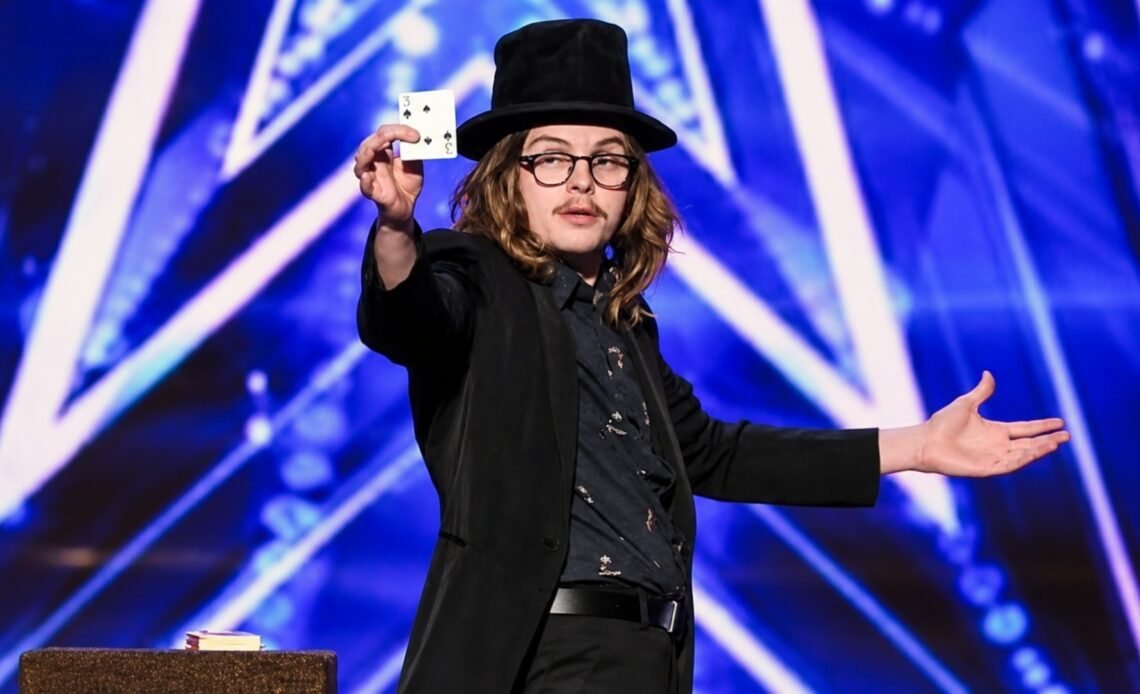
Jack Grady is a comedy magician from Cleveland, Ohio. He did his first show at eight years old, for the Ronald McDonald House, and has been doing magic for 19 years. His America's Got Talent audition is billed as the shortest in the show's history, and he is billed as the first magician to fight a professional boxing match. In September 2026 he filmed his first comedy special in Los Angeles.
When we spoke to Jack Grady he was in San Diego, doing a weekend at the American Comedy Co. and promoting it in a hurry, because he had just boxed a juggler. A few days later he was due to film his first special, which meant retiring bits he has worked on for more than a decade. Most people know him from one very short television audition. We wanted to know how the hour was made. None of it was written down.
An hour written on stage
The show runs about 55 minutes “on the dot”, and he would like another five. He has been performing it as a whole for about three years, though some of it grew out of things he was doing at sixteen and seventeen, now delivered in what he calls a “weird avant-garde, aggressive, in your face” style.
He does not write at a desk. He takes a trick, goes out and performs it, records the audio and listens back. Then he ad-libs around it, night after night, and keeps the lines that work. By his count more than a hundred jokes in the show were found that way. We have collected how 25 comedians write their jokes. Few work quite like this.
“I could never sit down and write a whole show, like, on the computer or whatever. I do my writing on stage. I’ve always been like that. My whole show is improvised, but not all improvised in one night, you know. It’s been improvised over years upon years upon years.”
We assumed it was easier to start from a comedy idea. He said the structure always rests on the trick. “The magic is the base of the pyramid,” he said. The story of the routine is the second level, and the actual lines go on top. “Without that base the whole thing fell apart.”
From card manipulation to an improv troupe
His first show was at eight, for the Ronald McDonald House. He learned from magic books and from old VHS tapes that taught tricks, partly because local magic shops were already closing. The complex sleight of hand was hard with small hands, and he says he did not master the really difficult material until he was about twelve.
At first he wanted to be a serious manipulator, the kind of magician who does precise, technical routines with balls and cards. That changed at fourteen. “It was at the age of 14 I joined an improv troupe and fell in love with comedy.” Adding comedy to the magic was, in his words, “a slow but deliberate decision”. Part of the reason was strategic. Young magicians, he says, tend to copy whoever is on top, and right now that is Shin Lim. Few of them are taking the comedic route, so it is a way to stand out. He went on to run improv troupes for several years, and our guide to improv for stand-up comedians covers what that training gives you.
As a child he idolised Criss Angel. As a teenager he found The Amazing Johnathan, whom he calls one of the greatest comedy performers of all time.
You can’t mix the ta-da and the ha-ha
Do magicians lose respect for their skill when they add jokes? He says it is a balance. There is a saying in the theory books on comedy magic that you cannot mix the “ta-da” and the “ha-ha”.
“You can’t necessarily mix, like, the punchline of a magic trick and the punchline of a joke. Sometimes you could break that rule. I definitely do that in my show.”
More often he uses one to cover the other. “You could use comedy to misdirect from the magic and vice versa.” He gave an example. Early in the show he turns an audience member into a magician. The room assumes the trick will go wrong, because the character on stage looks like a clown who cannot do real magic. Then it works, and the jokes make the surprise bigger.
One of his favourite pieces is a card routine built on the premise that five people in history have escaped hell and he could be the sixth. The story, which sounds like Greek mythology, took about three years to workshop. The tension builds and builds, and then the card turns up somewhere very rude. On its own, he says, that would be mildly amusing. Inside the story it lands. In his words: “It’s a way to turn a fart joke from hack to making it smack.”
Going on America’s Got Talent to make a meme
We suggested the America’s Got Talent judges had simply not understood his act. He said he had gone in knowing what would happen.
“I looked at my material in totality and I quickly realised I have nothing in my repertoire that they’re gonna like on that show. So I basically had the plan of, like, well, if they’re not gonna like anything I do, I might as well go on and make a meme.”
He knew, he said, that he was “going in there to get executed”, and the aim was “to create the most viral possible thing I could”. Across all the uploads, he says, the clip has around a billion views. He wanted something easy and memorable, “a brain worm”, and he sees it as the top of a funnel. People come in through the audition and, if they stay, end up following him into stranger things, like a boxing match with a juggler. Our piece on social media versus the stage looks at how comedians handle that gap between the clip and the live show.
As a child he wanted to be a professional wrestler, and the fights scratch the same itch. A friend calls it “meme boxing”, and he likes the title. He is less keen on the word influencer, and on most of the other influencers who box.
Andy Kaufman, and the switch
He first came across Andy Kaufman through the Jim Carrey film Man on the Moon, at about fourteen, around the time he was getting into comedy. What he took from Kaufman was the wrestling and the way he kept “blurring the lines of reality and show, and that’s something I love”. (We have written about what Andy Kaufman can still teach comedians.) It has a cost. When he said publicly that he was dealing with a substance use disorder, some people assumed it was a bit. It was not, he told them. He describes himself as a recovering addict.
Off stage he is calm and talks like anyone else. His manager watched him at a boxing press conference, chatting normally beforehand and then turning into someone else in front of the cameras, and decided the stage state needed its own name. Some fans who meet him in the street are disappointed that he is not the same person.
“When that switch goes on, though, my brain is like running at a million miles a minute. It feels like I got plugged into AI and I’m like supercharged, you know… I feel unstoppable when I’m in performance mode.”
He was direct about what that means for someone in recovery. “It’s addicting to be in that mode, you know, which is a good thing in some respects.” On stage, he says, he can think about the next joke or set up a callback while doing sleight of hand and still look as though he is entirely in the moment.
An unlikable character, and a thank you
The man on stage is meant to be hard to like. “I portray myself on stage as egotistical, rude, disgusting,” he says, and grotesque, and “very like traditionally unlikable, but those flaws in a character almost make it endearing to the audience.” At points in the show he steps out of character to thank people for coming. “It’s like you beat them so hard with a stick and then you give them a hug.” Byron Bertram told us something similar about building a stage character audiences remember.
The thank you is sincere. For a long time he worked what he calls “horrible, horrible, gruelling dead-end jobs”: driving for Uber and Lyft, a day job and a second job, and moving furniture onto trucks for a living. Now his income comes from ticket sales.
“I’m pretty much directly funded by my audience, in the sense of my revenue comes from ticket sales. I am so appreciative of these people, especially because the economy is bad now too.”
Exposure, purists and the night he lost the room
We asked about the videos online that reveal how tricks are done. “I’m one of the few magicians that doesn’t really get upset by exposure,” he said. He does not think it harms the art, partly because “some of the biggest fans of magic are the people who know a little bit about magic”. He has been fooled by tricks whose method he knew. The skill, in his view, is “taking the trick and transforming it into a piece and learning how to make the magic strong”.
Not everyone in comedy welcomes him. At the Funny Stop in the Cleveland area, the comic who went on after him the first time told the room: “I’m gonna do some pure stand-up comedy. I don’t need a suitcase to be funny.” He insists on the term comedy magician, not prop comic.
He avoids race, politics and religion in the show. But he told us, for what he said was the first time in public, about one joke he regrets. At a breast cancer comedy fundraiser, on the day the singer Liam Payne died, a card fell during a trick and he made a joke about Payne’s death. Nobody laughed. He says it was out of character, and not the room for it. Every comedian has a version of that night, as our piece on surviving bombing on stage shows.
A documentary, a game show and the next hour
A documentary came out of a podcast appearance. The filmmaker then asked whether he would like to make a film about a day in the life of what he calls “a B-list magician”. He is mostly himself in it, out of character. According to his press kit it premiered at the 2026 New York Film Festival.
On a game show called Human Versus Hamster, he says, he blacked out during a challenge, his heart stopped and he had to be resuscitated. The footage never aired. He is now working on a second hour, at an early stage, which includes an escape routine.
After the special he is touring the major cities of Canada in October 2026, followed by dates in Australia, including the Comedy Store in Sydney in December. His full biography, credits and quotes are in the Jack Grady press kit.
You can find Jack Grady at @jackgradymagic on Instagram, and his tour dates at punchup.live/jackgrady. For more conversations like this one, see all our comedian interviews.
See our Instagram post about this interview. Follow Hop For Pop on Instagram at @hopforpop and @thecomicsunseen.