
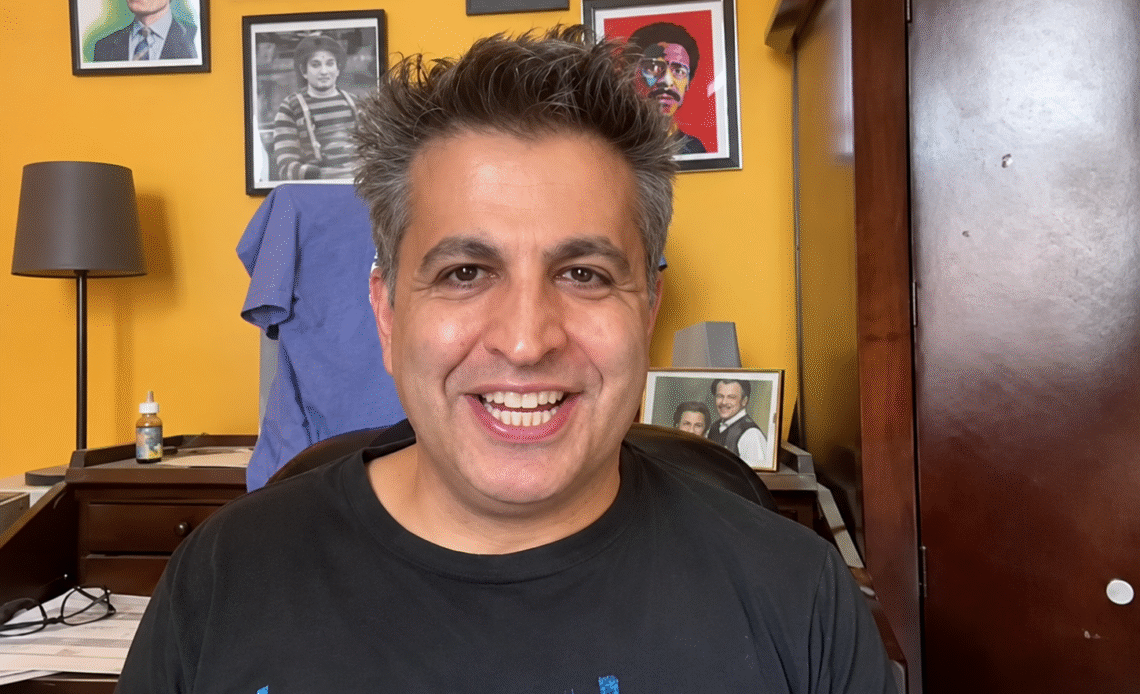
Paul Farahvar is a Chicago stand-up comedian and podcast host, and a former trial lawyer. He has two specials, the Dry Bar hour Always a Groomsman and Middlewestern, Middle Eastern for Helium, and has opened on tour for Jen Kirkman and Demetri Martin. His podcast Singles Only ran for 400 episodes, and he now hosts Why Are You Awake? and the lift-bound interview show Stuck With Paul.
Paul Farahvar did not set out to be a comedian. He was a lawyer who signed up for improv classes because he thought they would help him in court. Almost fourteen years later he is a headliner, and the thing he talks about most is honesty: why his delivery is so slow, why he now talks about his father’s death on stage, and why he has gone off the crowd work that many people still know him for. He also told us why opening for somebody bigger is the best job in comedy.
The lawyer in the improv class
As a child he watched Johnny Carson, David Letterman and Conan O’Brien, and liked the musical guests as much as the comedians. He assumed he would be a musician. Stand-up came much later, when he was practising law and taking classes at Second City “just to like become a better lawyer”. A friend who was opening for Bob Saget told him he was funny. He entered an open mic contest the next day and won it.
“I thought I was just going to do it for fun and it just took over my life. And I loved it so much. And I still do.”
He went on to the Conservatory at Second City. He never acted as a child, he says, because he was “too cool” for it, and he wishes now that he had. What improv taught him was that audiences want relationships and a point of view. We have written more about what improv gives a stand-up comedian.
Where the deadpan comes from
His delivery is dry and unhurried, and people sometimes assume it is a persona built over many years. He says it is just how he talks. “I wasn’t the funniest kid in class, but I would say things under my breath just to make my friends laugh.” He is comfortable on stage, and “the slowness is deliberate”.
The pandemic made it sharper. During Zoom shows he could not hear the room, so he had to wait for laughs that might or might not come. “I used to be afraid of quiet pauses, but now I love them.” Sitting a little longer, he says, makes the jokes better. Deadpan also needs patience from the comedian, and it does not suit every joke. The darker the material, the harder it is to pull off. Our piece on comic timing looks at why the pause matters so much.
Talking about his father on stage
After more than ten years, he says, comedians start wanting to take more chances. His new material includes his father, who died recently.
“I’m talking about death, you know, and it’s not fun, but it’s honest. And, you know, some people don’t like it, but it’s what I want to talk about.”
Rooms tense up. He hears people say “oh my god”, and his answer is that it is his show. Some people have come up afterwards to thank him for talking about it. It is not about shock, he says. When he started he did want to shock people, and he loved Anthony Jeselnik. But the shocking comics who succeed are great writers first. “A lot of comics just try to be shocking because it’s easy to be offensive.” Being funny is the hard part.
“Truth in comedy is what I was taught. You got to be truthful on stage. You know, sometimes you’re doing a show and things aren’t going well. I know I can go back to jokes that I did ten years ago that crushed. But I don’t want to because that’s not me anymore.”
He extends the same respect to comedians whose politics he does not share, as long as they mean it. Anyone willing to lose half their audience to say what they think is important has his blessing: “more power to you”. The ones he has no time for are doing it to sell tickets. We asked other comedians where they draw the line.
Two or three jokes, for two or three months
Some comedians write a new joke every day. He does not. “I focus on two or three jokes and just hammer away for like two, three months.” When we spoke he was working on a new twenty minutes so intensely that nothing else was coming. He still goes to a Chicago show built around new material once or twice a week, but recently he had only been trying new lines on existing jokes.
In the gaps he goes back to old jokes that never made it onto a special. One, about the Lollapalooza music festival, he wrote about eight years ago from something that really happened. He tells it now as a different person looking back, with a few changes to make it true to who he is today. He is also thinking about how to build his next special, and says he needs another ten to twenty minutes before it takes shape. There is more on process in how 25 comedians write their jokes.
One of his models is Taxi, which he used to watch at four in the morning after bar shifts in college. “Every sitcom is based on Taxi,” he says. What he took from it was relationships. The audience understood how the drivers related to each other, and each had a backstory. When he tells a story on stage, whether about himself or his mother, people need to be invested in the people in it. “And that’s what good writing is.” The show also gave him Andy Kaufman, about whom he had just finished his fourth book. He told us more about Kaufman, and why nobody could anger a crowd like that now, in our piece on what Andy Kaufman can teach comedians.
Why he went off crowd work
When he started, crowd work was how he filled time. Asked whether he had thirty minutes, he would say yes and plan ten or fifteen of them talking to the audience. He did not really want to write. Now it is the reverse, and the reason is the cameras.
“A lot of comics will just purposely do crowd work to get clips and I hate that. I hate when people are just doing it just for the clips and not being in the moment.”
He disliked it so much that he stopped doing crowd work even when a show needed it, and now has to remind himself it is part of the job. Opening theatre shows, where openers are not supposed to talk to the crowd, and working on a new hour have pushed it further away. People still message him to say they prefer his crowd work clips. He also thinks those clips no longer get the traction they did during the pandemic, when comedians posted crowd work rather than burn their written jokes online. We looked at this in social media versus the stage.
The reputation has had a cost. The last time he headlined, the club owner called to say every ticket had sold except the front row. A friend pointed out that people had seen his clips online. He does not think he is mean, and says he always brings it back to making fun of himself. “But that was a wake-up call for me.” His advice on doing it well is to listen. “I think it’s important to be honestly interested in what the person is saying.” His best clips, about tattoos and about teaching his nephew to cheat in high school, worked because they came from true stories and real curiosity.
Opening is the sweet spot
Headlining is the harder job, he says, because people came to see you. Opening for a big name carries almost no pressure. Nobody knows who you are and nobody minds.
“If you can get 10% of those people to love you, you’ve succeeded. I did theaters with like 1,000, 2,000 seaters and I was opening and I was like, I did fine. I didn’t like crush. You can’t really crush because if you do too well, that’s not good either.”
On those nights he reckoned he had won about two hundred new fans. If he had two hundred fans in every city, he says, he would sell out every club he plays. Headliners have given him every kind of note: no crowd work, swear less, swear more. One very dirty comic asked him to say at least a couple of things because he was so clean.
His favourite memory is his first time opening for Jen Kirkman, at the Steppenwolf Theatre in Chicago, six or seven years into comedy. It was a sold-out show and he was very nervous. He dropped the opening he had planned and asked who was there to see Jen Kirkman. The room went wild, and he told them they would have to wait ten minutes. They laughed, his nerves went, and he still opens that way. After that he opened for her whenever she came to Chicago. He also toured with Demetri Martin, a comedian he had watched growing up. Doing sold-out shows with him, he says, “was insane”.
Work hard, be kind
He has never met Conan O’Brien, but calls him his comedy icon. His goal was to do stand-up on Conan’s show, which no longer exists. He has a tattoo that reads “work hard, be kind”, from O’Brien’s farewell to NBC, and when he tagged O’Brien in a photo of it, the account shared it.
He has taken something practical from him too. At the Laugh Factory in Chicago he hosts Stand Ups, Sit Down, where comedians perform and are then interviewed. Like O’Brien and Carson, he tries to make his guests look good.
“The show is not about me. It’s about making sure you do well because then I look good, but more importantly you look good and the people leave here having fun.”
Some guests have still arrived thinking he was setting them up to look stupid. He never does. As for what is next, he says he is happy with how things are going but wants to take it up a notch. He wants to develop unscripted shows and talk shows. And if he could do only stand-up, every weekend, without worrying about ticket sales, “I would be very happy”.
Bookers and press can find his biography, quotes and credits in our Paul Farahvar press kit.
You can find Paul Farahvar at paulfcomedy.com and at @paulfarahvar on Instagram. For more conversations like this one, see all our comedian interviews.
See our Instagram post about this interview. Follow Hop For Pop on Instagram at @hopforpop and @thecomicsunseen.