
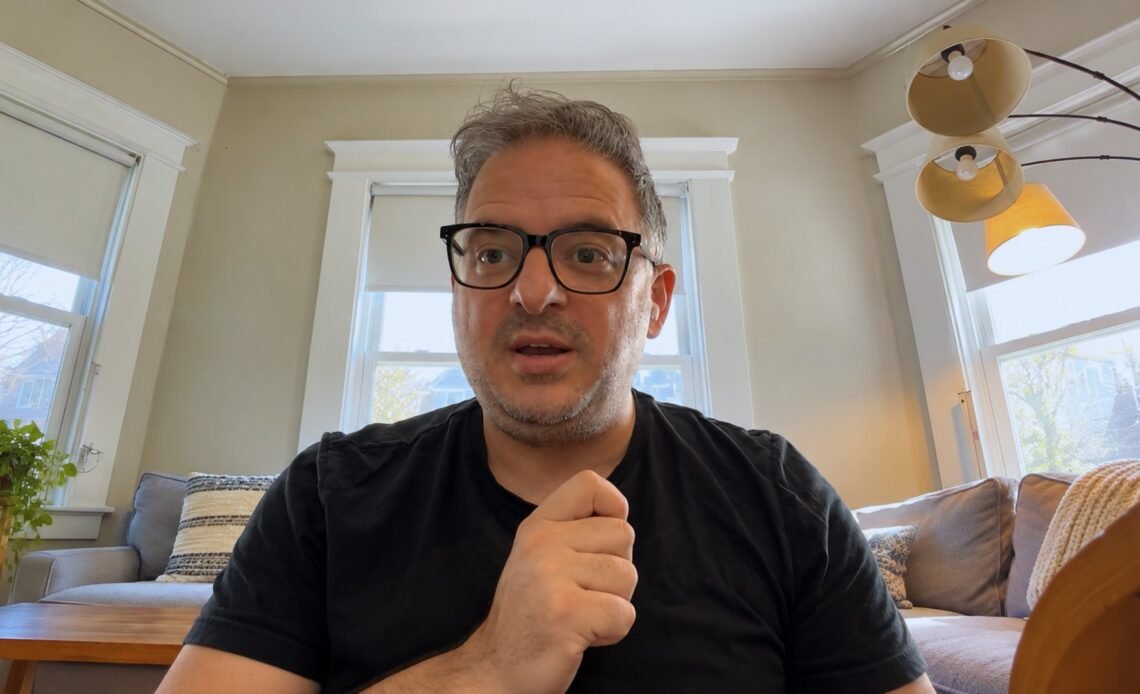
Greg Stone is a New York stand-up comedian known for true stories told at full volume. He started performing in 2001 and moved to New York to do it seriously in 2008. He has performed on The Late Late Show with James Corden, NBC's America's Got Talent, truTV's Friends of the People and AXS TV's Gotham Comedy Live. His first hour, The Amazing Greg Stone, came out as an album in 2019, and was followed by the special Nobody Presents Greg Stone.
Greg Stone has been doing stand-up for twenty-five years, and he thinks he was at his most honest on the very first night, when he had no idea what he was doing. He told us about the crowd work video that changed his career, why he thinks being mean to an audience is a sign of fear, and the five dollars he handed James Corden on network television.
Ten minutes, and nobody told him about the light
It started in 2001 with a bringer show: bring ten people and you get a spot. The room, at New York Comedy Club or Stand Up New York, he is not sure which, held eighty to a hundred people.
He was booked for ten minutes and had written what he guesses was two hours of material. Nobody had explained the light, the signal that you have two minutes left. He thinks he did about twenty-five minutes before they turned the lights out on him and cut the microphone. He was mortified, but also sure he had killed. “I wasn’t saying anything funny,” he says now. The laughs came from his friends and from the sheer energy. It was a first laugh of a kind, and we have collected other comedians’ first laughs too.
He kept doing bringer shows for about a year, until his friends told him they would not come any more. He has no illusions about the format: a producer charged $20 at the door, kept the money and paid nobody. For seven years he told himself comedy was a hobby. Then in 2008 he asked the comedian Mike Vecchione how often he got on stage. Stone was proud of five or six times a month. Vecchione went up five times a night, and told him to move to New York. He did, that year.
Trying to get back to the first night
New York open mics, often in dead silence, showed him how hard it really was.
“The first time I was on stage, I was probably the most of myself. And then you start bombing … And then it’s just these years of trying to get back to who you were before you started comedy.”
He compares it to Adam and Eve noticing they are naked. Once you become self-aware, you want clothes. On a performance level the job was to recover the energy he had on that first night. On a writing level it was something else: “understanding your own thoughts, honing those thoughts, crafting those thoughts so people understand them.”
“For me, the writing is the crowd work”
We asked whether he preferred writing or improvising. He loves both, and says they are not as separate as people think. Good crowd work, for him, is not asking where someone is from and making a joke about Ohio. It is a real conversation in which the person says something that reminds him of a story he has already written, or has been thinking about for years. He likens it to talking to someone at a party. (There is more on that skill in our piece on improv for stand-up comedians.)
The party idea runs through his whole act. When he started, someone told him he was the funny guy at parties, so he watched how he behaved at them. He had stories loaded and knew their beats. “I’m just walking on stage and telling these people this story. They are here with me, right? Like let them be here with me.”
“I like following the fear, right? I like talking about things I’m scared to talk about so that other people in the crowd who are afraid of that thing won’t feel crazy.”
He always felt like a weirdo, he says, and seeing George Carlin made him think he might not be so crazy after all. “All of my comedy comes from empathy.” Life is frightening, and he wants to tell people that everyone is scared, so they might as well laugh.
The clip that moved the needle
The video most people know him from began at the Comedy Cellar. He had been booked there for a year or two, and it was the credit he was proudest of. Then the bookings stopped, and he never found out why. It hurt, until he decided that losing one club did not make him any less of a comedian. “If there’s a microphone, I’m a comedian, right? Like doesn’t matter.”
Some time later, again for no reason he knows, the Cellar started booking him again. He decided to drop the scripted act and go up relaxed. He asked a woman about her family, and she told him her father had murdered her mother.
He had options, he says, and making fun of her was not one he would take. So every joke in the exchange was about himself. He kept checking that she was all right, partly because he cared and partly because the room would have turned on him the moment he seemed cruel. “It was storytelling, improvised storytelling,” he says. It also helped that, as he walked on, he had pressed a few piano keys and remarked that they sounded like a horror film. Without meaning to, he had set up the callback.
He was not sure the clip was any good. He showed it to his friend, the comedian Jon Fisch, who told him to post it immediately. It went on to get a couple of million views, before viral crowd work clips were everywhere. The lesson he took was to let go. “I love writing,” he says. “But if something happens in the moment, I got to take it.”
Strength is showing vulnerability
We suggested that a lot of younger comedians, and younger audiences, enjoy watching a comic be mean to the crowd. He called it a new comic thing, and admitted he did it too when he started. Being aggressive on stage, he says, is fight or flight. You are scared they are going to win. His model is Ted Alexandro, whom he describes as slow, thoughtful and in the pocket all the time.
“What’s harder: going on stage and being scared someone knows, or just saying, these are my flaws, I don’t really care? Like that to me is strength. Strength is showing vulnerability, not hiding it.”
He does not always manage it. He calls himself “the king of meltdowns”. At a recent show of about ten people, he told the crowd he had just lost some weight and a woman shouted that he was still fat. He lost his temper, swore at her and at the man who tried to calm him down, walked out to the train, then came back to tell the room why they were terrible. He was embarrassed afterwards, and turned that into a bit, and it is now one of his favourites. (We have collected more worst moments turned into comedy.)
Art, business and a lot of McDonald’s
Comedy, he says, is two things: art and business. Most comedians he knows love the art and neglect the business. Some are only average at the art and brilliant at the business.
“McDonald’s is also a good cheeseburger, right? Is it the best cheeseburger? No, but they sell five billion cheeseburgers … They know how to get you into the store. They are good at business. And right now comedy is kind of run by a lot of different McDonald’s.”
Fame is not what he is after. He wants to be famous enough to sell tickets, not so famous that every visit online means dealing with hatred. He has a family he loves and work he is proud of, and he is happy to keep looking for the money. “I have two or three of the things I want in my life,” he says. What he wants from a gig is simpler: “I want to make these people in this room happy for a minute.”
SiriusXM, six-minute bits and Mike Tyson
We first quoted Stone in our piece on the changes to SiriusXM’s Raw Dog comedy channel, which dropped many working comedians from its rotation. His special cost him $12,000 to make, which he says is cheap; many cost far more. Royalties from radio play were how comedians earned that money back. “It wasn’t like we were just like begging for money. Like that was part of the deal with making a special.” In his view the channel was not failing, and the list of who stayed makes little sense. Those are his views, strongly held.
For him the bigger loss is the format. Instagram rewards short, clean, tightly cut clips. Radio could carry a long story. “I love a six minute story,” he says. A friend had just cut one of his clips for social media: a five-minute bit about his wife buying him jiu-jitsu lessons became a single exchange, with the whole story behind it gone. We have looked at the wider question of social media against the stage.
We asked about laughs per minute, the measure many comedians swear by. He does not believe in it. If you are interesting all the way to one huge laugh, why is that worse? His wife is a nutritionist, so he compared it to white bread and whole wheat. He would rather have a bit full of heart and perspective.
“If you’re a boxer and the guy’s got more punches per minute, but then like Tyson hits you once and you go down, who won the fight?”
Five dollars for James Corden
For years he wanted a late-night spot and could not get one. What finally unlocked it was an idea: at the end of his set he would thank the host and put five dollars in his hand. The image made him laugh enough to write a clean, tight five around it, and in 2022 he did it on The Late Late Show with James Corden.
It did not go to plan. He finished and waited for Corden to come over. Stone had forgotten to say thank you and goodnight, so nobody knew he had finished. He kept going with crowd work until someone told him what he had missed. Corden came down, took the five dollars, and they laughed about it. As we pointed out, it was his first night all over again. “Running the light,” he said.
When he recorded Nobody Presents Greg Stone, the comedian Greg Warren persuaded him to include older material from The Amazing Greg Stone, since hardly anyone had heard the album. So he now has two or three hours of newer material waiting. He has not recorded the next hour yet because, with two small children, he is drowning. He plans to do it soon.
Our last question was what he would say to the comedians dropped from SiriusXM. His role in comedy, he says, is often the positive guy. His message was to remember what really matters. “We always come back,” he said. “We’ll figure it out.”
You can find Greg Stone at gregfstone.com and at @gregfstone on Instagram. For more conversations like this one, see all our comedian interviews.
See our Instagram post about this interview. Follow Hop For Pop on Instagram at @hopforpop and @thecomicsunseen.