
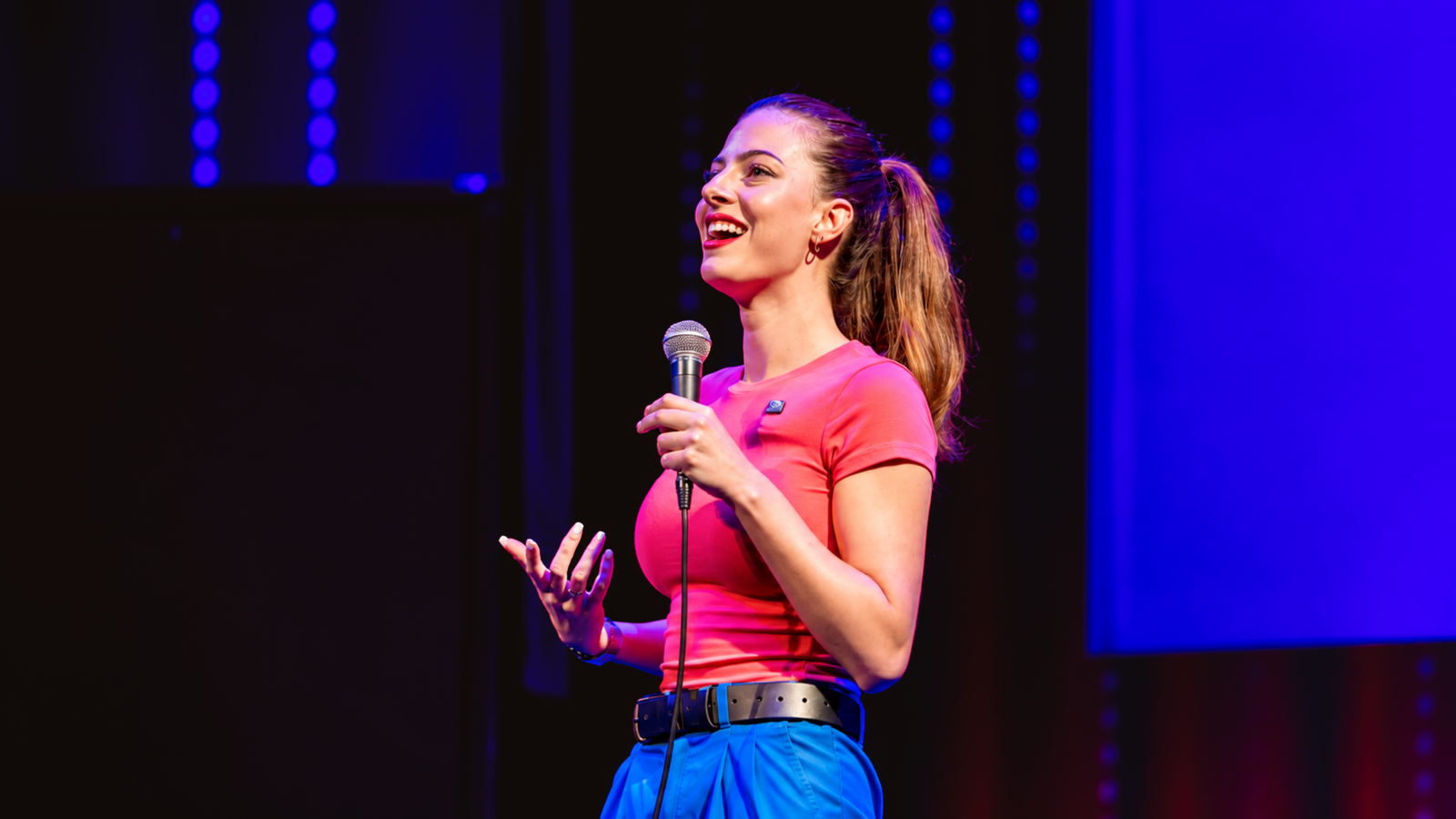
CeeKay Brown is a half-French, half-American one-liner and storytelling comedian based in Washington, DC and Barcelona. She has performed since childhood, training in theatre, Shakespeare, ballet, choir, pantomime, clowning and improv, and she also works as a voice actor. She did her first stand-up set in Brussels in October 2022, then 180 shows in her first year of comedy and 260 in her second. She has toured in support of Andy Huggins, Wyatt Feegrado and Tina Friml, and has taken her solo show, Thirsty, across the United States and Europe.
On 13 March 2026, two days after her birthday dinner in Washington, CeeKay Brown crashed her car. She passed out three times. For a while she could not remember her own name or her date of birth. She turned down the helicopter and left in an ambulance, with no broken bones and the one injury a comedian can least afford: it was to her head. Two weeks later she was back on stage.
Why a head injury is the worst injury for a comedian
For the first fortnight, light hurt her eyes and she could not turn her head. Sound was worse. “If I heard a clock ticking, it felt like screaming in my ears.” Then she tried an open mic, and found a level of stage fright she had never had. “For the first time I felt like I didn’t know if I could do it.”
The deeper problem was memory. She had forgotten most of her own material, and for the first time in years she had to carry notes on stage, which made her doubt whether she was a professional at all. She is precise about why this particular injury is so damaging.
“If I had just sprained an ankle or broken a finger, that would have been much better than injuring my head, because stand-up is so cerebral. You need to think fast and on your feet.”
A comic is always reordering a set as it happens: moving a bit forward because the room likes the last one, pulling out the Australia material because someone in the front row is from Australia. With a head injury, she says, you cannot think ahead, and one forgotten joke sends you into a spiral. The room itself was painful too. “Going on stage was like having fireworks go off constantly.”
She pressed on with a European tour anyway, had to reschedule the first three dates, and at the end of April had a panic attack on stage during her solo show. She does not present any of this as bravery.
“I don’t recommend a head injury if you’re a performer. Don’t try to go on your tour. Cancel the tour, take some time off, go see a doctor.”
When we spoke, during the Edinburgh Fringe, her memory and her eyesight were back to normal. Her hearing was not. She wears earplugs for most of the day, in the street, on the bus and in the bar of a comedy club, and takes them out only to perform. “At the end of every day, without fail, my ears are ringing.” A few nights earlier she had done an unplanned five minutes at midnight in the basement of a Greek restaurant and felt, for the first time since March, as energetic on stage as she used to be.
180 shows in her first year
Her first stand-up set was in Brussels in October 2022, at a show run by a friend who knew she had done theatre and improv. She told a five-minute story about the day she was born. “There were no punchlines, but the room was full and they really enjoyed the story.” Watching the more experienced comics on the bill, she could tell she was missing something. By April 2023 she had decided to do it properly.
“In my first year of comedy, I did 180 shows. In my second year of comedy, I did 260.”
That many repetitions got her further, faster, than four years in comedy usually does. She now has a manager, and she still goes to open mics to test material. She is also careful about the gap between a comic’s following and a comic’s act. “I don’t want my social media presence to be bigger than where I am as a comic.” As she puts it, she is still working on becoming “the final boss version” of herself.
Why she opens with one-liners about herself
Brown calls herself a one-liner comic who is turning into a storytelling one. The first ten minutes of her act are still almost entirely one-liners, about herself, her nationalities and her relationships, and that is deliberate. Opening that way, she says, “gets the audience prepared for what a joke sounds like”. Less experienced comics forget that a room has to be taught the rhythm of setup and punchline before it will follow you anywhere else. (We have a guide to how a setup and punchline fit together.)
The self-mockery comes from two of her heroes, Phyllis Diller and Joan Rivers, who both built acts on one-liners at their own expense. Diller is the bigger influence, and Brown admires how she would build a whole character out of her husband or a neighbour and then fire lines at it. Brown has a practical reason too. As a young woman on stage, she says, “I need to establish that I’m not arrogant. I don’t take myself seriously.”
Her usual persona is loud: a kind of excited anger, with a lot of yelling. Since the crash she has leaned on a second gear, fully deadpan, and found the jokes still work. “Even if I’m having a bad day and I’m super tired, I can just say my jokes.” Jason Salmon made a similar case for stillness and silence.
Theatre kid, clown and reluctant roast battler
She was put into ballet at five and started theatre and choir at nine, and was soon known as the theatre kid. She also had severe stage fright. At eleven a teacher prescribed more stage as the cure. It did not work, but she kept going, studied drama at university, and became a voice actor when the pandemic left her with no stage work. At one point she was in five plays at once alongside an office job. She has played one of the witches in Macbeth, directed, written and worked backstage, on the principle that if you love an art form you should try every part of it.
What helped with the fear was a costume. “When I wore a costume I felt less scared,” she says, and it is still true of her clown act, which she performs in a beard and had done at Monkey Barrel the night before we spoke. Stand-up offers no such cover. “The character of yourself is so much harder to play.” Byron Bertram found the same freedom in a tracksuit and a Russian accent, and Sevrin Willinder is another clown we met at the Fringe.
The same principle took her into roast battles, although, she says, “insulting people doesn’t come naturally to me, so it’s a muscle I have to train.” She has lost three, each time for not being harsh enough. The most recent defeat was to her own boyfriend, who announced he had brought her a gift, fetched a bouquet from backstage and handed it to the female judge. In the battles she won, she says, “I was mean without being hurtful.” A good roast joke points at something true that the target has never noticed, and its power is surprise. She also sees a use in losing: the best joke about you is often one somebody else wrote, and comics routinely ask to keep those lines for their own acts. Diogo Portugal, who started the Brazilian roast, defends the form; Judy Carter is less convinced.
Thirsty, and the Edinburgh Fringe hour to come
Thirsty, the solo show she began writing in 2023, is a tribute to her grandmother and to what her grandmother left her. It now opens and closes on a one-liner about the crash. She plans to debut the hour formally at the Edinburgh Fringe next year, under a new title, with more story in it, and she is hiring a director to help. Directors are common for Fringe debuts, she points out, and rare for club sets.
What she wants is an hour that tells a story and still has the rhythm of a club set, because American rooms expect joke after joke while British hours lean towards storytelling. Her model is a Dara Ó Briain show about being adopted, which she saw live: a single story, packed with punchlines and crowd work. Brendon Lemon talked to us about the same gap between British and American joke writing.
She is wary of one current habit. Do as much crowd work as you like in a show, she says, but be careful what you post.
“If you post more crowd work than you do jokes, you’re going to be training people to expect the crowd work and to hate the jokes.”
She makes exceptions for comics whose personality carries it, naming Aries Spears, Nate Jackson and Amber Autry. Her other current favourites are Chris Fleming, Maria Bamford, and the clowns Josh Glanc and Natalie Palamides. She admires Dave Chappelle’s ease on stage, whatever people think of his material; we have written about what his specials teach.
One more recurring character in her act is Anne Hathaway. “I’ve been compared to Anne Hathaway since I was 16,” she says, by strangers in cafes and audience members alike, so Hathaway gets her own section of the hour. Asked for three words to describe Thirsty, she chose “vulnerable, silly and dark”.
You can follow her at @ceekaycomedy on Instagram. For more from Edinburgh, see our Fringe coverage and all our comedian interviews.
Watch CeeKay Brown talk about the crash, one-liners and getting back on stage