
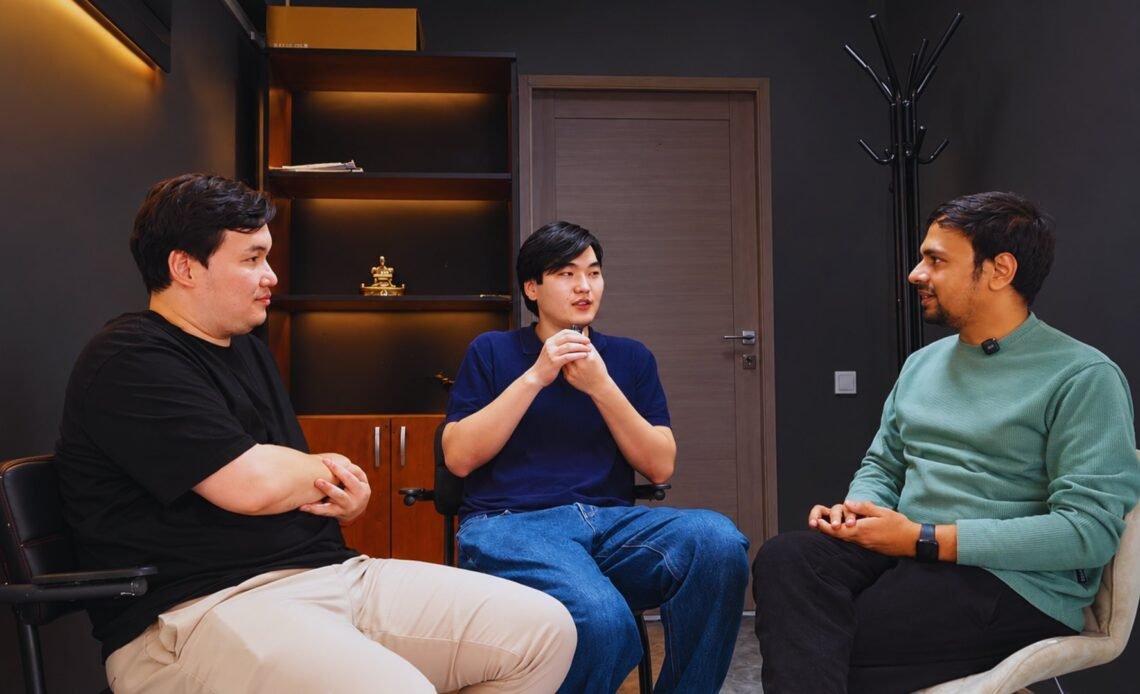
Good Night Comedy is an English-language stand-up outfit in Almaty, Kazakhstan, founded in 2023 and run by two comedians, Dosmukhamed Ali and Alisher. Dosmukhamed performs in Kazakh, Russian and English, organises the English-language programme of the city's annual comedy festival and has opened on tour for the Romanian comedian Victor Patrascan. Alisher came to stand-up through university KVN and spent six years in Russian-language comedy before switching to English.
People go to Almaty for the mountains. We went for the comedy. The city has a stand-up scene that runs in three languages, Kazakh, Russian and English, and almost nobody outside Kazakhstan knows it exists. Good Night Comedy is the English part of it. We sat down with its two comedians, Dosmukhamed Ali and Alisher, to find out how it was built. In Kazakhstan, they told us, the risk is not being cancelled. It is going to jail.
Three languages, and a fourth on the way
Dosmukhamed speaks three languages well enough to do stand-up in all of them, and he is working on Turkish. “I was planning to add Turkish now,” he said, before admitting it is currently his worst one. Russian is still the easiest language for him to be funny in. For Alisher, it might now be English, partly because English is almost all he watches. English comedy reaches him as well-produced specials. Kazakh comedy, he says, mostly arrives as random TikToks shot in a bazaar: funny, but low quality, and not much use as a model for stand-up.
Dosmukhamed thinks the language itself suits the form. English has short words that can mean several things at once, he says, and it lets you express emotion in a funny way without losing the cadence and flow. Kazakh is another matter. Only around thirty million people speak it at most, so it has not been worn smooth by global use the way English has. English, as one of them summed it up, is more efficient and Kazakh more colourful. Kazakh, in Dosmukhamed’s words, “has more juice in it”.
We asked how they handle emotions that only come out properly in a first language. They try not to slip into Kazakh on stage, because so much of the audience is from abroad. Alisher found the switch to English easier than it might have been. He already knew how to write a set-up and a punchline from Russian stand-up, had spent time speaking English in the UK, and studied at an English-language university. “I think it’s easier for us because we had background of doing stand-up and then came to English stand-up as comedians,” he said. We have looked at how comedians work in a language that is not their own in more detail.
KVN, a lockdown and a corporate detour
Both men started with KVN, the team comedy competition played in schools and universities across the former Soviet Union. Alisher joined at university. Before that he danced K-pop covers in shows for audiences of around 700 people. Stand-up came during the 2020 lockdown, when his classes were online and he had no job. “I was doing stand-up just because I needed money,” he said. “So then six years passed and I’m here.”
Dosmukhamed’s route was longer. He played KVN at school from 2011 and started stand-up in 2014. In 2017 he finished university and decided that comedy was for other people. He went into a serious career in technology and finance, in a suit and tie. In 2022 he came back to comedy, and this time he took it seriously.
The teacher everybody feared
His first real laugh came in his last year of school, at a KVN contest. The night before, his team realised that their material was not good enough. Within a day he was on stage doing an impression of the chemistry teacher. She gave everyone bad grades, he says, and was so powerful that even the principal would not fire her. Because it was his final year, he decided to take the risk.
The room, as he describes it, erupted. People were laughing and in shock at the same time, and he can still remember the energy moving from the front of the room to the back. It was prepared material, not crowd work, but it set the course for everything that followed. Plenty of comedians have told us about the first laugh that hooked them, and his account sounds familiar.
“One of the main reasons I still do this: I’m chasing the feeling that I had during my first performance.”
Dosmukhamed Ali
Crowd work, for very practical reasons
Good Night Comedy’s shows lean heavily on crowd work. Alisher came to it late, and he is honest about why.
“I was doing Russian stand-up comedy for six years, and I never did crowd work. I never wanted to do it. Then I realised that if you want to make money from stand-up, you have to get views, and the easiest way to get views now is to do crowd work.”
Alisher
It is the same pressure we heard about in our piece on social media versus the stage. On stage the two have settled into roles. Dosmukhamed has more energy and leads. Alisher sits further back, which gives him time to think of the next line. He has no shortcut for quick jokes. “It just comes with practice,” he said. A line that lands in crowd work can become material, they told us, once you change the set-up.
Dosmukhamed’s method is simple to describe. “The secret to do well in the crowd work is just to transfer my vibes to stage as successfully as I’m doing it offstage.” He needs to feel relaxed and present, and in a good emotional state. If he is, the rest follows.
Louis C.K. and the professor’s window
Does funny have to come naturally? Alisher does not think so. “I don’t think there’s innate, natural talent of just being funny without doing anything,” he said. His example was Louis C.K., who, according to people who have seen him more than once, makes the same gestures in the same joke at the same moment every night, and even times when he takes a sip of water. To Alisher, that is the point. “Intention is more about control.”
Asked what he would tell a beginner in Kazakhstan, he said to start with something simple. “If you’re a master of comedy, you can make something complex simple.” His standard for material comes from a university professor who taught him how to write.
“If you scream that in a window and then nobody will stop and pay attention, don’t use that. … Making them uncomfortable is also an emotion. It’s good emotion. I have to make them feel something, not necessarily good, but then you just need to release tension.”
Alisher
Dosmukhamed has tested that idea on his own audiences. Before Alisher joined him, he often hosted forty-minute stretches alone, mixing crowd work with material. Sometimes he would drop the funny-guy act and share what he was actually feeling, with no prepared way out, taking the room with him into darker places. Those turned out to be the good shows, he says. For more on how comedians build a set, see how 25 comedians write their jokes.
Our only magic is our brain
We asked whether stand-up was something new in Kazakhstan. Dosmukhamed argued the opposite. “I think comedy comes pretty naturally to our culture, because we’re basically a nomadic culture,” he said. Kazakhs stopped being nomadic only in the nineteenth century.
“Oral storytelling is very important because you don’t have ability to gather so much books and stuff. … For instance magicians, they have this stuff. We don’t have. Our only magic is our brain, our ability to communicate stories.”
Dosmukhamed Ali
Songs, folk stories and jokes are part of the culture, he says. In Soviet times there was Tamasha, a Kazakh comedy programme that he recently learned began on television and later moved to live shows.
From a Chicago open mic to an Almaty scene
The English scene, as Dosmukhamed tells it, came from two things happening at once. The first was personal. In the autumn of 2021 he went to the United States for his master’s studies and signed up for an open mic at the Laugh Factory in Chicago. There were around twenty comedians on the lineup, each with three minutes. He found that his background was the most interesting thing he had.
“My story was interesting because I have a Muslim name, I have an Asian face and I have a Russian accent.”
Dosmukhamed Ali
His first joke, he says, was that he makes it easy for racists to hate him for several reasons at once: “I have a 9/11 name, 7-Eleven face.” Then he went to Miami. “I performed in Miami. I bombed in Miami.” (We have a whole piece on surviving a bomb.) In North Carolina, at a packed Wednesday open mic, the same jokes worked, because he had learned what does and does not land in America. That night convinced him that “you can export comedy from Kazakhstan”.
The second thing was happening at home. In January 2022 there were mass protests in Kazakhstan, followed by changes at the top and a loosening of censorship. “There was this feeling of freedom in the air,” he said. Then came the war in Ukraine, and many Russians moved to Kazakhstan. In a new city, they went looking for something familiar, and stand-up was one of the things they found. Attendance, he says, skyrocketed. He has a joke about it: “Vladimir Putin improved my English.” He began doing English stand-up regularly in the summer and autumn of 2022, and the Good Night Comedy community started in 2023.
Since then he has helped run the English-language part of the city’s annual comedy festival, which started in 2022 and is now in its fifth edition. He also opened on the road for Victor Patrascan, who, he says, showed him what touring really involves: being tired and exhausted after hard travel and poor sleep, and still giving your best on stage.
Not afraid of cancellation, afraid of jail
Near the end we asked the usual question about whether comedy is getting more sensitive. Dosmukhamed said it was hard for him to judge, because he does not perform at the centre of the industry in the US or Britain. Then he described a very different set of limits. Kazakhstan, he said, is one of the few places where they can still go wild on stage “without being afraid of being cancelled, but we are still being afraid of being in jail”.
“We have like four comedians by now that went to jail because of the jokes.”
Dosmukhamed Ali
He was serious. Swearing in public spaces is also against the law, and the government treats Instagram, YouTube and other social networks as public spaces. What protects Good Night Comedy, in his view, is the language they work in. “What saves us is that we do it in English, and lots of policemen are not good in English.” It puts the arguments in our piece on where comedians draw the line in a different light.
They ended on a lighter note. Dosmukhamed would like to host the Oscars, and he named the year: 2033. He hopes this interview will not get him cancelled before then.
Promoters and journalists can find a biography, quotes and credits in the Good Night Comedy press kit.
You can find Good Night Comedy at @goodnightcomedy on Instagram and at @GoodnightComedyAlmaty on YouTube. For more conversations like this one, see all our comedian interviews.
See our Instagram post about this interview. Follow Hop For Pop on Instagram at @hopforpop and @thecomicsunseen.