
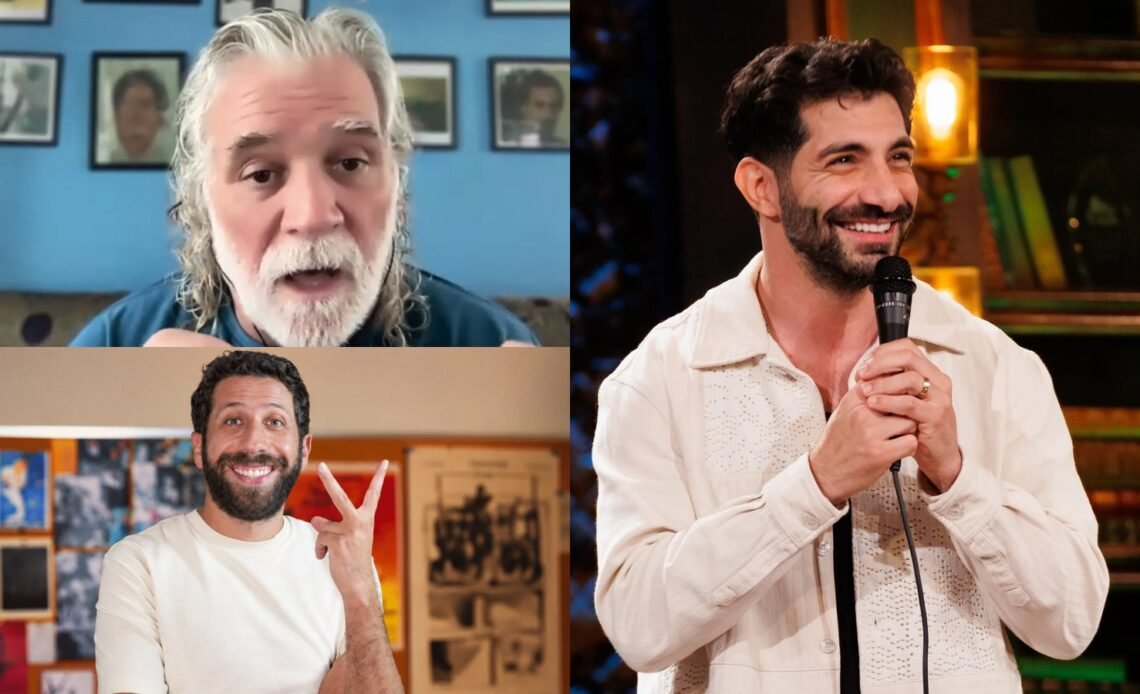
The manager Barry Katz gave us two careers to compare. One comedian, he said, got her break four months after she started. Another did stand-up for forty-two years, living in a studio apartment, before he was asked to headline. “Comedy isn’t fair,” Katz said. He has watched it for four decades and does not expect it to become fair.
Most of the comedians we interview are somewhere in the long middle of that story. They have been at it for years. Many have been ignored, turned down, or told plainly that they would not make it. This piece is about what that was like, and what kept them going.
Jump to: The long wait · Overlooked by the industry · The nights that nearly ended it · Paying for it · What kept them going · Common questions
The long wait
Tom Nemec: thirty-five years, and a first play at sixty
Tom Nemec is sixty. He has been sober for thirty-six years, since 1990, and started performing shortly after he stopped drinking. By the age of forty he had held 175 different jobs. He has done stand-up for about thirty-five years, and for much of that time he was not moving. He remembers another comedian at a gig asking who was hosting, and then saying:
“Dude, you’ve been doing this nine years. I’ve only been doing it six and I’m featuring.”
Nemec is plain about the reason. He calls it an inability to follow through, and says the 175 jobs were the same habit in another form. What he did keep doing was getting on stage. For decades he put pieces of his childhood into club sets, and people came up afterwards to check that none of it was true. During lockdown he began writing it properly, without telling anyone. Two and a half years later it was a one-man play, his first, which he took to the Edinburgh Fringe at sixty. Read our interview with Tom Nemec.
Byron Bertram: twenty years of “what’s his name?”
Byron Bertram was good for two decades and it did not help. He could headline in Vancouver. People told him he was hilarious and then asked what he was called. “I’m just another white guy who’s doing comedy,” he told us. The change came when he invented a Russian character, and within a couple of years Bill Burr was sharing his videos. The twenty years were not wasted. They are why he was ready. Read our interview with Byron Bertram.
Overlooked by the industry
Ian Edwards: “mostly ignored”
Ian Edwards is a comedian other comedians admire. Bill Burr has introduced him as one of the best comedy writers. He was also the first comedian Conan O’Brien signed to his record label. We asked what being first felt like, and his answer was about everything before it.
“Before, I’d felt mostly ignored by certain segments of the comedy industry, or show biz, period. So being given an album definitely made me feel acknowledged.”
He does not treat the recognition as an arrival. Each accomplishment, he says, “adds up to a complete career and encourages you to keep going”. Decades in, what worries him is not being overlooked. “My fear is becoming complacent.” Read our interview with Ian Edwards.
Paul Elia: no streamer called
Paul Elia has two stand-up specials, and both are free on YouTube. We asked whether that was a principle. It was not. “None of the streamers wanted them, so that’s why I chose YouTube.” No one called, so he released them himself. His sketches have since been watched more than 250 million times. Read our interview with Paul Elia.
Marina Di Marzo: every application rejected
Marina Di Marzo applied to graduate acting programmes and was rejected by all of them. She could wait a year and apply again, or she could make her own work. She chose the second. What followed was about two years of bombing in basements, sometimes on stages built from hay, and once in front of an audience of one. She counts it as the most useful training she had. Read our interview with Marina Di Marzo.
John Achkar: “no one cares about my stories”
John Achkar tells long stories on stage, and early on he was told to stop. “People told me audiences don’t like stories, that no one cares about my stories.” He kept telling them. Years later the French comedian Gad Elmaleh, his childhood hero, asked him to open his shows. Achkar took that as “proof that my comedy works”. He has also filled the Olympia in Paris, and still keeps a plan B. Read our interview with John Achkar.
The nights that nearly ended it
Jackie Joy: crying, then freezing, then coming back
Jackie Joy’s friends told her she could not do stand-up, because her English was broken. She did her first open mic anyway, came off stage and cried. Three months in she was given a Saturday night with established names. “I literally froze.” The audience called out to encourage her and it made no difference. She nearly quit, and did not perform again for three months.
She came back with a system. She records every set and scores each punchline in a spreadsheet. She now produces and sells out her own shows, for a reason she borrowed from her mentor Judy Carter: “You cannot wait for people to open the doors for you. You need to open the door.” Read our interview with Jackie Joy.
Brendon Lemon: 109 nights in a row
Brendon Lemon had been a comedian for fourteen years when he moved to Chicago and found the standard far above him. He did open mics for 109 consecutive nights and bombed at most of them. The worst was five minutes without a single laugh, in a room made up entirely of other comedians. “That bomb was so bad it shattered something inside of me.” He was twenty-eight and wondered whether comedy was for him at all. What kept him in was advice he attributes to Robin Williams: tell anyone who wants to be a comedian not to do it, and if they listen, it was never theirs. Lemon decided to stop listening to anybody. Read our interview with Brendon Lemon.
Stephan Dyer: bombing in front of his father
Stephan Dyer bombed for two years before a set went well. Then he left a senior job at a bank to do comedy full time. A year later, on tour in Mexico, his father came to see him perform for the first time, and he bombed again. “It felt humiliating. But I also knew that if I stuck with it, the story would get better.” It did. His father is now one of his biggest supporters. Read our interview with Stephan Dyer.
Whisper Theatre: eleven people, and one bad dinner
Britt Anderson and Richie Schiraldi’s first Edinburgh Fringe show drew ten or eleven people, most of them friends. Later, in the pandemic, they sat at dinner in tears and came, in his words, a breath away from giving up theatre. They wrote a farce. In 2026 they brought three shows to the Fringe. Read our interview with Whisper Theatre.
Irene Woo had a smaller version of the same moment. Open mics, she says, “can be really brutal sometimes. You’re the only woman in the room.” After one especially bad night she stopped for a couple of weeks. Then she went back. Read our interview with Irene Woo.
Paying for it
Persistence costs money, and most comedians pay for it with other work.
- Tori Morancay worked three jobs in Los Angeles for a year so that she could afford to move to New York and do stand-up. Read our interview with Tori Morancay.
- Chloe Matonis sells hardware by day, and says each job helps the other. “Once you bomb on stage, you can handle rejection selling things.” Read our interview with Chloe Matonis.
- CeeKay Brown was once in five plays at the same time alongside an office job. Later she was back on stage two weeks after a head injury. Read our interview with CeeKay Brown.
What kept them going
- Expect it to take ten years. Dyer’s advice to new comedians is the most practical thing anyone has told us on this subject. “Most of the outcomes you want will take 10–15 years. Be impatient with action, but patient with results.”
- Open the door yourself. Elia put his specials online. Di Marzo made her own shows. Joy produces her own nights. None of them waited to be chosen.
- A bomb is information. Edwards calls every set “a data gathering experience”. Danielle Slaughter told us “the most important set is the next set”. Meg Millane has the sharpest version: “When you truly, truly bomb, it’s because you give up on yourself.”
- One person is enough. Rebecca Wolf remembers nights when nobody laughed, and then a stranger took her aside to say they liked one joke. Di Marzo played to an audience of one and still preferred it to not performing.
- Rejection is not a verdict on you. Krystyna Hutchinson was turned down by Saturday Night Live, the show that made her want to do comedy. She no longer takes it personally. It is, she says, only what the show needs at that time.
- Be ready anyway. Katz’s point about the comedian who waited forty-two years is that he was funny the whole time. “You have to be accountable and train behind the scenes, when no one’s looking, so you’re ready for when the lights shine the brightest.”
You can read more from Barry Katz, Meg Millane, Rebecca Wolf and Krystyna Hutchinson in their own interviews. For the stories behind the material, see how thirteen comedians turned their worst moments into comedy. For what the work looks like day to day, see how 25 comedians write their jokes.
Common questions about making it in comedy
How long does it take to succeed in stand-up comedy?
Usually more than ten years. Stephan Dyer puts most results at ten to fifteen. Byron Bertram worked for twenty before he broke through, and Tom Nemec made his first solo show after thirty-five. A few people get there in months, and they are the exception.
Is it normal to bomb as a comedian?
Yes, and for a long time. Stephan Dyer bombed for two years. Marina Di Marzo did the same in basements. Brendon Lemon bombed most nights for six months when he was already fourteen years in. All of them describe it as the training.
Is it too late to start comedy, or to try something new in it?
The comedians we spoke to suggest not. Tom Nemec wrote his first play at sixty. The comedian Barry Katz describes got his first headline spot in his seventies. What they had in common was that they never stopped getting on stage.
For more conversations like these, see all our comedian interviews.